bobs yeruncle
Participating member
- Location
- Golden Horseshoe
Follow along with the video below to see how to install our site as a web app on your home screen.
Note: This feature may not be available in some browsers.
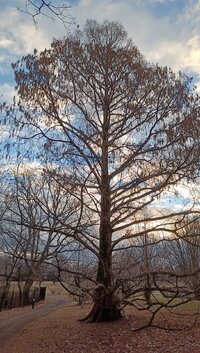
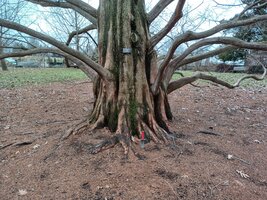
That is MUCH broader canopy than my 55 ft tree shape ! ! !love a mature dawn redwood
View attachment 95394
View attachment 95395
~70 years, southwestern Ontario
The B.t. for beetle control is a different strain than that for lepidoptera. Not saying there cannot be overlap..but generally not. Also, B.t. is best targeted at the larvae, not adults.can you obtain beetlegone? its a biological insecticide, a bacillus thuringiensis subspecies that produces a protein toxic to certain insects. its a foliar application, scarab beetles eat the leaves ingest the protein and die. its also lethal to caterpillars so shouldnt be used near host plants for lepidoptera. granular formulations are available for turf but i don't think they've proved as effective as direct application. for grub control in turf you can still try nematodes but they're fussy and conditions have to be just right
we've been planting companion flowers to try and attract tachinid flies to the rose garden i work at for the past six years but to my knowledge nobody has yet seen one. in theory they would parasitize adult beetles and impact the overall population. sometimes i just have to send students out with buckets of soapy water to knock down as many beetles as possible, but this year seemed to be a natural lull in the japanese beetle population
This sounds hopeless !The B.t. for beetle control is a different strain than that for lepidoptera. Not saying there cannot be overlap..but generally not. Also, B.t. is best targeted at the larvae, not adults.
Bacillus thuringiensis (B.t.) : Landscape : Center for Agriculture, Food, and the Environment (CAFE) at UMass Amherst
What is B.t. ? B.t. is the abbreviation for a species of bacteria, Bacillus thuringiensis, commonly found in nature. These bacteria can live and multiply within the bodies of insects, and produce spores and protein crystal toxins which can result in death of the insect host. In order to work as...ag.umass.edu
My understanding is that controlling local (as in your yard) populations of larvae has little impact on adult populations on your landscape trees and shrubs and controlling your local adult population on trees and shrubs has little impact on larvae in your turf. The beetles are mobile enough that they'll find there way there.
I stand corrected! Thanks for posting the info.the subspecies used in grubgone and beetlegone showed mortality vs monarch larvae in a study contrasting its use vs beetles
![]()
Strengths and limitations of Bacillus thuringiensis galleriae for managing Japanese beetle (Popillia japonica) adults and grubs with caveats for cross-order activity to monarch butterfly (Danaus plexippus) larvae - PubMed
This study supports efficacy of Btg strain SDS-502 for reducing defoliation by adult JB in urban landscape settings. Granular formulations, however, failed to control JB grubs in turfgrass soils. Btg should not be used in gardens with larval host plants of the monarch butterfly or other non-pest...pubmed.ncbi.nlm.nih.gov
Maybe you have a cultivar.That is MUCH broader canopy than my 55 ft tree shape ! ! !
I do not see opposing branch structure of a Dawn Redwood ???.