Compact Bulldog Bone

David, can you post the all the mods in your most recent update? Mostly, it seems you've shortened the uppers, but is that the hinge point length?

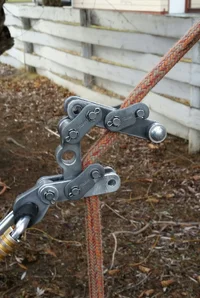
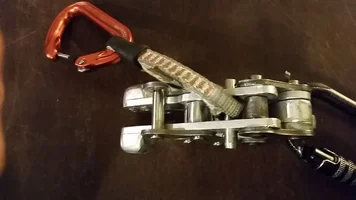
Eric, I have done several small things but the big change, and it is a big change, was shortening the top arm. As this picture shows, I redrilled the upper pivot link hole bringing everything closer to the spine. The hole spacing and length of the top arm is now identical to the lower arm. Look how much that lowered the top arm. It is now always very close to the release point. The top link still has the same amount of friction but with the shorter length of lever it exerts less control over the BDB while being easier to release because the leverage now favors the release side of the arm. You can also tell by the reduced bend of the rope at the top link and the increased angle at the spine, that more load is being carried by the spine. This is good as the spine can handle more heat and dissipate it more effectively than the steel links. Due to the increased load on the spine, I not only made it symmetrical so it can be rotated to 4 wear surfaces, I made it from stronger 7075 T6 aluminum. The only other changes were a loading notch cut in the top arm and carving out some inside material on the arms to allow the fatter Vortex a little more room.
Please do remember it is winter here in Montana and my altered BDB has not seen enough hours yet for a full on field report.20141211_110343-1_resized.webp
 
Eric, I have done several small things but the big change, and it is a big change, was shortening the top arm. As this picture shows, I redrilled the upper pivot link hole bringing everything closer to the spine. The hole spacing and length of the top arm is now identical to the lower arm. Look how much that lowered the top arm. It is now always very close to the release point. The top link still has the same amount of friction but with the shorter length of lever it exerts less control over the BDB while being easier to release because the leverage now favors the release side of the arm. You can also tell by the reduced bend of the rope at the top link and the increased angle at the spine, that more load is being carried by the spine. This is good as the spine can handle more heat and dissipate it more effectively than the steel links. Due to the increased load on the spine, I not only made it symmetrical so it can be rotated to 4 wear surfaces, I made it from stronger 7075 T6 aluminum. The only other changes were a loading notch cut in the top arm and carving out some inside material on the arms to allow the fatter Vortex a little more room.
Please do remember it is winter here in Montana and my altered BDB has not seen enough hours yet for a full on field report.View attachment 29274
Thanks for the reply, David.

At what length from the original pivot hole did you create the new one (center to center)? I may be trying to build up a few alternate components here, as you have. I would rather not alter a stock part, but create optional ones, allowing me to revert to the original if desired.

EDIT:...this is not to say that I need to change the Bone at all, I'm just quite intrigued by all that's been posted.
 
same here! I'm curious to know how the shorter arm will work for me and for others. Just to clarify things, shortening the arm doesn't decrease grip, just decreases the pressure to release the bone? please correct me if I'm wrong.
 
same here! I'm curious to know how the shorter arm will work for me and for others. Just to clarify things, shortening the arm doesn't decrease grip, just decreases the pressure to release the bone? please correct me if I'm wrong.
I think it's the equivalent of asking the lower bollard to do more work for you.
 
Eric, the easiest way to figure the length is from the friction link pivot hole. The pivot point of the arm is one inch from there, center to center. You can also use the bottom arm as a template for the top arm.
 
I believe that Davids mod with the shorter arm would not be satisfactory with ropes that are skinnier than the Vortex pictured. That is my experience anyway, as I started with the Bone with the 1" spacing on the upper arm and it was slipping on my other ropes. In addition it did not engage as reliably when weighted. However if you drill a hole as David has pictured, you can try it for yourself and switch back easily if desired.
 
Tyler, the changes I made do decrease the percentage of load carried by the top arm. To be honest I don't see this working for the thinner ropes. In general, the thinner the line the less latitude it has for feathering friction so the friction control device needs to be able to handle that. Fat rope because it has so much surface area has great control latitude so it is less touchy, sensitive to control inputs. In essence, what I did to my BDB made it more touchy, sensitive. Just the opposite of what you want for a thin rope.
 
I agree that the 1" spacing will not work with thinner ropes. I made new upper arms for mine and reduced the pivot pin to friction link spacing from the stock 1.5" to 1.25" for use with a Yale 11.7mm and 3/4" bollard. It is right on edge of reasonable and I intend to make another set and open the spacing up by another 1/16" to gain back a little wider safety margin.
 
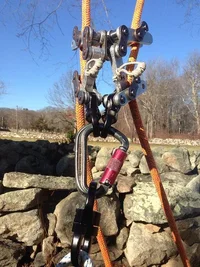
I posted this in the DRT thread in Climber's Talk, but just wanted to add it in here. Oh man is this nice. Thanks Tom D for the swivel idea. They work very well in this system. If I climb on just one Bone, I can connect to the bridge eye of the swivel, but that cancels out being able to freely rotate with a second point of attachment. Good that the option to connect back into the swivel as I normally do is still there if I really want it.

DSRT Setup.webp
 
I posted this in the DRT thread in Climber's Talk, but just wanted to add it in here. Oh man is this nice. Thanks Tom D for the swivel idea. They work very well in this system. If I climb on just one Bone, I can connect to the bridge eye of the swivel, but that cancels out being able to freely rotate with a second point of attachment. Good that the option to connect back into the swivel as I normally do is still there if I really want it.

View attachment 29296
Very nice Eric. I have still yet to even attempt DRT but that's looking solid.

I told myself no more orders till spring time, but that nano swivel is calling my name hypnotically.
 
Very nice Eric. I have still yet to even attempt DRT but that's looking solid.

I told myself no more orders till spring time, but that nano swivel is calling my name hypnotically.
TRUE! Can't you see a Nano just spinning around and slowly getting closer and closer? LOL! I'll admit, I wasn't crazy about the Nano mod until I began to climb DSRT more and more. That is where they shine so bright. Otherwise, in SRT, I would prefer just to use the Rotator L on the bridge.

Man, we've had some super warm weather lately and I've been flying this for a few days...totally laughing out loud at how well it works.
 
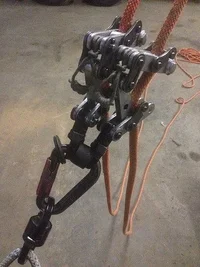
Once again I'm posting this here and in the DRT thread.

Safety mods, check.
Scalloped upper arms, check.
Relocated tending points, check.
Rubber keepers on the biner, check.

We are GO for takeoff!

image.webp
 
Eric, are you using an adjustable bridge? The reason I ask is that with the BDB advancing tether being on the top link, it really is much better to pull up, not out and back. So to do that the choices are to run the tending strap loose or keep the bones as low as possible.
 
Eric, are you using an adjustable bridge? The reason I ask is that with the BDB advancing tether being on the top link, it really is much better to pull up, not out and back. So to do that the choices are to run the tending strap loose or keep the bones as low as possible.
I'm freakishly tall. ;) I think my bridge is a bit on the shorter side as well. Just a lanyard over the shoulder while playing around in the shop and it is smooth as glass. Much improved over the other tending point IMO.
 
Hahaha! OK, just trying to keep you from becoming freakishly flat, big guy.
Good looking out, Dave! To be honest, this new system (doesn't necessarily mean DSRT) is so efficient for all around work, I don't mind a bit of sitback after a long ascent. It's not anywhere near enough sitback to shock load anything if I slipped, and I can easily regain those few inches by lifting the system by finger before loading into it.
 
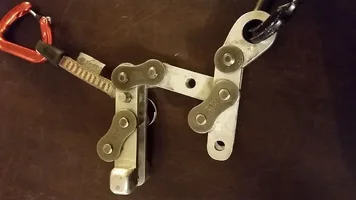
Ive found that attaching a tether between the top link and the upper-arm friction link is better than attaching it to the top link.

It provides optimal tending, allows for a shorter tether and is less prone to slipping.

14199062488051217530159.webp 14199061060621289760590.webp
 
Gordon, the arms finally arrived. I have yet to drill the new tether holes in them so I'm still using my interim ones.

I humbly suggest you give that tether spot a try. I think you may find it sufficiently safe to incorporate it into new bdb production.
 

New threads New posts

Back
Top Bottom