Co-Dom Removal risk vs. reward question

This original post includes a question I am figuring out tonight;

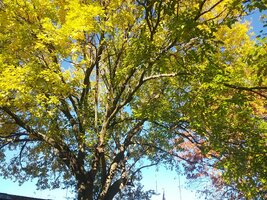
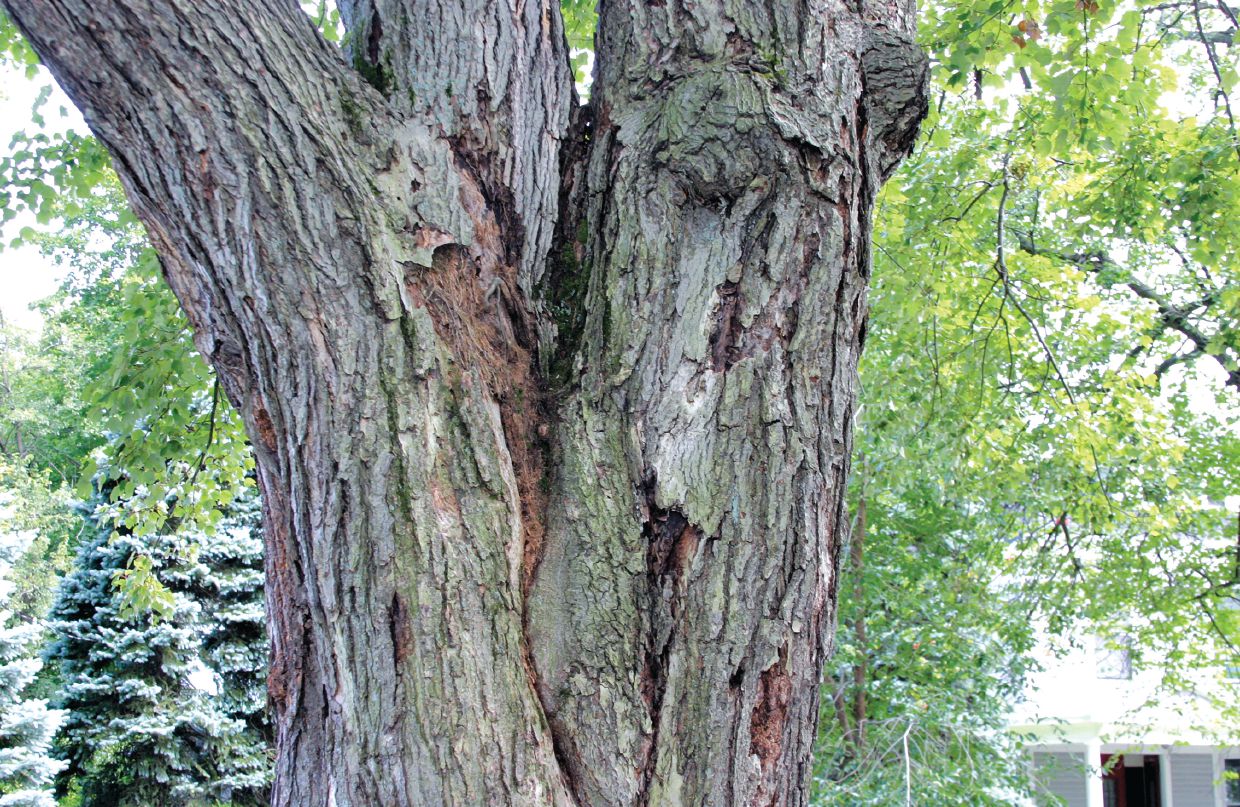
I am working on a co-dom Mulberry. It's got a deck built around it, growing way over a fence, a guesthouse, basically the entire drip line is over hazards.

One of the leads has signs of decay or rot, like a fuzz coming out of it about 3 feet above the crotch. (Pardon, no pictures) It's pointing right at the corner of the guest house. Also has a lead that peeled off and leaning hung up (original reason for call).

While it's a sorry tree in some senses, it is showing great vigor, plenty of new growth. I pruned it 3 years ago.

I recommended removing the lead with the bad signs, etc. Yet I also shared my concern for opening up a big trunk sized wound at the base of the tree. I am waffling between whether that's a good move for this tree, or if it's got a shot.

I took off the weight leaning furthest horizontally; tomorrow will either continue removal, or prune and leave a decent looking upright section. I am beginning to hope that with life in that stem, it will be able to isolate and CODIT that bad stuff (my scientific estimation). Whereas if I remove that lead, I remove that source of disease, while opening up a huge entryway for "the devil it don't know".

My Question is:
Does this reasoning hold water? That a vigorous tree stem receiving end weight reduction and a good cleaning prune, has a better chance at surrounding and curtailing the disease, compared to the risk of introducing more disease directly at the base of the remaining lead by removing that trunk completely?
 
TCIA published an interesting article on favoring large cuts far away from the trunk over large cuts at the branch collar. This is specifically talking about large cuts that won't likely seal over before a decay pathogen infects the wood. I think this is especially relevant on codominant stems that don't have branch collars and take even longer (if ever) to seal over. Here's the article:


To answer @dspacio 's question, I think it depends on the disease the tree has. If it's an aggressive and typically fatal disease, getting rid of all infected tissue might be the best option, but I think reducing the end weight and leaving lots of leaf surface area so the tree can put on more wood around the infected area and hopefully strengthen itself faster than the disease weakens it might be a better approach if the disease isn't very aggressive.
 
TCIA published an interesting article on favoring large cuts far away from the trunk over large cuts at the branch collar. This is specifically talking about large cuts that won't likely seal over before a decay pathogen infects the wood. I think this is especially relevant on codominant stems that don't have branch collars and take even longer (if ever) to seal over. Here's the article:


To answer @dspacio 's question, I think it depends on the disease the tree has. If it's an aggressive and typically fatal disease, getting rid of all infected tissue might be the best option, but I think reducing the end weight and leaving lots of leaf surface area so the tree can put on more wood around the infected area and hopefully strengthen itself faster than the disease weakens it might be a better approach if the disease isn't very aggressive.
TCIA published an interesting article on favoring large cuts far away from the trunk over large cuts at the branch collar. This is specifically talking about large cuts that won't likely seal over before a decay pathogen infects the wood. I think this is especially relevant on codominant stems that don't have branch collars and take even longer (if ever) to seal over. Here's the article:

tcimag.tcia.org

Use Your Head(ing) Cut to Delay Decay

One of the most common shortcomings of urban tree management worldwide is the failure to remove select branches in a timely manner throughout the lifetime of a tree. This has many important impacts on management and safety, including: • contributing to poor structure (such as codominant stems or...
tcimag.tcia.org


I remember when this article came out in print. A game changer From what I have seen in large trees with a "stub" left far enough away from the Branch collar, Branch bark ridge or a heading cut/wound.

Above my garage is a 100 year old English Walnut (poor compartmentalizer) that had a good length of a large lateral break off in a strong windstorm, years ago. I made a cut to clean up the tear wound, leaving an 6" diameter "Stub" behind.

Clearly now 5 years later, I see the result as good, as C.O.D.I.T. stopped the decay, and dormant buds have emerged on that Lateral closer to the main trunk, with new growth to build energy back into the old growth tree.
 
This original post includes a question I am figuring out tonight;

I am working on a co-dom Mulberry. It's got a deck built around it, growing way over a fence, a guesthouse, basically the entire drip line is over hazards.

One of the leads has signs of decay or rot, like a fuzz coming out of it about 3 feet above the crotch. (Pardon, no pictures) It's pointing right at the corner of the guest house. Also has a lead that peeled off and leaning hung up (original reason for call).

While it's a sorry tree in some senses, it is showing great vigor, plenty of new growth. I pruned it 3 years ago.

I recommended removing the lead with the bad signs, etc. Yet I also shared my concern for opening up a big trunk sized wound at the base of the tree. I am waffling between whether that's a good move for this tree, or if it's got a shot.

I took off the weight leaning furthest horizontally; tomorrow will either continue removal, or prune and leave a decent looking upright section. I am beginning to hope that with life in that stem, it will be able to isolate and CODIT that bad stuff (my scientific estimation). Whereas if I remove that lead, I remove that source of disease, while opening up a huge entryway for "the devil it don't know".

My Question is:
Does this reasoning hold water? That a vigorous tree stem receiving end weight reduction and a good cleaning prune, has a better chance at surrounding and curtailing the disease, compared to the risk of introducing more disease directly at the base of the remaining lead by removing that trunk completely?
Red or paper mulb? Size? IMO ones that are let to grow to a natural mature form are always half dead or have big structural issues. they do pretty well when maintained as more of an orchard tree, ie regular heading cuts. I guess what I’m saying is don’t treat it like a white oak… you can be a little more aggressive. as far as going all the way to the base… I would still try to avoid that. Maybe give an aggressive trim on that lead and see how it responds.
 
Red or paper mulb? Size? IMO ones that are let to grow to a natural mature form are always half dead or have big structural issues. they do pretty well when maintained as more of an orchard tree, ie regular heading cuts. I guess what I’m saying is don’t treat it like a white oak… you can be a little more aggressive. as far as going all the way to the base… I would still try to avoid that. Maybe give an aggressive trim on that lead and see how it responds.
X2. If it's a White you'll have to try to kill it to do any sort of harm that it won't naturally do to itself. This seems more like a question of how to maintain the desired structure of this tree for visual and safety purposes rather than how to keep it alive because it will survive a nuclear holocaust hahaha. Definitely a species-specific answer for this one.
 
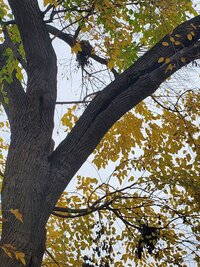
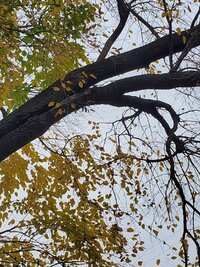
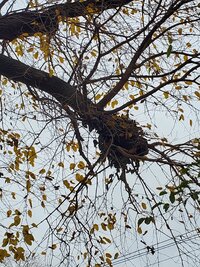
Here's a cut I made nowhere near a union on a big vigorous Mulberry in my own yard almost seven years ago. The last picture shows the cut in 8" wood, with new live growth 2" from the cut and no signs of decay at the cut. This was done just for end weight reduction because the crazy angle of the preceding union caused an inevitable split that started traveling back towards the previous union. The two limbs are now cabled together and continue living happily. FYI that is a squirrel nest, not a callous lump at the end of the branch.
 

Attachments

  • 20221111_160957.jpg
    20221111_160957.jpg
    733.7 KB · Views: 17
  • 20221111_161002.jpg
    20221111_161002.jpg
    774.2 KB · Views: 17
  • 20221111_161052.jpg
    20221111_161052.jpg
    810.4 KB · Views: 17
Last edited:
Welp! Customers.....what ya gonna do?

I presented dynamic cabling as an option but pushed for reduction while explaining reactionary growth and wood dynamics as best as I could. I just found out today that they decided to go with an uninsured, unlicensed person who is charging $350 to remove and haul off the leader over the house. Lol


• Aim High, Climb Trees •
Yeah it’s a thing for sure. What I despise is the client who asks many many questions in detail, blows a bunch of smoke up your a$$.. you never hear from them again and drive by to see some incredibly botched job based on the answers to your question.
 
TCIA published an interesting article on favoring large cuts far away from the trunk over large cuts at the branch collar. This is specifically talking about large cuts that won't likely seal over before a decay pathogen infects the wood. I think this is especially relevant on codominant stems that don't have branch collars and take even longer (if ever) to seal over. Here's the article:
Not sure if I'm quite understanding this article - is the goal to continue to reduce the stub back over the years until it's a proper branch collar cut? Or just one-and-done below the point of decay?

I have a spruce in my yard with a pretty strong co-dominant about halfway up. It seems like spruces do this quite often and seem to be very healthy for years like that, but I've definitely wondered if it's worth starting a process of heading and reduction cuts until the co-dom is functionally eliminated.
 
Thanks for the replies. It's good to hear observations of how these heading cuts respond over time.
This tree was as you describe, @Stumpsprouts and @Njdelaney , loads of weak shallow unions with broad reach.
The trunk itself stayed, I did remove the largest horizontal branch leaving a ~10" cut. It sounds like I could have gotten away with a smaller heading cut. I like that way better.

Sometimes people just want to see a lot of cutting, thinking it's safer. This one ended up being challenging to describe what was needed for this tree to make it safe. Why if she can't afford a full removal, she needs to look at tree health til then, not just hacking sections off....
 
Just to be crystal clear, we're talking about reducing in a few stages, taking it back a bit each time until the cuts arrive at the collar, which will likely cover some length of stub inside, right?
Consider if the Genus is a good Compartmentalizer.

You may be better off directing your question to the Author(s) of the Article I posted earlier.

Your question (s) is a good one.
 

New threads New posts

Kask Stihl NORTHEASTERN Arborists Wesspur TreeStuff.com Teufelberger Westminster X-Rigging Teufelberger
Back
Top Bottom