
Simple manThere is nothing better than having just the right amount of rope

Navigation
Install the app
How to install the app on iOS
Follow along with the video below to see how to install our site as a web app on your home screen.
Note: This feature may not be available in some browsers.
More options
You are using an out of date browser. It may not display this or other websites correctly.
You should upgrade or use an alternative browser.
You should upgrade or use an alternative browser.
Climbing an extra few feet
- Thread starter dmonn
- Start date

Get good on spurs for removals. Best advice I was given for working in spurs is to not jam the spurs into the wood. Simply step up on them and let them do the work. Take little precise steps. Jamming or forcing the spur into the tree causes you to miss and spur out or gaff yourself or your rope. You should be able to comfortably stand on very small diameter spars with no trouble and a little practice. Like rock climbing, trust your feet.
Only made two climbs in spurs on a thick oak. I was stomping them in and then if felt like pulling nails, each step up....cant wait to try this approach when spring hits...Thanks!

moss
Been here much more than a while
- Location
- Carlisle, Massachusetts, U.S.
Only made two climbs in spurs on a thick oak. I was stomping them in and then if felt like pulling nails, each step up....cant wait to try this approach when spring hits...Thanks!
Stomping them in is brutal on knees, I did the same. So much art in tree climbing, the subtle details of spurring provided by Mr. Bing are a gift.
-AJ

Evo
Been here much more than a while
- Location
- My Island, WA
Just have to make sure they are sharp, they don’t need deep penetration, just trough the bark and into the wood. Stomping does have a time and place, I will occasionally stomp in before taking a top, or catching a piece.
theatertech87
Branched out member
- Location
- Rochester
Deep penetration lolHe said penetration

Kris Anderson
Participating member
- Location
- Kelowna,BC
I also feel wobbly in skinny tops mainly on the way domn .Now when I get to about 8" on my way up I think ahead and come up with a plan for the top. Leave some well placed stubs to hang on to and climb up on gives you a good tip on the way down to when it's time to chunk wood instead of tip towing down a flagpole
dmonn
Branched out member
- Location
- Port Washington Wisconsin
Great ideas. Thanks.
I've been spending more time on spurs, and getting more comfortable with them. I've tried not jamming them in, and it does make a difference in how my legs feel the next day. The spikes have also never slipped when I've done that. When I'm down to a 5 or 6 inch stem in a little breeze it's still pretty wobbly, but I'm getting better. When it's really windy I save those climbs for another day.
My top handle is back in action. Less hand saw work and more chainsaw work is def easier.
Curious--I saw a pic of a guy on spikes on-rope but didn't see a lanyard, and no mechanical ascenders. ??? Was he likely on the way down after climbing on spurs with lanyard, then setting a rope TIP at the top of his climb? If the tree I'm climbing looks even a little bit sketchy, I'll set a rope in an adjacent tree, climb and top the sketchy tree on spikes and use the rope setup just as a safety backup. I've even used two ropes on opposite sides of the tree I'm taking down, especially if the tree I'm climbing looks especially sketchy and/or the closest trees are not tall enough or not close enough. An unexpected Tarzan swing into the trunk of a tree just doesn't sound like fun.
My biggest concern when I'm up high and tied in with a lanyard is what happens if the tree breaks at a point below my lanyard? There's no quick release on a lanyard (for good reason), but then the tree you're on is falling with you attached, and you're sill attached to a safety rope tied to a different tree. That just seems like the worst (maybe second worst) scenario. Would the rope break first, the lanyard break first, the saddle break? If you survive it intact and are suspended, getting down wouldn't be a problem. Cut the tree where your lanyard is attached and descend on your rope. Has this scenario ever happened to you or have you heard about it happening?
I've been spending more time on spurs, and getting more comfortable with them. I've tried not jamming them in, and it does make a difference in how my legs feel the next day. The spikes have also never slipped when I've done that. When I'm down to a 5 or 6 inch stem in a little breeze it's still pretty wobbly, but I'm getting better. When it's really windy I save those climbs for another day.
My top handle is back in action. Less hand saw work and more chainsaw work is def easier.
Curious--I saw a pic of a guy on spikes on-rope but didn't see a lanyard, and no mechanical ascenders. ??? Was he likely on the way down after climbing on spurs with lanyard, then setting a rope TIP at the top of his climb? If the tree I'm climbing looks even a little bit sketchy, I'll set a rope in an adjacent tree, climb and top the sketchy tree on spikes and use the rope setup just as a safety backup. I've even used two ropes on opposite sides of the tree I'm taking down, especially if the tree I'm climbing looks especially sketchy and/or the closest trees are not tall enough or not close enough. An unexpected Tarzan swing into the trunk of a tree just doesn't sound like fun.
My biggest concern when I'm up high and tied in with a lanyard is what happens if the tree breaks at a point below my lanyard? There's no quick release on a lanyard (for good reason), but then the tree you're on is falling with you attached, and you're sill attached to a safety rope tied to a different tree. That just seems like the worst (maybe second worst) scenario. Would the rope break first, the lanyard break first, the saddle break? If you survive it intact and are suspended, getting down wouldn't be a problem. Cut the tree where your lanyard is attached and descend on your rope. Has this scenario ever happened to you or have you heard about it happening?

Great ideas. Thanks.
My biggest concern when I'm up high and tied in with a lanyard is what happens if the tree breaks at a point below my lanyard? There's no quick release on a lanyard (for good reason), but then the tree you're on is falling with you attached, and you're sill attached to a safety rope tied to a different tree. That just seems like the worst (maybe second worst) scenario. Would the rope break first, the lanyard break first, the saddle break? If you survive it intact and are suspended, getting down wouldn't be a problem. Cut the tree where your lanyard is attached and descend on your rope. Has this scenario ever happened to you or have you heard about it happening?
Most of the time when you are tied into another tree, your system is actually supporting the tree you are in and dampening forces. I have had one failure occur to me in this scenario, and it was a lot less dynamic than you might imagine (leverage). Fibers fail until your system is fully tensioned, and then the tree comes to rest. You can then butt-hitch or hand toss material until leverage goes back your way and you can put the tree back in your control or back into your rigging. That is a kind-of worse case scenario, when it happened to me, it wasn't obvious how degraded the interior of the tree was (basswood). Most of the time, if I am approaching a really bad tree, I will set multiple TIPs in other trees to help distribute load and create a wider coverage of tensioning leverage on the hazard tree. In the worst of trees that I have done, outside of crane reach, I have set guy lines from the tree into neighboring anchors, and used a break-away lanyard while being tied into another tree. In these situations I always set up rigging systems in other trees to drift the work away as quickly as possible. If I don't have these options available (and I'm still willing to climb), I work off of multiple tie-ins within the tree and rig the structure to distribute forces. I try to take as much weight off of TIPs and rigging points while still leaving a little fuzz for dampening. By the time I work my way back to one TIP/rig point, most of the leverage has been taken out of the structure of the tree that would pose a threat of failure.
If you can't take any of these options, and think the tree might fail under you, walk away.

southsoundtree
Been here much more than a while
- Location
- Olympia, WA
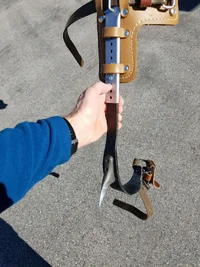
Let's see your spurs. How did you adjust the height on pads?
Pole spurs are great in thin barked trees.
Pole spurs are great in thin barked trees.
dmonn
Branched out member
- Location
- Port Washington Wisconsin
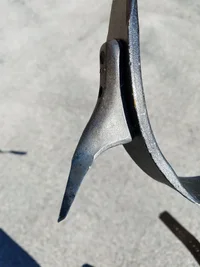
I'll see if I can get the photo to paste properly. They are tree spike. I'm on mostly green ash trees, so the bark is decently thick.
The spikes are Kleins. I adjusted them so the upper strap fits just above my calf muscle.
The spikes are Kleins. I adjusted them so the upper strap fits just above my calf muscle.
Attachments

Crimsonking
Been here a while
A crew leader I was under detested stubs, and I’ve come to agree with him. I will only leave them at my top cut; none beneath me. They love to cause trouble. As far as tip-toeing, a choked system means you can ditch the lanyard for descending to your next cut on a clean spar. I’ve shredded my forearms walking down a spar with just my lanyard. Gaffed out on a pine, slid down about 6-8’. A choked anchor is required for a spar anyway, I believe.I also feel wobbly in skinny tops mainly on the way domn .Now when I get to about 8" on my way up I think ahead and come up with a plan for the top. Leave some well placed stubs to hang on to and climb up on gives you a good tip on the way down to when it's time to chunk wood instead of tip towing down a flagpole
southsoundtree
Been here much more than a while
- Location
- Olympia, WA
Falling into a stub, when rocked by a back top-catch, can be very dangerous.
I think that the pad is supposed to be 2 fingers below the bone bulge at the top of the lower leg...ish. Experiment if they don't feel right.
I have climbed lots of good-sized fir in pole spurs, sometimes only in solid bark plates at the bottom. The bottom is less secure, but the top is way more secure.
Looks like you have bolt-on spurs. Buy pole spurs. Those pads are what I had, but way broken in. On tree spurs, those pads are probably sub-par...for pole spurs, probably adequate.
I'd GUESS that the ash bark and a little wood might hold just fine, unless the bark is sloughing. If solidly attached, you have so much less foot wobble, spurs in, and foot touching front and/ or back, than you typically do on tree spurs.
I think that the pad is supposed to be 2 fingers below the bone bulge at the top of the lower leg...ish. Experiment if they don't feel right.
I have climbed lots of good-sized fir in pole spurs, sometimes only in solid bark plates at the bottom. The bottom is less secure, but the top is way more secure.
Looks like you have bolt-on spurs. Buy pole spurs. Those pads are what I had, but way broken in. On tree spurs, those pads are probably sub-par...for pole spurs, probably adequate.
I'd GUESS that the ash bark and a little wood might hold just fine, unless the bark is sloughing. If solidly attached, you have so much less foot wobble, spurs in, and foot touching front and/ or back, than you typically do on tree spurs.

treebilly
Branched out member
- Location
- N. Lawrence
This is why I don’t leave stubs! Besides the headache of things snagging on the way down. I recieved two broken ribs from leaving stubs at my top cut when they didn’t let it run. Truth be told it was also my inexperience at the time.Falling into a stub, when rocked by a back top-catch, can be very dangerous.
I’d find a better pad though. If you decide to buy pole gaffs just pay attention to placement. Muscle memory can cause you to miss when switching to a different length spur. Also the pole gaffs will work fine on most ash. The lower bark is thicker. Just check before fully putting weight on them.
And in response to @treebing, in my area it’s on a tree to tree basis. While a lot have failure at the root plate and transition area, many are fractured 10-15’ above the ground. Also seeing crotches deteriorating. Wood both top and bottom is sound but the union has turned to punky garbage. Typically the straight grained pieces hinge well. It’s a real treat dealing with them. Honestly can’t wait till they’re gone. Hoping the seedlings can be resistant though. I’ve found a few younger trees that are isolated that have yet to be attacked. Mostly surrounded by spruce at an abandoned tree farm
Last edited:
Crimsonking
Been here a while
I should specify, I leave vertical forks at the top, when reasonable. It’s just to make the first rappell without adjusting my fs.Falling into a stub, when rocked by a back top-catch, can be very dangerous.
I think that the pad is supposed to be 2 fingers below the bone bulge at the top of the lower leg...ish. Experiment if they don't feel right.
I have climbed lots of good-sized fir in pole spurs, sometimes only in solid bark plates at the bottom. The bottom is less secure, but the top is way more secure.
Looks like you have bolt-on spurs. Buy pole spurs. Those pads are what I had, but way broken in. On tree spurs, those pads are probably sub-par...for pole spurs, probably adequate.
I'd GUESS that the ash bark and a little wood might hold just fine, unless the bark is sloughing. If solidly attached, you have so much less foot wobble, spurs in, and foot touching front and/ or back, than you typically do on tree spurs.


