Climbing an extra few feet

Who has a problem with their spikes slipping? I have climbed about a hundred dead ash trees and 10,000 others with spikes and they slipped one time.

 
The footloops are a good option if you go spurless, my preference also. You could also leave stubs when you know you’re going to be taking the top. If you do go above your TIP, always be pushing away from the tree with a hand or knee, so that it’s more of a pendulum swing, rather than a drop if you should slip.
 
So question then Kevin - do you tend to keep the same body angle when spurring up into spindly tops that you do on larger diameter wood. Because I must admit, as the stuff gets smaller I tend to stand more vertical than I do lower down. But then again my daughter sez I ski like a putz too . . . Never really thought about this point.
 
I hate climbing with spurs when I've got a climbing rope attached. I've nicked my climbing rope with my spurs a few times, and hate to see the damage to the climbing rope. I'm much more comfortable climbing SRT, and without spurs on. For me it's a lot faster and feels safer.

Maybe my spurs aren't comfortable enough or I haven't done enough climbing with spurs to develop good technique. At the point where I'm going to top the trees, the trunk is often kinda skinny for spurs. Maybe it's my technique, but when the trunk gets down to 5 or 6 inches in diameter the tree sways with every step up. My spurs are so close together that I feel unstable--like I could easily swing sideways halfway around the tree and have the spikes pop out. Not a comfortable feeling.

Tied in with a rope makes me feel safe and secure by comparison.

Comments?

In 2019, you can order spurs with foot ascender and a place to attach knee ascender built in to the spur - best of both worlds.
 
So question then Kevin - do you tend to keep the same body angle when spurring up into spindly tops that you do on larger diameter wood. Because I must admit, as the stuff gets smaller I tend to stand more vertical than I do lower down. But then again my daughter sez I ski like a putz too . . . Never really thought about this point.
I take smaller steps the smaller it gets. But my weight goes into the tree rather than down. Watching someone who is really good on spurs (I am not that guy) is pretty neat. It kind of reminds me of a ballerina on pointe.
 
Thanks for the suggestions and advice. I'm sure over time I'll get more comfortable using spurs, and the advice on technique and sharpening is much appreciated.

One of the reasons I don't feel comfortable using spurs at the top of an ash is the increased sway. I THINK the stem is solid enough or I wouldn't be up there, but I figure why add more sway than necessary. As a top comes off there's plenty of sway sometimes, but it seems like when I'm gaffing up (or down), there's even more sway than when the tree top breaks off. I try to take little baby steps up there, and also lanyard in closer to the stem. That adds to the discomfort but results in less sway. I know the spikes feel more solid when I am at an angle more away from the stem, but the increased sway isn't fun.
 
Regarding spiking my climbing rope--good point. Taking more care and using better technique would prevent it.

Regarding chainsaw use at the top--after the top division of the trunk, what's left is pretty small diameter. I've got a very sharp handsaw that weighs a lot less than my 12" top handle. I takes me less than 2 minutes to saw each stem off by hand. My tophandle saw is also out of commission until the replacement part comes in.

If for some reason I would slip out of a footloop, as long as my SRT connection is left intact, I would only fall about 2 feet. I don't think that would qualify as much of a fall arrest jolt on my body. The reason to get above the main TIP is to get myself up to a better cutting height. Maybe two steps up on spurs would be a better way to go.

I took a good look at the last few tops I cut off, and they looked pretty solid. That makes me feel good about my judgement so far. Other trees that I decided not to climb, or not climb as high, were also good calls. When I topped or dropped those a lot of the upper branches were a little weak. I like to think I use a good dose of caution when I climb, and have learned when to say "NO, find a different way."
 
This is a neat thread. Weird experiment: This summer I had a couple of jobs that were so hot even Tarzan woulda' stayed outa the trees. That hot. And the spurs I use have velcro straps - good spurs but - hot. No, incandescently hot. So on one of the last trees I did before the snow flew, I tried not using spurs but constructing an etrier type of thing out of an old rope bit. The top was a loop choked to the stem and there were two legs connected (just knots) to each leg mid way down the rope, with a F8 knot on the end of each leg. When I went up to the destination SRT, I choked the etrier and then transferred foot ascender and then knee ascender to the etrier (I figured rightly or wrongly it would be easier than staying on the climbing line) from the climb line. Experiment wasn't a complete success as I had too long a bridge piece between the two legs of the etrier so I wobbbled a bit, but the principle was intact. This experiment may be repeated this summer. Seemed way better than just a choked sling to stand on. Tree climbing using aid gear - who'da thought?
 
Last edited:
Regarding spiking my climbing rope--good point. Taking more care and using better technique would prevent it.

Regarding chainsaw use at the top--after the top division of the trunk, what's left is pretty small diameter. I've got a very sharp handsaw that weighs a lot less than my 12" top handle. I takes me less than 2 minutes to saw each stem off by hand. My tophandle saw is also out of commission until the replacement part comes in.

If for some reason I would slip out of a footloop, as long as my SRT connection is left intact, I would only fall about 2 feet. I don't think that would qualify as much of a fall arrest jolt on my body. The reason to get above the main TIP is to get myself up to a better cutting height. Maybe two steps up on spurs would be a better way to go.

I took a good look at the last few tops I cut off, and they looked pretty solid. That makes me feel good about my judgement so far. Other trees that I decided not to climb, or not climb as high, were also good calls. When I topped or dropped those a lot of the upper branches were a little weak. I like to think I use a good dose of caution when I climb, and have learned when to say "NO, find a different way."
Always listen to that inner voice. Getting out of your comfort zone doesn't mean ignore it, for me getting out of my comfort zone tunes me into that voice.
 
If for some reason I would slip out of a footloop, as long as my SRT connection is left intact, I would only fall about 2 feet. I don't think that would qualify as much of a fall arrest jolt on my body.
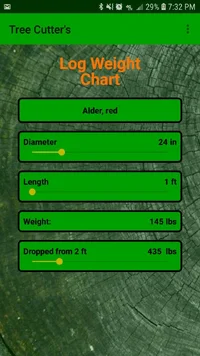
Ignore the wood species this just shows that a 145lb weight (such as a climber) falling 2 feet is an impact of 435lbs. If your concerned with the tree swaying I wouldn't want to drop that much into your tie in. If your heavier than 145 then the amount of force if you fall multiplies even heavier.

Screenshot_20190303-193227.webp


As for gaffing your rope, try attaching a carabiner on your leg strap and run your rope through it and on the outside of your leg. It will keep the rope away from the gaffs
 
The foot loop thing can work. Learning to use spurs will be beneficial though. If you’re going to be doing a lot of dead ash please learn how to read them. Not questioning your abilities but they are quick to decline and are not to be trusted. My area has been hit hard and we’re getting to the point of unsafe. I am the only employee that deals with them if they are requested to be climbed. If I turn it down the company turns it down unless another option can be used. We are now looking into a spider lift for these reasons as I have been turning them down more often. Even after being removed the firewood deteriorates at an excellerated rate. They are bad news
 
One of the reasons I don't feel comfortable using spurs at the top of an ash is the increased sway. I THINK the stem is solid enough or I wouldn't be up there, but I figure why add more sway than necessary. As a top comes off there's plenty of sway sometimes, but it seems like when I'm gaffing up (or down), there's even more sway than when the tree top breaks off. I try to take little baby steps up there, and also lanyard in closer to the stem. That adds to the discomfort but results in less sway. I know the spikes feel more solid when I am at an angle more away from the stem, but the increased sway isn't fun.

The sway entirely comes down to technique. Me personally as i get into smaller wood I'll leave my lanyard loose and at a good adjustment to sit back into and climb holding myself vertical with my hands on the stem, smaller steps, gentler steps and a smooth even rhythm help to reduce sway as well.

Same concept as getting a good rhythm going when rope walking
 
This is a neat thread. Weird experiment: This summer I had a couple of jobs that were so hot even Tarzan woulda' stayed outa the trees. That hot. And the spurs I use have velcro straps - good spurs but - hot. No, incandescently hot. So on one of the last trees I did before the snow flew, I tried not using spurs but constructing an etrier type of thing out of an old rope bit. The top was a loop choked to the stem and there were two legs connected (just knots) to each leg mid way down the rope, with a F8 knot on the end of each leg. When I went up to the destination SRT, I choked the etrier and then transferred foot ascender and then knee ascender to the etrier (I figured rightly or wrongly it would be easier than staying on the climbing line) from the climb line. Experiment wasn't a complete success as I had too long a bridge piece between the two legs of the etrier so I wobbbled a bit, but the principle was intact. This experiment may be repeated this summer. Seemed way better than just a choked sling to stand on. Tree climbing using aid gear - who'da thought?

One of the nice things about spikes is that they will come out if you get whacked by a piece of wood, and I can take them out quickly if it looks like wood is coming at my legs. I can't do that if my foot is attached to a rope or in an etrier.
 
The sway entirely comes down to technique. Me personally as i get into smaller wood I'll leave my lanyard loose and at a good adjustment to sit back into and climb holding myself vertical with my hands on the stem, smaller steps, gentler steps and a smooth even rhythm help to reduce sway as well.

Same concept as getting a good rhythm going when rope walking


this.


Look at Reg Coates RECOATES on youtube for the video about climbing dead fir tops!


The chainsaw will allow you to spear cut, less horizontal push on the tree. Less wiggling than hand-sawing.


FALLING 2' onto no significant amount of rope in the top of a Crappy tree, NO THANKS.


You can lean back more on spurs in wide wood.


A 540 lanyard wrap can help a lot when climbing in skinny wood. no concern about FALLING into your climbing system.


People will want to minimize things. A 2' slip doesn't sound like a 2' fall. A concussion doesn't sound like a brain trauma.
 
When you're not on spurs, girthing a sling or to for footholds to advance up is excellent. You can girth a short sling runner and clip your lanyard into it as a "single rope" SRS lanyard to stabilize your position making the cuts above your lanyard tie-in.
-AJ
 
Last edited:
My experience with ash is that the wood stays intact much longer than the roots. Seemingly solid tree will just fall over because all the roots are gone. Unlike some other dead trees, dead ash
wood wolds its hinge and is easy to work with. It is the roots that will completely disappear.
 
Bing is right about ash retaining its wood properties. Here in southeast MN we are in our first big wave of infestation, so for the last two years most of my work has been ash removals. I still tie into the nosebleeds with confidence, at over 200# with gear.
The fall into the system is a really interesting topic. I don’t look at two feet as a lot to slide down a tree, but a sudden straight drop without structure to try and grasp might be jarring from a hard anchor. A base anchor would be a completely different story. Last year I had a freakish redirect failure on a cottonwood. It was a strong compression angle on some meat, so the only explanation we have come up with was epicormic growth. Anyways, I was ascending, and it sent me straight down over 15’. Because I had my ascenders on, my hitch couldn’t slip, so the rope took the force. Thankfully, there wasn’t any structure for me to fall on, and besides the heart attack, I was fine from the impact. I had 150’ of Yale Scandere running through the tree, which has some bounce. I’m pretty sure that elongation (which, ironically, I find annoying) saved my health, if not my life.
I still have anxiety about cottonwoods... Since this incident, I have removed several... by crane ; )
 
I used to run my rope through a biner at my side...works pretty much everytime, no brainer. Not easy to tend.

Over time, I've become unconsciously competent at feeling the the climbing rope is on top of my boot, going to the outside of my foot, rather than between my feet. Hard to spike it here.

Take your time. Take some breathes.


Also, I carry my rope a fair bit. A little extra weight if you use the right length rope, especially with a canopy choke or base-tie. Saves a lot of ropes tangling, and work for the groundies,. way easier to self-lower, too.

My bagged rope will pay out cleanly in an emergency descent, as well as being easy to manage.

Climbing an 80' tree with 75' of rope, with a trunk choke on SRT is very efficient. 75' of rope is easy enough to ignore, at my size, at least. Half the time, you're carrying half that rope.


I've been on some longer ropes lately, and broke out my old piece of Poison Hyvee for the Akimbo, which is short as a climbing system, Long as a lanyard. I'm reminded that I like climbing on rope that is just long enough. 120' does most PNW trees I run into, with an emergency descent option, ready to go... I rarely go higher than 120'. That gives me a 60' TIP for Base-ties, and DdRT out of the tree, if needed.
 

New threads New posts

Kask Stihl NORTHEASTERN Arborists Wesspur TreeStuff.com Teufelberger Westminster X-Rigging Teufelberger
Back
Top Bottom