Chunking down

Re: Blocking down

glens, i see nobody took the discussion elsewhere. No big deal, we covered plenty in this thread, imo.

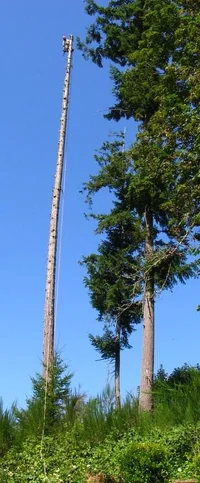
The video still doesn't play, audio only. As far as compression goes, I'd like to get mine down to sizes similar to eric's, which have good quality but are much smaller mb's per a similar time than mine. I always want to shoot at the highest resolution, then compress as needed. This is easy with stills and should be as well for video.

What is interesting is, that I can rotate my videos with my photo editor, but then the sound is garbled and obnoxiously loud at first then goes silent. Edit, I just tried it again, on the new computer, and it works. But, the file size is now 10 times higher! Ouch! 54 mb for 15 seconds. go figure
 

Attachments

  • 37774-GigHarbor3w.webp
    37774-GigHarbor3w.webp
    64 KB · Views: 74
Re: Blocking down

I have to agree with Roger here. Longer lengths take more thought. I rarely use 70* or greater up in the tree. That's not to say that I never do. But, Mangoes, one thing you mention about pressure on a spar being reduced by an open face would be wrong in my opinion. If a piece rotates all the way past 70* before a release, it will place the same (or more ) pressure on a spar than any other cut. And, if it is a fibrous tree, the fiber will cause the spar to pull and then tghe release will cause a recoil.

The point is, you need to know as many options as possible in order to get the desired result.
 
Re: Blocking down

Rodger,

Good points and I agree , since I deal with alot of conifirs as well.

Any experienced faller will tell you that a 70 % face cut is ridiculous. Not to mention , it's a hell of a lot of sawing on bigger wood . The same thing can be accomplished by widening the back of the face cut .

Average rule in rotating wood is abot 18%...100' tree 18' with about a normal 45% face.Providing it's a fairly straight spar.You can get three logs to turn 270 one 18'two 16'.6" if it's 100'. the third face will tend to be wider for more roation. ( Or wider at the back of the face)After that , figure your height again, multiply by 18% gives you approx. length you can take.This varies , so dont take it as the gospel .

45% and 70% cuts are taught because those are the averages and safe cuts. There has to be a standard set somewhere. Thats like saying the collar on every tree is at 45 deg off the 90 deg. most of you know as well as I , thats not true in most cases, but it gets you close if you dont know any better.

The varied face cuts are for different reasons. Talk to someone who knows what thier doing before practicing over someones house or newly planted lawn.

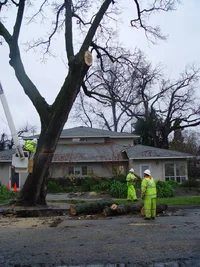
this is a face cut I posted in rigging.I think I did. If not , oh well. Far from 45% or 70% only to lay it flat on the logs below. If I had put in anything wider, it would have put a two foot hole in the pavement.(important not when making narrow faces). It must be true all the way accross or your log is going to veer one side or th other.

Thanks
Greg
 

Attachments

  • 37841-facecutNorthernLateral.webp
    37841-facecutNorthernLateral.webp
    195.3 KB · Views: 84
Re: Blocking down

The guys out west seem to snipe most of the face cuts and along with the gap in the corner a narrow face cut can be used but I still see a lot of wood being pulled when the tree lays down.
Chain speed is critical particularly with a head leaner.
GF says a tree will slide off the stump with a snipe but I've never had a need for it, would be interesting to try it, no doubt safer with a larger face cut if it works.
I can see it working due to the mechanics.
 

New threads New posts

Back
Top Bottom