
Navigation
Install the app
How to install the app on iOS
Follow along with the video below to see how to install our site as a web app on your home screen.
Note: This feature may not be available in some browsers.
More options
You are using an out of date browser. It may not display this or other websites correctly.
You should upgrade or use an alternative browser.
You should upgrade or use an alternative browser.
Chunking down
- Thread starter Stumper
- Start date

- Location
- Canon City ,CO
Re: Blocking down
Mahk, Right. Chunking down. That is what I said. /forum/images/graemlins/grin.gif I follow the reasoning. Back before I knew any other tree guys to talk to I was calling it blocking down-because I was cutting firewood blocks. I wonder why the Brits call it "chogging"?CHunks of lOGS?
Mahk, Right. Chunking down. That is what I said. /forum/images/graemlins/grin.gif I follow the reasoning. Back before I knew any other tree guys to talk to I was calling it blocking down-because I was cutting firewood blocks. I wonder why the Brits call it "chogging"?CHunks of lOGS?

treebing
Been here much more than a while
- Location
- Detroit, Mi.
Re: Blocking down
I would like to talk about the angle of the face cuts in chunking big chunks. Meaning no block. The arbormaster guys really promote the 70 degree face cut correct? I have been doing that but have found it to be true that the hinge has longer to work and thus more control but it seems to be harder for it to land flat and I have nose dived some big chunks which isn't the best thing. Therefore It seems that the old 45 degree face cut allows the log to pop off sooner and thus flatter? I think that there must be some more science into the face cut angles for different applications than the 70 degree that ken and rip promote. thoughts?
I would like to talk about the angle of the face cuts in chunking big chunks. Meaning no block. The arbormaster guys really promote the 70 degree face cut correct? I have been doing that but have found it to be true that the hinge has longer to work and thus more control but it seems to be harder for it to land flat and I have nose dived some big chunks which isn't the best thing. Therefore It seems that the old 45 degree face cut allows the log to pop off sooner and thus flatter? I think that there must be some more science into the face cut angles for different applications than the 70 degree that ken and rip promote. thoughts?

- Location
- Retired in Minneapolis
Re: Blocking down
Like Eric said, Jerry Beranek goes into some good detail about this in his book. He writes about how to setup rotations to get logs to flip and land on the top, butt or flat.
Paying close attention to the face angle and how that affects what happens to the top of the spar when the log breaks the hinge is important. An open face tends to reduce the amount of spring-back in the spar. That keeps the climber from getting whipped around or breaking the top of the spar out.
Like Eric said, Jerry Beranek goes into some good detail about this in his book. He writes about how to setup rotations to get logs to flip and land on the top, butt or flat.
Paying close attention to the face angle and how that affects what happens to the top of the spar when the log breaks the hinge is important. An open face tends to reduce the amount of spring-back in the spar. That keeps the climber from getting whipped around or breaking the top of the spar out.

Roger_Barnett
Participating member
- Location
- Seattle, in the PNWet
Re: Blocking down
bingo, treebing. When I told Ken Palmer how I control log spin by making a very closed face but deep wedge cut, he said sooner or later, I'd get in trouble. But what does he know, he doesn't routinely drop 26-40 foot log length conifer sections, as I've done for over 20 years. Just gotta be careful, know your wood fibers, and stay well away from knots.
Those guys do a good job of training, but can't think outside the box.
bingo, treebing. When I told Ken Palmer how I control log spin by making a very closed face but deep wedge cut, he said sooner or later, I'd get in trouble. But what does he know, he doesn't routinely drop 26-40 foot log length conifer sections, as I've done for over 20 years. Just gotta be careful, know your wood fibers, and stay well away from knots.
Those guys do a good job of training, but can't think outside the box.
Roger_Barnett
Participating member
- Location
- Seattle, in the PNWet
Re: Blocking down
Lots of good talk at the TH. Here's a paste of my post over there:
Lots a good talk about a simple sounding subject, but it really isn't.
Personally, I do whatever the situation calls for. Which hopefully is log lengths. If I have room, I rarely bother with a tag line for vertical wood under about 20 feet and 16 inch dbh. Just cut a deep hinge to allow for less back weight, and muscle them over.
Re chunking (I think the term blocking refers to wood lowering?), I use mismatch/snap cuts as a last resort. Prefer to cut straight through, using a wedge if needed, up to 4-6 footers. Small 4-8 footers I might use snap cuts. longer wood gets a hinge/backcut.
Re the fool's cut that ya'll are talking about, yes, one must be ultra careful not to allow them to happen. But, sometimes, leaving a strap can be used to your advantage, if you want a piece to swing backwards..this is usually only used for horizontal limb wood though, and I'm sure many of you utilize the trick, including with full length branches. Conversekly, though, over the years, I've had several times when I have overlapped the cuts far enuf when snap cutting, and had the section peel off sideways, or hang up, requiring more cutting. Reckon that's cause I don't like snap cutting (one reason is it makes for funky firewood) and don't do it that much.
Above all, gotta watch and manage that drop zone! Also, look out for roots. On the big fir which we just did, we dug a hole, and tied back all the understory foliage, so as to be able to avoid wood lowering-it all had to be cut anyhow. We did have two bounce a bit, due to a root, and the log wall not being built high enough....no damage though. The excellent pics from that job and most of the last three months' shots are stuck for now on my spyware damaged laptop. I've my fingers crossed that they'll be recoverable.
Lots of good talk at the TH. Here's a paste of my post over there:
Lots a good talk about a simple sounding subject, but it really isn't.
Personally, I do whatever the situation calls for. Which hopefully is log lengths. If I have room, I rarely bother with a tag line for vertical wood under about 20 feet and 16 inch dbh. Just cut a deep hinge to allow for less back weight, and muscle them over.
Re chunking (I think the term blocking refers to wood lowering?), I use mismatch/snap cuts as a last resort. Prefer to cut straight through, using a wedge if needed, up to 4-6 footers. Small 4-8 footers I might use snap cuts. longer wood gets a hinge/backcut.
Re the fool's cut that ya'll are talking about, yes, one must be ultra careful not to allow them to happen. But, sometimes, leaving a strap can be used to your advantage, if you want a piece to swing backwards..this is usually only used for horizontal limb wood though, and I'm sure many of you utilize the trick, including with full length branches. Conversekly, though, over the years, I've had several times when I have overlapped the cuts far enuf when snap cutting, and had the section peel off sideways, or hang up, requiring more cutting. Reckon that's cause I don't like snap cutting (one reason is it makes for funky firewood) and don't do it that much.
Above all, gotta watch and manage that drop zone! Also, look out for roots. On the big fir which we just did, we dug a hole, and tied back all the understory foliage, so as to be able to avoid wood lowering-it all had to be cut anyhow. We did have two bounce a bit, due to a root, and the log wall not being built high enough....no damage though. The excellent pics from that job and most of the last three months' shots are stuck for now on my spyware damaged laptop. I've my fingers crossed that they'll be recoverable.

Mangoes
Participating member
- Location
- Greater Toronto Area
Re: Blocking down
Roger, I'll be honest and say if I wanted to know how to make 20' lengths land flat I would ask you over and Eastcoaster. Buuuutt... I might disagree with you on arbormaster boys being closed minded, if you sense resistance to your methods I would hazard to say it's because the engineering of your techniques havn't been put to paper...yet. I think it would be neat if you could have software programed to calculate the forces and reactions both beneficial & negative that exhist in different hinging techniques. Curently AM has proven that when poping tops out of a naked stem, you don't want huge forces enacted on the stem that could produce results varying from the human-paddle-ball, to outright failure of the spar, and a good way to do that is with a 70-90 face cut. I am more akin to the general rule of ensure to top is level with the horizon when the hinge fibres break. Slightly more general it takes leaning tops into account a bit better.
.................then again your horizon is a little ......irregular.
Roger, I'll be honest and say if I wanted to know how to make 20' lengths land flat I would ask you over and Eastcoaster. Buuuutt... I might disagree with you on arbormaster boys being closed minded, if you sense resistance to your methods I would hazard to say it's because the engineering of your techniques havn't been put to paper...yet. I think it would be neat if you could have software programed to calculate the forces and reactions both beneficial & negative that exhist in different hinging techniques. Curently AM has proven that when poping tops out of a naked stem, you don't want huge forces enacted on the stem that could produce results varying from the human-paddle-ball, to outright failure of the spar, and a good way to do that is with a 70-90 face cut. I am more akin to the general rule of ensure to top is level with the horizon when the hinge fibres break. Slightly more general it takes leaning tops into account a bit better.
.................then again your horizon is a little ......irregular.

- Location
- Gibsons BC
Re: Blocking down
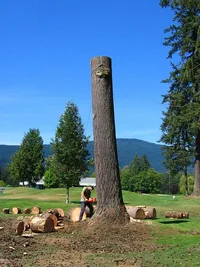
In conifer country dropping lengths flat is an essential skill as roger says. Depending on wood size and the landing zone I usually drop the longest lengths practical, often using the cut illustrated in my attachment for lengths up to 14' or so and then a deep acute conventional notch for longer logs with either a tagline or wedges to get them over. A general rule for logs that are too big for a climber to directly influence how they turn in the air is to take a fifth of the height of the spar with a standard conventional notch, in which case they will make just one full turn and land flat.
In conifer country dropping lengths flat is an essential skill as roger says. Depending on wood size and the landing zone I usually drop the longest lengths practical, often using the cut illustrated in my attachment for lengths up to 14' or so and then a deep acute conventional notch for longer logs with either a tagline or wedges to get them over. A general rule for logs that are too big for a climber to directly influence how they turn in the air is to take a fifth of the height of the spar with a standard conventional notch, in which case they will make just one full turn and land flat.
Attachments

- Location
- Gibsons BC
- Location
- Gibsons BC
Re: Blocking down
[ QUOTE ]
It looks like everything coulda just been dropped.
[/ QUOTE ]
everything was dropped butch hehe...i'm on your side!
[ QUOTE ]
It looks like everything coulda just been dropped.
[/ QUOTE ]
everything was dropped butch hehe...i'm on your side!
Roger_Barnett
Participating member
- Location
- Seattle, in the PNWet
Re: Blocking down
That's fine mangoes...but, suffice to say, I'm very comfortable with the technique, and expect to never have a problem with it, as long as caution is always used.
Open faces are great for those times when:
1: The wood is knotty, and the wood is fibrous.
2:You don't care about losing scale.
3:You want the section to come over smoothly, as in when lowering wood.
4:You want the section to not sail out.
5:You want the tip to auger in....hmmm, why would that be desired?
6:You're worried about fiber tear, and pull forward then push back of the spar. This is certainly a concern with spindly trees with lots of branch weight or an intact top, but that's not what I'm talking about. And, even then, when topping a tree, I rarely make over a 45 degree face, as I don't want it coming down tip first.
1 and 4 are situations which sometimes are a factor when dropping log lengths as we often do..but rarely is 4 much of a problem, as unless there is a large area available with plenty of room to accomodte margin of error, I won't be dropping long stuff...at least not from over 30-40 feet.
All that said, mangoes and other open face believers, what do you think of the extremely closed face (with snipe) method used by west coast big timber fallers like Gerry Beranek?
Here's a 1.8 mb video of a long fir top section coming over, from about 74 feet up. At that height, a full open face might have allowed it to spin a bit more, and maybe not get stuck in the ground as it did. Sorry, this was a few years ago, when I still was in the habit of holding the camera vertically, not a good thing for video.
That's fine mangoes...but, suffice to say, I'm very comfortable with the technique, and expect to never have a problem with it, as long as caution is always used.
Open faces are great for those times when:
1: The wood is knotty, and the wood is fibrous.
2:You don't care about losing scale.
3:You want the section to come over smoothly, as in when lowering wood.
4:You want the section to not sail out.
5:You want the tip to auger in....hmmm, why would that be desired?
6:You're worried about fiber tear, and pull forward then push back of the spar. This is certainly a concern with spindly trees with lots of branch weight or an intact top, but that's not what I'm talking about. And, even then, when topping a tree, I rarely make over a 45 degree face, as I don't want it coming down tip first.
1 and 4 are situations which sometimes are a factor when dropping log lengths as we often do..but rarely is 4 much of a problem, as unless there is a large area available with plenty of room to accomodte margin of error, I won't be dropping long stuff...at least not from over 30-40 feet.
All that said, mangoes and other open face believers, what do you think of the extremely closed face (with snipe) method used by west coast big timber fallers like Gerry Beranek?
Here's a 1.8 mb video of a long fir top section coming over, from about 74 feet up. At that height, a full open face might have allowed it to spin a bit more, and maybe not get stuck in the ground as it did. Sorry, this was a few years ago, when I still was in the habit of holding the camera vertically, not a good thing for video.
Attachments
Roger_Barnett
Participating member
- Location
- Seattle, in the PNWet
Re: Blocking down
[ QUOTE ]
and then a deep acute conventional notch for longer logs with either a tagline or wedges to get them over. <exactly, grasshopper, exactly!!>>A general rule for logs that are too big for a climber to directly influence how they turn in the air is to take a fifth of the height of the spar with a standard conventional notch, in which case they will make just one full turn and land flat.
[/ QUOTE ]
Sounds about right, gord. The log that Ken dropped, in the video in my last post, was about 30% of the remaining spar, so it augered in... When i'm way up there, i like to take 16-20 footers, and hope for the best...gotta have a lot of room as they might bounce or flip. Interestingly enough, I don't like logs to land flat, as that greatly increases breakage, unless the ground is soft.
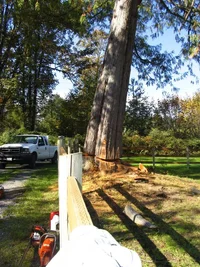
Dave Stice saw no use for an open face when felling this 2500 bf cedar 14 months ago....see pic
[ QUOTE ]
and then a deep acute conventional notch for longer logs with either a tagline or wedges to get them over. <exactly, grasshopper, exactly!!>>A general rule for logs that are too big for a climber to directly influence how they turn in the air is to take a fifth of the height of the spar with a standard conventional notch, in which case they will make just one full turn and land flat.
[/ QUOTE ]
Sounds about right, gord. The log that Ken dropped, in the video in my last post, was about 30% of the remaining spar, so it augered in... When i'm way up there, i like to take 16-20 footers, and hope for the best...gotta have a lot of room as they might bounce or flip. Interestingly enough, I don't like logs to land flat, as that greatly increases breakage, unless the ground is soft.
Dave Stice saw no use for an open face when felling this 2500 bf cedar 14 months ago....see pic
Attachments

Re: Blocking down
[ QUOTE ]
Here's a 1.8 mb video of a long fir top section coming over, from about 74 feet up. At that height, a full open face might have allowed it to spin a bit more, and maybe not get stuck in the ground as it did. Sorry, this was a few years ago, when I still was in the habit of holding the camera vertically, not a good thing for video.
[/ QUOTE ]
My first stab at video editing. It's now right side up, and I hit it with some gamma correction so we could see some detail in the shadows. For some reason now it's 1.3 MB. Hope I didn't degrade it too much...
(I won't say anything about <u>m</u>illi<u>b</u>its v. <u>M</u>ega<u>B</u>ytes
[ QUOTE ]
Here's a 1.8 mb video of a long fir top section coming over, from about 74 feet up. At that height, a full open face might have allowed it to spin a bit more, and maybe not get stuck in the ground as it did. Sorry, this was a few years ago, when I still was in the habit of holding the camera vertically, not a good thing for video.
[/ QUOTE ]
My first stab at video editing. It's now right side up, and I hit it with some gamma correction so we could see some detail in the shadows. For some reason now it's 1.3 MB. Hope I didn't degrade it too much...
(I won't say anything about <u>m</u>illi<u>b</u>its v. <u>M</u>ega<u>B</u>ytes
Attachments
Mangoes
Participating member
- Location
- Greater Toronto Area
Re: Blocking down
Roger, great feedback, just to clarify my standpoint, I'm fan of an open face, or any other method, as long as it is Safer, Easier, and Efficient. I get a little like Spyder and 'speriment with different ideas like you've been sharing. Hopefully one day down the road it'll be another tool in the 'mental toolbox' that comes in handy. I also hope everyone understood that the horizon comment alluded to those big tall rocks that inhibit the view out West.
Roger, great feedback, just to clarify my standpoint, I'm fan of an open face, or any other method, as long as it is Safer, Easier, and Efficient. I get a little like Spyder and 'speriment with different ideas like you've been sharing. Hopefully one day down the road it'll be another tool in the 'mental toolbox' that comes in handy. I also hope everyone understood that the horizon comment alluded to those big tall rocks that inhibit the view out West.
Re: Blocking down
I'll see what I might do to duplicate the codec in Roger's video. The following two lines are culled from the output of the player; the one starting with "-" was his, the one starting with "+" was mine:
-Selected video codec: [ffmjpeg] vfm:ffmpeg (FFmpeg MJPEG decoder)
+Selected video codec: [ffodivx] vfm:ffmpeg (FFmpeg MPEG-4)
I'll see what I might do to duplicate the codec in Roger's video. The following two lines are culled from the output of the player; the one starting with "-" was his, the one starting with "+" was mine:
-Selected video codec: [ffmjpeg] vfm:ffmpeg (FFmpeg MJPEG decoder)
+Selected video codec: [ffodivx] vfm:ffmpeg (FFmpeg MPEG-4)

Re: Blocking down
[ QUOTE ]
"Error downloading codec" it says.
[/ QUOTE ]
Glens, I have had this error code before, too. I have rendered and burned to disk a DVD before and then tried to play it in a different computer and it won't play...gives the above error message. I researched the problem (Google, manuf. support forums, etc.) but couldn't make sense of it.
Is there a way to determine which codec is missing and somehow correct it? (Do you load a certain "codec file" into the directory with the mpg or what?)
[ QUOTE ]
"Error downloading codec" it says.
[/ QUOTE ]
Glens, I have had this error code before, too. I have rendered and burned to disk a DVD before and then tried to play it in a different computer and it won't play...gives the above error message. I researched the problem (Google, manuf. support forums, etc.) but couldn't make sense of it.
Is there a way to determine which codec is missing and somehow correct it? (Do you load a certain "codec file" into the directory with the mpg or what?)
Re: Blocking down
This thread is getting redirected with video quetions...do we need to start a different one?
This thread is getting redirected with video quetions...do we need to start a different one?
New threads New posts
-
test
-
 Alternatives to standard asphalt around roots
- Started by southsoundtree
- Replies: 5
-
-

-

-
 For Sale: 2018 Vermeer BC1000XL Chipper | 918 Run Hours | Deutz Diesel
- Started by Blue Ribbon Tree
- Replies: 2
-

