
Can this tree be made "healthy"?

dmonn

Branched out member
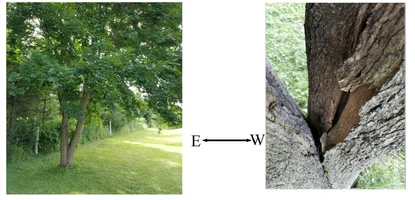
I've got a nice specimen maple in my yard that's got some problems.
1566063831079.webp
The stem on the west seems to be pulling away from the stem on the east, exposing some included bark. The bark above the union has split and the interior is starting to rot. (right hand photo)
1566064014820.webp

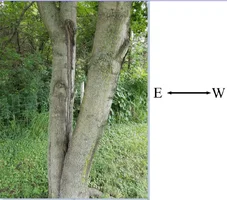
The stem on the east also has a large split in the bark, but seems to be healing better, with less rot in the middle.

It would be nice to keep this tree another 10 years or so. Can I reduce the size and weight of the stem on the west before rot and gravity take over and prune the whole thing at once? Remove a large-ish branch from it at a union to make that happen? Any other thoughts/ideas (including dropping the tree and replanting)?

Thanks.

Don
 
How is the root flare?

I am inclined to say that some heavy reduction and simple static cabling should buy you 10 years, which could get a replacement established. It looks like it has one large nasty wound/union on an otherwise healthy tree. If given the chance, it will probably keep being alive for many years if you can keep it standing.
 
Another vote for removal of the west stem. Another ten years of growth is only going to increase the risk of it failing... but I'd bet the east stem will chug along for a very long time and remain healthy.
 
Not sure about the self cleaning oven reference, but I get that it is not an outstanding specimen. But when most of your trees are dead ash, box elder, and buckthorn, a live maple that's taller than I am is a specimen tree.

Sounds like removal of the west stem would be good. For that I fell the stem a foot or so above the union, but then cut the stub off with a horizontal cut at the union. Is that right? It seems like it will be removing a large percentage of the tree. Is that better than removing one or two largish branches from the west stem every year for a few years before taking the rest of the stem?
 
  • Like
Reactions: ATH
How does a huge wound in an infected and poorly defending tree, and removing half the tree's photosynthetic potential, and a lot of stored nutrients help it deal with decay and lawn problems?

Get an arborist there is you want to save it.

Cable and brace.
Root collar excavation/ Stem-girdling root pruning.
Water and mulch.
 
I've got a nice specimen maple in my yard that's got some problems...

That statement is wrong on so many levels but getting 10 more years out of it should be doable. A crown reduction by someone that knows what they are doing will go a long way by itself. I would not remove an entire lead, that would be too much. Cabling and bracing could be added, if deemed appropriate after the pruning.

The only thing you need to understand is what will be damaged if it fails, and are you OK with that. Get another tree started, soon.
 
Last edited:
I agree with @cerviarborist that you have quite the turd there...

Sometimes you can rehabilitate a trash tree into something decent, or even aesthetically superior. Try to distill the essence of the tree in your mind, looking at the big wood first, and also paying attention to where small wood forks off. Try to see what the tree could become. Overall, my impression is that the two main trunks have character low down, then kind of fizzle out into three parallel verticals. Perhaps one of the leaders has a low branch that takes a wider angle. You could cut the parallel vertical above that. Choose the new leader with the best angle - not too disjunct with the vertical it is coming from, and yet significantly getting away from the "we're all parallel here" look. It's possible that the new taper will drop to a quarter or even less of the current diameter of the leader. Try to do what gives the tree the ideal form in 5-10 years. Here are some forms, just to get you started:


The form should be compatible with the landscape and associated physical processes in your region. In Florida, I generally stay away from cliffside forms because they would look silly in this landscape (unless I was working at a sinkhole).

As far as health and structure go, the tree looks like it has a good leaf flush, so that points to a degree of health that is present despite the wounds on the trunk. I feel like you can prune it, perhaps heavily, and get away with it. If it dies, you're probably okay with that in this case. I would mulch the tree for its health and to keep the mower/whacker off it.

Structurally, a heavy prune is probably enough to reduce the wind force leverage below what the tree is kitted up for, so I'm not sure that cabling and bracing are necessary yet, but they might be 5-10 years from now when the tree has put some weight back on. I don't know much about snow weight leverage on trees, but it may bear on trees in your area more or less than wind does.
 
If it fails in the likely direction, it hits my lawn. Any other direction the targets aren't very significant (wire fence, or mostly healthy spruce or poplar trees that would likely cause it to hang up). I'm OK if it fails. It would be nice if it didn't fail in the near future (the next year or two). It's a partial visual screen between us and our future neighbors who plan to build a two-story house. We planted some evergreens (mostly spruces) a few years ago that will improve the visual screen in the next five or ten years.

Crown reduction was my first thought, as well as possibly cabling. I think it's a good tree to use for putting what I've learned at conferences and reading into practice. If I screw it up and kill the tree, it's not the end of the world.

Regarding form, the tree has a nearby "neighbor" that my wife and I both love. It has a near-spherical form, with large branches opening wide from a single primary lead, starting about 8 feet off the ground. The tree is about 50 or 60 feet high. It's out in the open, and my wife and I have been tending to it since we bought the property 8 years ago. It's about doubled in size (DBH, not height) since we bought the property. The tree with issues would look good with that form, except it is adjacent to other larger trees that would affect that form. I think crown reduction on the west side of it would help to achieve a compatible form.
 
Two of the three spruces are off to a great start. They're growing well and look very healthy. The third one looks less healthy, so I'll check the root-collar depth. Thanks for the suggestion. Regarding hydration and mulch, all three have been given the same treatment. About 2 inches of mulch, with none against the trunk. Watered as needed for the past two years. Rabbit fencing since they were planted.

The adjacent property has been vacant for 5 years, so the tall weeds and grass are great bunny habitat. The rabbit population keeps our dogs fit chasing them back through the fence into the vacant property. It's a hoot watching our Jack Russell try to sneak up on the rabbits across mowed lawn!
 

New threads New posts

Back
Top Bottom