Cabling

Mark,

As I thought about it today I kinda figured that it would be hole size. Thanks for the answers to my questions.

Didn't expect this to turn into a disscussion on synthetic vs steel systems. Great info so far, keep it going. I have point to add later.

Tod, as for the crews and the public I have not had any complains, only lots of positive. I will go into detail later, have to run out now.

Later
 
New Arboriculture or old my cables synthetic or static (I will use both depending on the structure)when they are sold are sold with the client understanding that I retain the right to inspect the cables as I see fit. Annually and/or after a weather event.
 
[ QUOTE ]
What if the client moves and the new owner is not aware of the dynamic system and has no arborist inspect it.

[/ QUOTE ]

That's where the NATMP comes in.

-Sean
 
hey Tod,

Nice spider web!! that thing ain't going nowhere /forum/images/graemlins/wink.gif

I can understand that steel could be viable in certian wood sorts with a good compartmentalization. But if you're putting in thousands per year, seems to me that you are putting them in every tree sort you come across.

Would it not be an idea to let the tree sort and situation determine what sort of anker you would use??

Also i think as arborists it is our job to educate and inform the client/public of what system is best and how to maintain it. I can't imagine that appearance would then play a roll in what they think about it.

Jelte
 
This is a good topic! Thanks for all of the comments.

I'm kinda glad that I wasn't here yesterday. It looks like I had to answer some questions, and then Todd comes along and takes the heat for me. Thanks Todd /forum/images/graemlins/blush.gif

I think most everything was discussed, but here's a few answers anyway. I do use dynamic cabling on occassion. This particular tree is one of the largest trees in the area, since it is only a few blocks off of the ocean. I really want to keep it around.

Three main reasons for steel on this:

1) The leader that we cabled is about 70' long (heavy).

2) The client repeatedly said..."if we loose this leader onto the neighbor's house, you guys are gonna cut the tree down!". I chose to use the strongest cabling that I felt confident it.

3) There's already steel in the tree with large through bolts.

Does this change anything for any of you?
 
Great thread guys, lots of good info. I can't really comment on static and dynamic, because I've never used a dynamic system, but I did want to mention an article in the newest Journal. It's a study using a a computer simulation of a new design for a static system. It's supposed to put less stress on the tree, and is less invasive because it uses fewer bolts. Thought you all might be interested.
 
Whoa...easy there Nick, what's the point you're trying to make here ? Seems pretty off the mark to me... not to mention in very bad taste.

On the other hand maybe I just misunderstood you - please clarify !

/forum/images/graemlins/confused.gif
 
One point the JOA article failed to mention with their new configuration, and a point to think about with the system Mark used, is it dramatically increases repeated flexing of the steel cable, and we all know about cycles to failure, especially with High Strength cable.
We hashed this over a few years ago at the ISA forum when the cable termination ends came out. We talked at that time about: ANSI, cycles to failure, liability, the old synthetic vs. steel, and about a hundred other topics. Interesting stuff, for sure.
Somebody should come up with a heavy duty inline spring for cables. They make little ones that hold maybe 500 pounds or so that you can buy at the hardware store, but if they made something that was rated at a strength that equaled the HS steel we are using, that would be a big improvement to the steel systems. When we see the trees break off above the cables, it not from decay but the karate effect. Adding "give" to the steel cables would reduce this.
 
Mike Maas,

"Somebody should come up with a heavy duty inline spring for cables."

Exactly my thoughts. This spring(season) I came up with an idea that I think is a great way to add suspension to steel cables. I'll test this winter and get back to ya on that.

Couple other things:

1. I like steel cabling, it's my company that is liable and I'm going to use what I feel the most safe with. I've seen my cabling put to extremes and last. Many trees I cable need incredible support, most that many tree companies would not want to do.

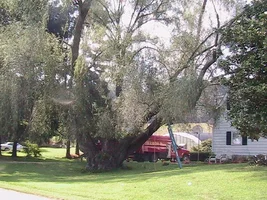
talk about testing, I put in 3 long spans of cable on a HUGE weeping willow this year, basically 4 trunks that came together and splitting 5-7 inches apart. I put 3/4" rods through trunks w/ almond eyes, and plates and nuts on rear. Two weeks after the installation a tornado (yes, a real tornado) went through that property, snapped off all the large norway spruce and crossed over this willow. It ripped the entire thing out of the ground. Now,picture this, two long almost horizontal trunks went out toward and over the house. The tornado flipped the tree away from the house, the cables held and pulled those 2 trunks all the way over and into the driveway.
I have before pictures and I'm trying to get some after pictures from the customer. the pickup in the driveway was crushed but no damage to the house.

Attachment on here shows willow. (before)

I'm going to stop writing here, cause I know I skip over the long ones sometimes. Next point on next post.
 

Attachments

  • 15713-WILLOW.webp
    15713-WILLOW.webp
    242.4 KB · Views: 228
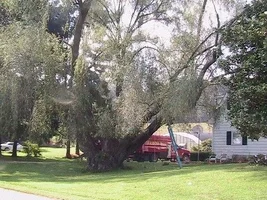
Wait, here's same pic resized for those of you like me with slow connections/computers.

Willow.
 

Attachments

  • 15715-willow overall.webp
    15715-willow overall.webp
    85.1 KB · Views: 192
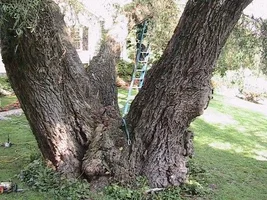
another pic of willow, closer view. pic reduced 50%.

look at caribiner in crotch and 020 on ground to give size referrance
 

Attachments

  • 15717-willow close.webp
    15717-willow close.webp
    87.1 KB · Views: 214
Okay point 2 :

Have you guys examined where old cables brake? Like 15-20yr old cables in trees?

I've seen it at one location mainly. It's in the dead end loop. I think that when a tree grows out over the lag/bolt and out over the thimble and part of the loop it freezes up the movement of the thimble. Now there is no movement and the strands get all the movement at the point where they meet the wood. Just like when you bend a coat hanger back and forth you eventually get it to brake.

Now, again, I've only seen this on 15-20 old weathered systems.

That's where I always see them brake, right where the loop goes into the wood.
 
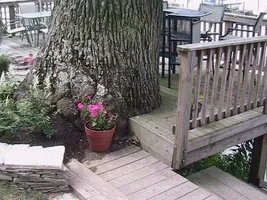
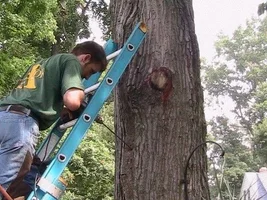
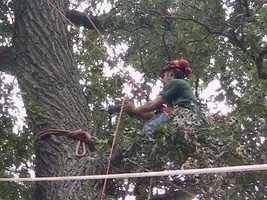
Okay, I was originally responding to show this Oak cabling I did this year.

Very interesting job.

Very large Red Oak on the bank of the Bush river.

Customer calls, says oak lifting several inches on one side.

Oak with heavy lean. Old, neat tree.

Deck built around oak and a big boat piere maybe 30 foot below.

I decide to take on anchoring the awesome tree.

Install "guide wires" (3). Anchored through a rock oak, a hickory and a concrete anchor we poored 4 feet under the soil.

I had a welder cut some thick plates for me. I use 3/4" threaded rod, large forged almond eyes, nuts and high strength cable.

I've spent 3 hrs now looking up these pics, transferring them to disk on one computer and taking them to this computer. So I hope you like them.
 
Piere below (is that how you spell piere?) Looking from that oak deck.
 

Attachments

  • 15721-piere.webp
    15721-piere.webp
    40.3 KB · Views: 192
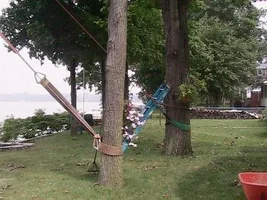
temporary supports I put on that same day I looked at oak. bull ropes.

These will be the 2 trees we anchor to with the cables. Down low of course so it wouldn't put leverage on these trees and pull them over too, but high enough for people to walk under.
 

Attachments

  • 15722-tempsupportOAK.webp
    15722-tempsupportOAK.webp
    67 KB · Views: 190
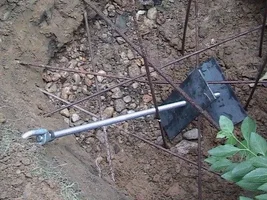
This is the third anchor point. We had to make one, the blue spuce wasn't large enough to trust.

This is the hole my groundman Justin dug by hand. 4 feet deep, 4x4. pic shows re-bar and threaded rod with almond eye and large plates. Positioned for concrete to be poored. I think we put in 320 to 400 lbs of concrete. Covered up those plates, sealing them inside the concrete. Of course there are nuts behind those plates.

Now also of course; the weight of the concrete is not important, the large surface area that won't pull through the soil is important. 4feetX4feet holds a lot of soil, ever see what those little duckbill anchors can hold?

those plates that will be in the concrete are around 12" long and 5"wide.
 

Attachments

  • 15728-holeOAK.webp
    15728-holeOAK.webp
    77.7 KB · Views: 206

New threads New posts

Kask Stihl NORTHEASTERN Arborists Wesspur TreeStuff.com Teufelberger Westminster X-Rigging Teufelberger
Back
Top Bottom