This one was fifteen hundred. A thousand for the tree; 200 cable materials; 300 cable labor. No charge for spinning my wheels buying 6' lag rod, or for dancing sugarplums in my head.
There is value of marketing by spreading the word that a more versatile palette of services is offered than competing arborists. Not to mention that a $400 hedge was thrown into the mix in the clients back yard. Never would have gotten that job unless the cabling service was offered.
Cabling keeps the mind sharp by forcing an arborist to think about future scenarios based on observations of present conditions. The client is relying on us to consider implications of modifying tree architecture.
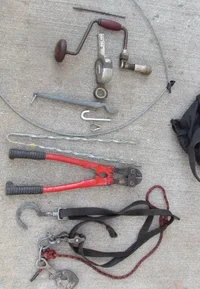
One thing that may help is a standardized list of a matched set of materials for a particular job. Even the correct size drill bits could be sold in a kit of j-lag (or thru eyebolt, nut & washers), thimble, and spool of wire. Even tools like a Cable-Aid lag spinner, hand drill, bolt cutter, jackstrap, cable grab, and a bucket could be packaged up by retailers. I don't have any experience with Wire Guy hardware, but it seems vastly simpler as an elegant solution. I imagine the extra holding power isn't necessary when increasing the liklihood of spreading decay to the opposite side of the stem by drilling thru the trees defenses.
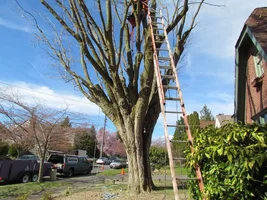
For example, this job used small hardware going into 3-6" diameter stems that are only about 30' long. The load on the hardware will be light for a few years because of the large amount of weight removed by pruning, so the hardware terminations are the smaller sized stuff.
The EHS cable is disproportionatly strong: it holds around 5,000 pounds, I believe.
The threads that are screwed into the wood are the weak link: Around a minimum of a half ton each, times 2 = 1 ton of lateral force capacity (including safety cushion). Love to hear your opinions about thread strength in various species of wood.
The lag increases in its holding power after a few years of wall 4 wood covering the head of the lag.
In my cable kit there was an old bent Irwin hand drill bit. This bend was caused by not being in a stable climbing position during an earlier job. Luckily there was a spare. Cost: $13 at Home Depot. My outlay: $26 (for both). Pricing schemes cannot leave out details like spare parts. How many folks go out on a tree job and use every saw in their truck?
Thimbles are an item that does come in light duty and heavy duty models. These things vary from 25 cents to a buck or more, so it pays to buy the good stuff. The cheap ones are made out of thin chrome plated metal. The wind jerking the tree around can cause the cable to momentarily go slack, which can allow the thimble to move within the confines of the j-lag head and get bent. This occasionally results in displacement of the thimble, leaving the eye of the dead end unprotected in the following years. The thicker gauge steel of the more expensive galvanized thimbles allow the dead end to seat better in a more stable, inertia-resistant position.
The quality thimble also controls one of the lifespan limitation factors of the installation better. As new wood is added around the stem and piles up around the head of the lag, it eventually reaches the thimble. When the thimble begins to be enveloped, it can be displaced during windstorms due to the motion being limited on one side or the other by this callus. As soon as the thimble pops off the cable end, it no longer protects from abrasion of metal on metal, and the dead end eventually breaks.
All of the costs must be adjusted upwards for the long runs described (by you folks earlier) due to repeated trips to the opposite side of the tree to retrieve cables, measure, etc. For example, when installing 2 cables on each stem of the box, I was able to reach across the tree with a 12' polesaw back to the other side of the tree to retrieve the loose half of the cable. In larger trees, this would involve attaching a routed line with a spare cable grab, which would be more expensive.
Hope this hijacking helps with understanding the cost factors. Without a description of what work is involved, quoting a price is preliminary.
There is value of marketing by spreading the word that a more versatile palette of services is offered than competing arborists. Not to mention that a $400 hedge was thrown into the mix in the clients back yard. Never would have gotten that job unless the cabling service was offered.
Cabling keeps the mind sharp by forcing an arborist to think about future scenarios based on observations of present conditions. The client is relying on us to consider implications of modifying tree architecture.
One thing that may help is a standardized list of a matched set of materials for a particular job. Even the correct size drill bits could be sold in a kit of j-lag (or thru eyebolt, nut & washers), thimble, and spool of wire. Even tools like a Cable-Aid lag spinner, hand drill, bolt cutter, jackstrap, cable grab, and a bucket could be packaged up by retailers. I don't have any experience with Wire Guy hardware, but it seems vastly simpler as an elegant solution. I imagine the extra holding power isn't necessary when increasing the liklihood of spreading decay to the opposite side of the stem by drilling thru the trees defenses.
For example, this job used small hardware going into 3-6" diameter stems that are only about 30' long. The load on the hardware will be light for a few years because of the large amount of weight removed by pruning, so the hardware terminations are the smaller sized stuff.
The EHS cable is disproportionatly strong: it holds around 5,000 pounds, I believe.
The threads that are screwed into the wood are the weak link: Around a minimum of a half ton each, times 2 = 1 ton of lateral force capacity (including safety cushion). Love to hear your opinions about thread strength in various species of wood.
The lag increases in its holding power after a few years of wall 4 wood covering the head of the lag.
In my cable kit there was an old bent Irwin hand drill bit. This bend was caused by not being in a stable climbing position during an earlier job. Luckily there was a spare. Cost: $13 at Home Depot. My outlay: $26 (for both). Pricing schemes cannot leave out details like spare parts. How many folks go out on a tree job and use every saw in their truck?
Thimbles are an item that does come in light duty and heavy duty models. These things vary from 25 cents to a buck or more, so it pays to buy the good stuff. The cheap ones are made out of thin chrome plated metal. The wind jerking the tree around can cause the cable to momentarily go slack, which can allow the thimble to move within the confines of the j-lag head and get bent. This occasionally results in displacement of the thimble, leaving the eye of the dead end unprotected in the following years. The thicker gauge steel of the more expensive galvanized thimbles allow the dead end to seat better in a more stable, inertia-resistant position.
The quality thimble also controls one of the lifespan limitation factors of the installation better. As new wood is added around the stem and piles up around the head of the lag, it eventually reaches the thimble. When the thimble begins to be enveloped, it can be displaced during windstorms due to the motion being limited on one side or the other by this callus. As soon as the thimble pops off the cable end, it no longer protects from abrasion of metal on metal, and the dead end eventually breaks.
All of the costs must be adjusted upwards for the long runs described (by you folks earlier) due to repeated trips to the opposite side of the tree to retrieve cables, measure, etc. For example, when installing 2 cables on each stem of the box, I was able to reach across the tree with a 12' polesaw back to the other side of the tree to retrieve the loose half of the cable. In larger trees, this would involve attaching a routed line with a spare cable grab, which would be more expensive.
Hope this hijacking helps with understanding the cost factors. Without a description of what work is involved, quoting a price is preliminary.