Cabling pricing

Static cables (boxed in) do plenty to deter splitting. I doubt if you have done much cabling from posts of yours I have encountered in the past years and pictures you have posted.

This is very nostalgic....the third forum over 5 years I frequent where any arboricultural opinion I express finds Mr. Meilleur's response in attempted contradiction (what a compliment). Too much fun.

"I'm not sure slime flux (bacterial wetwood) is not a decay issue". Is that what you said Guy.

"If wetwood fluids were the primary cause of bark killing (and decay) then there would be large dead (and decayed) areas below all the large branch stubs on elms and poplars where wetwood fluids flow".

Furthermore...."Wetwood is a disease of wood, but is also a type of biological protection wood. So long as wetwood is present....DECAY WILL NOT DEVELOP".

Pg. 172 and 173 Shigo MA

The reason we do not drill holes in elms, etc with oozing slime flux (like I did back in the late 60's) is because the drilling spreads decay and the fluxing is of little consequence. The rodding will also expedite and magnify the spread of this interior decay pocket in Oxman's op(just as tubes did)in Dr. Shigo's experiment.... See diagram 1,2,3,4 topic 151 page 171 for scientific experiment that proved this.
 
If you pay attention to the movement that causes spliting in co-doms with cables, you'll notice that it is really only when a tree has two co-doms that they move (in a twisting motion), cuasing splitting.. once a tri-dom has been boxed in with three cables, the tree simply cannot twist in a way to caue significant splitting. That has been my experience.. I would think that a tree boxed in with four or more cables would also be protected from splitting, but I haven't really thought that one out too well, nor watched their motion in the wind.
 
Good comments on the drilling into dead wood causing spread of decay. I abandoned the plan to bolt.

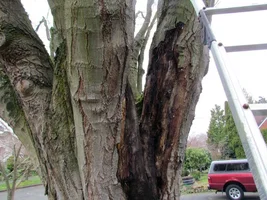
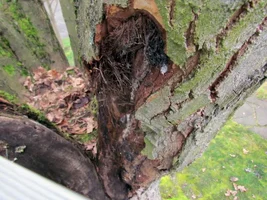
Peeling away more loose bark to see the other half of the codominant with the seam revealed more decay than was apparent at first inspection. Here's a shot.
 

Attachments

  • 272966-aBarkPeel1.webp
    272966-aBarkPeel1.webp
    101.5 KB · Views: 103
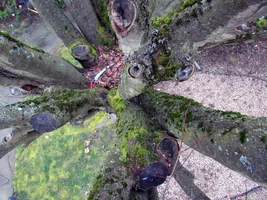
Looking down into the main fork from above. Some of the big old cuts are visible that were made to reduce complexity.

The handsaw is sitting on top of the debris that has filled up the vertical cavity since it was last cleaned.
 

Attachments

  • 272969-aBigOldCuts1.webp
    272969-aBigOldCuts1.webp
    140.1 KB · Views: 83
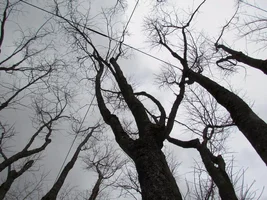
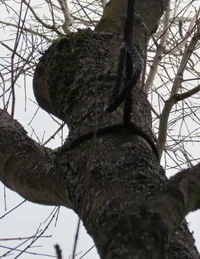
Looking up at the old cables from the main fork. The pruning history can be clearly seen by the old heading cuts that form zigzags in the formerly straight branches.

The Cobra is the cable with the bulge. It is going. The other cable is staying.

This is a pretty complex structure for a box. It would have to be a 20 sided box.
 

Attachments

  • 272970-aCableJob11yrsOn1.webp
    272970-aCableJob11yrsOn1.webp
    120 KB · Views: 89
Heres a close-up of one end of the Cobra cable. It was set in a fork, and the new growth has swallowed it up.
 

Attachments

  • 272971-aCobra11yrsOn1.webp
    272971-aCobra11yrsOn1.webp
    110.2 KB · Views: 98
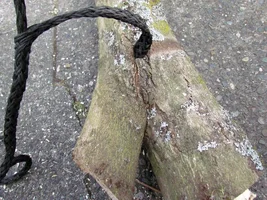
I started pruning the tree today. The Cobra cable was removed first thing. Here's a shot of it lying on the ground.
 

Attachments

  • 272972-aCobra11yrsOn2.webp
    272972-aCobra11yrsOn2.webp
    132.8 KB · Views: 98
Good pictures Oxman. Have you ever given the species of this tree?

Looks like a very damp environment with moss and lichens. Is this tree's root system covered in pavement? Any chance of getting a pict. of the stem at the ground level to the splits with a person standing next to it for perspective?

Tree appears low in vitality as it has no callus/woundwood involved with darkened cuts that appear to be old.

Is that old dynamic cable embedded in the trunk and girdling it?

That canker doesn't looked decayed?
 
Nice work, Mike. The cobra in the fork did not work out well; bad positioning from the start, assuming revisits and adjustments perhaps, but the best-laid plans often get plowed up.

Good woundwood observable on canker above fork shows vitality. On the old topping cuts it's hard to see tree response. Smart to stop bark removal when lots of adventitious roots are encountered. Dose!
Temporary poultice there? or permanent--train aerial roots like a banyan!


Looks like a bigleaf maple...?

Good idea to skip the rodding--the bmp on this is waaay invasive-hardware-happy imo.

"I'm not sure slime flux (bacterial wetwood) is not a decay issue". This is a misquote--shoving words into a small and irrelevant box. Please read again:
"I'm not sure the flux is not a decay issue"

Flux = flowing liquid.
Repeating: Not all fluxing is bacterial wetwood, aka "slime flux". The fluxing in this tree seems due in large part to the activity of wood decay organisms.
 
[ QUOTE ]
I think using the the wedge grips, plus cable for a 30 foot span- just for material alone cost about $75.00,

[/ QUOTE ]

And as you say materials alone are $75, without considering shipping, waste material such as the end of the length of cable, time for someone to order it, money spent in advance to have it in inventory ready to go, wire cutters that wear out in time, etc.

Seems like any typical retailer has 100% mark up to cover such costs.

Then their is the travel time, the mentioned "opportunity cost", possible legal issues.

Sounds like a lot of people should be charging more for this specialized service that a lot of tree companies don't offer, don't do well.
 
[ QUOTE ]
Seems like any typical retailer has 100% mark up to cover such costs.

[/ QUOTE ]i agree that doubling material cost is fair to cover overhead; that's SOP for me.[ QUOTE ]


Then their is ... possible legal issues.

[/ QUOTE ] no need to go there, imo. general liability covers it; E&O may be a reasonable add-on but is often so full of holes it is not worth it. follow the standards and you are covered by the strength of the industry. [ QUOTE ]


Sounds like a lot of people should be charging more for this specialized service that a lot of tree companies don't offer, don't do well.

[/ QUOTE ]

Absolutely!
lily.gif
 
Ok, so I've never done cabling. Where do you start? I know the 2/3rd rule, but how do you determine if a tree needs it? When it has larg leaders spread far apart? Like Silver maples with multiple leaders going in opposite directions? Book on learning PROPER cabling?
 
I believe it is a Modesto Ash.

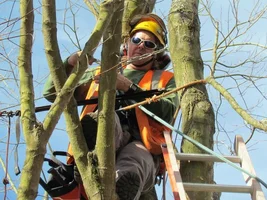
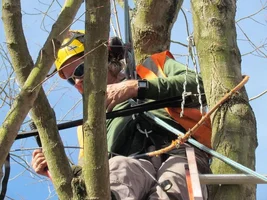
Heres a shot of the during. Notice the cable running past my left shoulder. The configuration ended up being a triangle box.
 

Attachments

  • 273129-ACableJobDuring1.webp
    273129-ACableJobDuring1.webp
    104.6 KB · Views: 81
[ QUOTE ]
Ok, so I've never done cabling. Where do you start? I know the 2/3rd rule, but how do you determine if a tree needs it? When it has larg leaders spread far apart? Like Silver maples with multiple leaders going in opposite directions? Book on learning PROPER cabling?

[/ QUOTE ]

http://secure.isa-arbor.com/webstore/Bes...tems--P156.aspx

mike, your pic did not come through.

ash, huh? o well--do I get half a point for seeing that it's opposite-branched?
smirk.gif
 
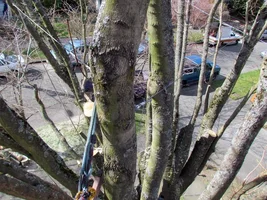
This is a view of the complete triangle. On the right side of the photo is a powerline & a phone line to get confused about.

Notice the Blue Streak climbing line on a hitchclimber pulley in the lower center. A white Safety Blue climbing line is at the left point of the triangle.

The right leg of the triangle in the foreground has swaged terminations, which are in forged round eye lags, and were left untouched.

The left leg is the Dead End I was working on in the previous pic.

Regarding the question about where to find 'instructions', there was an Arbor Age article I wrote that appeared when the first ANSI bracing standard was released. Arbor Age has dropped some of their old archives, but I'll try to dig up a scan.
 

Attachments

  • 273131-ACableJobAfter1.webp
    273131-ACableJobAfter1.webp
    146.5 KB · Views: 78
Talk about a thread hijack! I haven't seen a hijack like this in a long time.
applaudit.gif


I think people stating rates and their reasons are helpful. I also like Raven's question. Since I don't provide the service, I'd rather hear what others say...
 
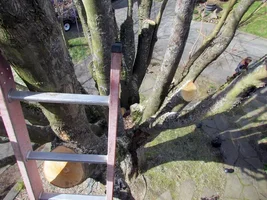
This attachment photo looks down at the rotten fork.

Instructions?

First, the decision to install artificial support systems should usually involve only basket cases. The front porch of this house is directly under the rotten fork of this tree, making it a candidate for extreme measures.

The second factor is that the primary treatment of the weak wood is heavy pruning. We topped the hell outta this sucker. Half a dozen 8-10" cuts low down, and dozens of 30' long limbs were removed to reduce weight and leverage. This is every 2 years, and costs a lot of money.

Many trees can do perfectly fine without cables after a significant amount of weight has been removed.

The 3rd factor is the cable, bolts, props, guys and other mechanical assists are done only AFTER heavy pruning. Furthermore, the decision to cable should usually only be made after the physical act of pruning itself is complete.

Y'know how the tree moves with the weight of the climbers body. Y'know how a limb snaps upright tall & proud when the top is taken out of it? This is the Body Language of Trees that climbers are conversant with. If you have pruned the tree, and it is still talking to you, all saggy and loopy, then consider cabling. Being a good listener is an art, but words are not the medium of communication. Experience with cutting big branches is. It helps to return to a tree over & over to watch decay progress with an analytical mind.

4th might be choice of materials. 5th may be the execution.
 

Attachments

  • 273136-ACableJobAfter2.webp
    273136-ACableJobAfter2.webp
    123.7 KB · Views: 65
This attachment shows the cable stretched by the leather come-a-long called a Jackstrap. Another view if it was shown earlier. It has a cable grab on one end that clamps on the wire that is already attached at the far end of the run. There are 2 pulleys on it with a flat leather belt running to a friction buckle that can be released while under tension. The other end has a large hook that is mounted on a swivel. OK, I've let the cat out of the bag with this trade secret. Perhaps someone can check the Klein linemans tool catalog and report back to us on availability & pricing?

The jackstrap doesn't actually stretch the cable, of course. It just bends the two stems together while we attach an unelastic cable between the two. After the hardware is installed, the come-a-long is removed, and a clean, non droopy cable is the result. How tight, you may ask. I'll avoid that can of worms. Lots of people have weighed in on tautness. It's amazing how far apart estimates can be on the weight of a seasons crop of leaves.

At the right side of the pic is the j-lag installed, with a thimble and a dead end hanging from it. At the very bottom of the photo is the about-to-be-cut end of the Extra High Strength (EHS) cable with a roll of black tape on it. The black & red thing in my hand is a small bolt cutter.

Many arborists make a big deal about measuring the span the cable needs to fill, then having the ground crew cut it and send it up to the climber. This can even require 2 climbers. Not always necessary.

A good procedure is to install one end, then climb over to the other end, drill it, screw in the lag and rig the come-a-long. Voila! Ready to measure & cut.

A thimble protects the dead end from abrasion over the years. Use them.

Soft lay cable is made out of a weaker type of steel that can be bent and spliced by hand. EHS cannot be worked by humans. The dead end, sometimes known as a tree grip is wrapped around the EHS in a spiral motion. The pattern of the wire strands is matched so they mate perfectly with each other. Please make sure to wrap the longer leg of the dead end around the cable first, before the shorter end.

The drill we used today is a hand drill. the holes that the lags are set in must be perfectly in line with each other. Some day someone will invent a an electric drill that has a laser mounted on it that shoots backwards. This laser will be aligned with the stem on the opposite side of the tree so that the holes are drilled perfectly straight. This way, no motion will torque the hardware, prolonging the life of the cable installation.

More trade secrets revealed!
 

Attachments

  • 273140-ACableJobDuring2.webp
    273140-ACableJobDuring2.webp
    104.5 KB · Views: 63

New threads New posts

Back
Top Bottom