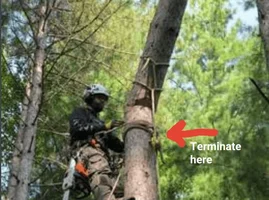
Agreed on going with other mitigation options where possible.
If it were a specimen with low vigor and not much internal growth - so not a good candidate for reduction - and without great options for cable placement, what then?
I don't think this kind of cabling would be appropriate for high risk situations, but if someone loved a tree and it was over a lower value target like a fence, what about a technique like this for helping to minimize potential damage?
Good point about ANSI. Would you ever have someone acknowledge that a technique is experimental/not ANSI as a way to mitigate liability?
Cool questions.
First, if it is a specimen tree in that state I might consider taking cuttings and propagating the next generation before it fails or dies. A replant is probably in order.
Specimen trees usually need to look good, so I am uncertain about how to achieve that with any cabling system.
I think you might want to elaborate what you mean by specimen tree - emotional attachment, small size, exotic, superior aesthetic, etc. It sounds a little Charlie Brown from your description.
Lastly, fences are cheap to repair as compared to cabling, so I am not convinced that there is anything to gain there.
I would focus on holistic management - tiny bit of reduction, mulch with arb chips, water, maybe a cycle of paclobutrazol, tomography on the weak spot, prune adjacent trees to provide access to sunlight, support temporarily with yukitsuri during snowfall season. Try to get all the incremental gains pointing the tree in the same direction.