Best Ring&Ring Setup SRT

ArchiePittsburgh

New member
Location
Pittsburgh
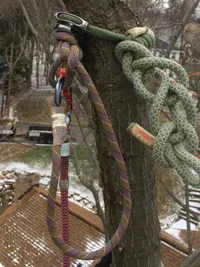
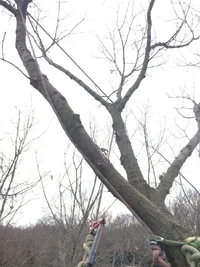
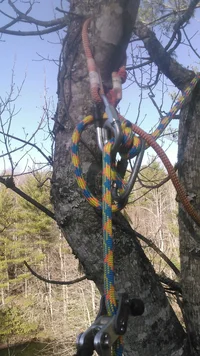
1D739DEB-7BF3-4968-8601-05602B1130DF.webp I tie in backwards using a ring and ring with SRT.
Here’s why: I can lower my friction saver down out of the tree with complete control every time.
I introduced this idea around this time last year-I’ve been using it ever since, and it’s become my favorite canopy TIP SRT.

What you’ll see in order is:
1. I jam a stopper knot on the larger ring of a friction saver. You are now boarding a round trip flight to redirect city
2. When I hit the ground, I attach a throwline to the tail of my climbing line, then retrieve my climbing line so the throwline runs all the way through my redirects, through my friction saver, and back down to the ground.
3. Attach a retrieval ball when throwline hits the ground-now pull back up and retrieve your friction saver, lowering it totally controlled from your first redirect.
4. If there are too many redirects and the friction won’t allow you to lower your friction saver, release your redirects with the other side of your throwline and a throwball-once you release enough redirects, lower the throwball back to the ground and tie a retrieval ball on the opposite side.
5. Once again, in the last shot you’ll see the throwline pulled back up to retrieve the friction saver and lower it down to the ground out of the first redirect.

There are some details which certainly help making sure everything goes smooth-ask if you have any questions.
Sorry the quality sucks butt, I’ll make a more in depth and better quality video once the weather breaks. Yinz enjoy!

 
Yeah, I love to use rings for my Single Line anchors too, I choose the Fimbl Climb for ultimate compactness. And like you show, knot blocking on either 'LARGE' or 'SMALL' ring is safely achieved.
You didn't tie in backwards, you tie in as Roger Sassolas and Francois Dussenne first envisaged the retrievable anchor, putting the Working End through the Little Ring first. DdRT anchoring tends to keep the climb line as an uninterrupted line from anchor to climber, so great for SRT pole work. SRT and its inherent desire for natural anchoring, re-directs, load sharing is best blocked against the little ring, Working End passed through Large ring first and retrieve ball on the Standing End.
Ring anchors give consistent friction on retrieve, how smoothly a climber can remove systems is often over-looked. I applaud your use of them. I do my retrieve with an Access line, not throw line, I can retrieve with eyes closed, it is that consistent (when set up right!) and then throughout my work aloft I have an Access Line for Rescue or a second climber to come up and give a hand.
I run a different system from you but they are facing the same direction.
I love how this system is can be turned over on its head and still function, it has interesting symmetry.
 
Ring and ring friction savers are good when there are multiple redirects to take-I’d prefer a Texas tug style setup if I’m only taking one or two redirects, so as not to worry about retrieving excess hardware.
I’ve struggled with finding ways to consisently and safely retrieve ring and ring friction savers as long as I’ve been using them. It took awhile for me to develop this technique

This is the only method of setup and retrieval where the user can consistently lower the ring and ring down with complete control (that I’m aware of). This is what separates this method of setup/retrieval from the other, traditional SRT method of jamming a knot on the small ring in order to retrieve with the tail of the climbing line
 
Ring and ring friction savers are good when there are multiple redirects to take-I’d prefer a Texas tug style setup if I’m only taking one or two redirects, so as not to worry about retrieving excess hardware.
I’ve struggled with finding ways to consisently and safely retrieve ring and ring friction savers as long as I’ve been using them. It took awhile for me to develop this technique

This is the only method of setup and retrieval where the user can consistently lower the ring and ring down with complete control (that I’m aware of). This is what separates this method of setup/retrieval from the other, traditional SRT method of jamming a knot on the small ring in order to retrieve with the tail of the climbing line

If you jam the small ring, you still tie on your retrieval ball and throw-line on the same end and retrieve the friction saver. Yet likely not as nicely with as many redirects as you are using. Very cool.
 
Last edited:
If you jam the small ring, you still tie on your retrieval ball and throw-line on the same end and retrieve the friction saver. Yet likely not as nicely with as many redirects as you are using. Very cool.

Thanks Mike-you’re also correct, if you were to go through natural redirects and tie a throwline on with a retrieval ball you could theoretically retrieve the ring and ring while still controlling it.
TBH I’ve had issues retrieving ring and rings in this traditional fashion even when it’s isolated in a MRS system (plus needing throwline as long as 3x the height of anchor point becomes a pain after ~60’)
When a single redirect is incorporated, the user would need 4x height of anchor point (when incorporating a redirect that’s the same height of anchor) + horizontal length incorporated by redirects...that can get messy (and need a ton of throwline) quick.
With my ‘jammin’ method 2x height of anchor (length of throwline) is needed (I haven’t had an issue yet with a 180’ hank)-it’s also pretty clean compared to the traditional 3/1 method of retrieval. Thanks for your interest
 
6612CF3D-12CA-4858-BD52-75640CFACC35.webp

One of the more important concepts I didn’t focus on originally in this post is anchoring the friction saver underneath the union (as seen), then retrieving with this method-when set up correctly, it’s nearly impossible to get your ring and ring FS stuck.
So in addition to safely and consistently lowering your FS (and being able to tie into higher PSP’s working in compression), you also can’t get it stuck when retrieving
 
What's your process for setting this up? Do you set the friction saver first, then go up and get your redirects, or do you get the redirects first, then come down and set the rings?
 
View attachment 49889

One of the more important concepts I didn’t focus on originally in this post is anchoring the friction saver underneath the union (as seen), then retrieving with this method-when set up correctly, it’s nearly impossible to get your ring and ring FS stuck.
So in addition to safely and consistently lowering your FS (and being able to tie into higher PSP’s working in compression), you also can’t get it stuck when retrieving

With the cinched anchor being below your first redirect, this essentially makes it a canopy tied basal anchor, doesn't it? Is there a benefit to using this instead of a traditional basal anchor? Other than ground guys with saws near the rope.

For what it's worth I do like how easy it is to retrieve and I can see the benefit if you were switching back and forth between doubled and single rope. But after a single redirect it would be hard to switch back to the moving rope system.
 
What's your process for setting this up? Do you set the friction saver first, then go up and get your redirects, or do you get the redirects first, then come down and set the rings?

@theatertech87 I almost always set an initial isolated anchor below my anticipated final PSP with just a running bowline backed up with a Yosemite, retrieval line attached to the tail.
Ascend up, then set my friction saver, and the redirects are incorporated as I move through the tree. Hit the ground, utilize the redirects to lower out my ring and ring. I just filmed a more in-depth video over the weekend, editing it down this week so I should be able to better explain the process soon. Thanks for your interest
 
With the cinched anchor being below your first redirect, this essentially makes it a canopy tied basal anchor, doesn't it? Is there a benefit to using this instead of a traditional basal anchor? Other than ground guys with saws near the rope.

For what it's worth I do like how easy it is to retrieve and I can see the benefit if you were switching back and forth between doubled and single rope. But after a single redirect it would be hard to switch back to the moving rope system.

@Jehinten You’re absolutely right, it’s a canopy anchor that you can setup in compression, as if it were a basal anchor. IMHO basal anchors have some inherent risks associated with them (as you said, ground guys with saws, material falling into and compromising them, yourself as a climber damaging it, twice the amount of elasticity, etc.), and this method incorporates the best of basal anchors (being able to string multiple union together in strength, retrieve natural redirects from the ground [you can even retrieve multiple mechanicals redirects, but I’ll be focusing on that in the near future]) along with the benefits of canopy anchors (easy to advance, limiting your exposure to damaging the basal leg, low elasticity, utilizing retrieval leg as an access line, etc.).
I don’t often switch between MRS and SRS, although this would help working from MRS to SRS-but as you said, not really SRS to MRS after a redirect or two. I have set a redirect MRS and descended down to incorporate a friction saver and make it SRS in order to prune trees in compression though. Thanks!
 
Also, some supplemental videos I put together with my buddy Andrew Tomaskovic (I’m behind the camera)
I’m working on my FPV video in which I will try to be all encompassing about the technique and include more information. I’ll share that after I’m finished editing

Part 1, setup-
Part 2, application and retrieval-
Part 3, small scale model-
 
Also, some supplemental videos I put together with my buddy Andrew Tomaskovic (I’m behind the camera)
I’m working on my FPV video in which I will try to be all encompassing about the technique and include more information. I’ll share that after I’m finished editing

Part 1, setup-
Part 2, application and retrieval-
Part 3, small scale model-
Sorry but I don’t see how the retrieval side in the first video can be used as a emergency access line. You would be relying on the injured climber to act as ballast.
 
Sorry but I don’t see how the retrieval side in the first video can be used as a emergency access line. You would be relying on the injured climber to act as ballast.

No worries, two things: 1: the access line doesn't have to be used strictly for emergencies, it can also be used by other climbers to access the tree to work.
2: You’re correct, you need the climbing side of the line to be weighted in order to use the retrieval as an access line. Depending on the scenario, as long as the climber in danger hasn’t compromised their climbing line or their connection to the line, the retrieval is good to be used for access.
If the retrieval does need to be used as an access line, it’s required that A) the PSP is suitable for a 2 person load and B) the “injured” climbers’ side needs to have their weight in the system-that weight along with the friction created by using a ring and ring FS is enough to counter the rescuers’ weight on ascent. This idea was originally brought to my attention by Lucas Drews
If you wanted to create an independent access line as a retrieval, you can do that as well when setting up your canopy anchor. Feed the retrieval over a suitable union and back down to the ground so that a rescuer could just anchor an end to the trunk for a basal anchor, then attach to that midline to be used as your retrieval line.
 
I dig the big ring jam idea!

Here's what I use for a friction saver. Hard to tell but there's one of those lanyard clips that holds the butterfly to the thimble prussik.
Retrieves with a xsre, all steel hardware, and you can move or advance a tie in.
KIMG0721.webp
 
What’s the big advantages of using a rrfs as an initial tip if every other redirect is a natural crotch. I get that it sees the most work usually as an initial point but the final can often see the brunt of the work.
 
What’s the big advantages of using a rrfs as an initial tip if every other redirect is a natural crotch. I get that it sees the most work usually as an initial point but the final can often see the brunt of the work.

Since every other redirect is a natural crotch, they create a lot of friction on retrieval.
With a Texas tug style canopy anchor, you may be able to retrieve 2 (possibly 3) natural redirects. With a ring and ring FS you can use as many redirects as you’d like-as long as you can pull your retrieval side down, you will be able to retrieve the hardware
 
I dig the big ring jam idea!

Here's what I use for a friction saver. Hard to tell but there's one of those lanyard clips that holds the butterfly to the thimble prussik.
Retrieves with a xsre, all steel hardware, and you can move or advance a tie in.
View attachment 50833[/QUOTE
Is that an op eye n eye split tail with a power cord thimble prussik formed into an AFS?
 

New threads New posts

Back
Top Bottom