Before and after

Sorry, didn't mean to insinuate that arborists cannot call themselves arborists if they make coronet cuts. Just that coronet cuts are not arboricultural cuts. That is, they're not in the best interest of the tree. I would call them wildlife management cuts.

I would be careful of fads: I didn't see anything in Mr. Fay's article that the practise was supported by much else than his opinion.
 
I wasn't really posting the article as proof of anything just as a way of explaining the thoughts behind the practice to those who might be unsure.

Coronet cuts are merely a potential management tool within the ecological management of veteran trees and their biotic community its inaccurate to describe that as a fad. A broader based perspective is what governs the approach taken by all LGA's with classified sites in the UK and most of Europe...that wider perspective does have applicatioins beyond veteran trees.
 
thanks for posting that sean.

hey stumper, sorry i seem to have hijacked your thread
frown.gif


shall i start another?
k.
 
I myself have not created many coronet cuts. But I like the principles they consider. As far as my interpretation of Neville's comment about creating surface area, if it is correct the diagram attached describes the increase in surface area. The red dots are the dormant buds. With coronets there are more opportunities for them to develop (but this isn't the only reason to employ them!)

Term he used was 'retrenching' which described what a lot of research on veteran and ancient trees in natural areas was observing. Nature through stress, disease, climatic events, forces a veteran tree to 'retrench' and to survive it has to. This was described well by Kathy, where a secondary canopy develops within the boundaries of the original. She and stumper synthetically induced this event.

A lot of good reading here..... http://www.treeworks.co.uk/publications.php
it isn't a fad if trees can be safely brought into the 3-4-6-700 year old status. As well the ecological significance of an ancient/veteran tree is astounding. Trees that sterile arboriculture would remove can have more biodiversity than an entire plantation stand of perfectly structured trees.

As far as scientific legitimacy.......does limbwalker, advanced (mine), aspen, asplundh, etc, etc employ ecologists to ensure whats 'best' for the tree is best for all other facets of the bigger picture......the ecosystem in which it resides. Treeworks aparently does.....and I would surmize there is a certain scientific legitimacy to the principles being put to print. (bartlett and davey might)

Here's one to stir up the Northa American tree management philosophy. http://www.treeworks.co.uk/downloads/13%20-%20Guidance%20Diagramme.pdf

The term 'not for the best of the tree' is one that will change it's definition over the next few decades. If we manage only for perfect trees (perfect form, perfect structure, perfect compartmentalization, perfect pest disease impact) then we will eliminate the opportuinity for ancient trees to develop. Some of Nevilles documentation claims that the retrenching of veteran/ancient trees increases their longevity. That doesn't fit our status quo on this side of the pond.

I wish I had the picture....but he had one of a tree he could not date.....the claim was upwards of 1500 years old. It did't make sense though, there were 4-5 stems 18" diamter in a semi circle abou 6-8 feet diameter. Analysis indicated that these were watersprouts, genetically identical to the original tree that had continued to grow long after the last of the original tree had decayed. To have a part in that is TRUE tree management.
 

Attachments

Great post Mangoes, agree 100% with the points you raise and the suggestion of future possible developments directions for individual businesses too.

Seems to me our interaction with and management of trees is always evolving and developing (well hopefully anyway!) lessons drawn from the field of veteran nad ancient tree care can be very relevant to the urban forest, it informs our view of just what the potential is, and just how adaptive and resiliant some of our urban tree species can be in certain conditions.

I'm well impressed by Arbs like Kathy who go out of their way to preserve individual trees finding sound defendable methods to achieve that outcome, whilst recognising that yes this is perhaps well short of the ideal, the best practice persay, but it is an application of best practice within the tight limitations imposed by the specifics of that brief.
cool.gif


Its very good to have these things questioned and challenged though so we can all thrash out (in our own minds as much as anything else) what each of us sees as the best way to manage our trees (clients trees sorry!) for the long term not just for 1-5yrs.

Shame Neville isn't on here would be very good to have him throw some grenades into the mix!!!
wink.gif
 
Kathy, thanks for looking up the BMP's. It's extremely unfortunate that they do not adhere more closely to the standards--a pet peeve of mine--, but they will be changing a lot following the updated ansi standards coming out next year.


[ QUOTE ]
The red dots are the dormant buds. With coronets there are more opportunities for them to develop

[/ QUOTE ]Mangoes I think your dots are located where adventitious buds may form, not where fully formed dormant buds lay waiting--which is at the nodes. My pics are too big for this site--gotta relearn resizing. [ QUOTE ]
Nature through stress, disease, climatic events, forces a veteran tree to 'retrench' and to survive it has to. This was described well by Kathy, where a secondary canopy develops within the boundaries of the original.

[/ QUOTE ]Absolutely right. Gilman's pruning book does a great job of illustrating and describing retrenchment as the goal of crown reduction.
 
[ QUOTE ]

Both the Forestry Commission and the Forest Stewardship Council, are incorporating this kind of approach into the management of their wood habitats.

[/ QUOTE ]Sean, that's all good for preserved woodlands, where beetles and fungi have a higher importance. I love visiting these areas, like the Olympic peninsula, and Appalachia.

But what does it have to do with caring for landscape trees in urban areas? I talked to the local Auduboners just this month about the usefulness of dead wood returned to the ground, and snags left in some areas, and other ornitho-arboricultural practices.

But leaving or for goodness' sake encouraging decay in the urban landscape seems antithetical to tree care. Decay is the enemy of any tree with valued contributions and a target--or am I missing something here?
confused.gif
 
[ QUOTE ]
I myself have not created many coronet cuts. But I like the principles they consider. As far as my interpretation of Neville's comment about creating surface area, if it is correct the diagram attached describes the increase in surface area. The red dots are the dormant buds. With coronets there are more opportunities for them to develop (but this isn't the only reason to employ them!)

[/ QUOTE ]

Topping, or regular internodal cuts have even more surface area. By your logic, a regular internodal cut would be even better. I read in Fay's article that coronet cuts mimic natural tearing. Why not just tear the limbs or peel cut the limbs? I do not believe that coronet cuts cause "better" epicormic sprouting.

[ QUOTE ]
Term he used was 'retrenching' which described what a lot of research on veteran and ancient trees in natural areas was observing. Nature through stress, disease, climatic events, forces a veteran tree to 'retrench' and to survive it has to. This was described well by Kathy, where a secondary canopy develops within the boundaries of the original. She and stumper synthetically induced this event.

[/ QUOTE ]

Ok. This makes sense. Though I'm not sure that these coronet cuts are the best choice. If you are developing a interior canopy, why would you want that canopy to have weak attachment points and large decay columns?

[ QUOTE ]
A lot of good reading here..... http://www.treeworks.co.uk/publications.php
it isn't a fad if trees can be safely brought into the 3-4-6-700 year old status. As well the ecological significance of an ancient/veteran tree is astounding. Trees that sterile arboriculture would remove can have more biodiversity than an entire plantation stand of perfectly structured trees.

[/ QUOTE ]

I don't think that the lack of coronet cuts in modern arboriculture are the reason we don't see 700 year old silver maples in urban environments. I would also not agree that arboriculture is very sterile. Try as I might, I've made poor cuts and poor decisions. Besides, the ratio of managed vs unmanaged trees is still very small. That is, I doubt that arboriculture sterilizes the surrounding environment.

[ QUOTE ]
As far as scientific legitimacy.......does limbwalker, advanced (mine), aspen, asplundh, etc, etc employ ecologists to ensure whats 'best' for the tree is best for all other facets of the bigger picture......the ecosystem in which it resides. Treeworks aparently does.....and I would surmize there is a certain scientific legitimacy to the principles being put to print. (bartlett and davey might)

[/ QUOTE ]

Scientific legitimacy is started by what we're doing right now. It is not an insult to ask Mr Fay or anyone else to support their arguement and present it for peer (us) review. I like to think of certain practises having foundations. These foundations are supported by how well the practise achieves it's objectives, use over time, ability to withstand criticism etc. New practises, therefore, should have an uphill battle in order to achieve legitimacy.


[ QUOTE ]
The term 'not for the best of the tree' is one that will change it's definition over the next few decades. If we manage only for perfect trees (perfect form, perfect structure, perfect compartmentalization, perfect pest disease impact) then we will eliminate the opportuinity for ancient trees to develop. Some of Nevilles documentation claims that the retrenching of veteran/ancient trees increases their longevity. That doesn't fit our status quo on this side of the pond.

[/ QUOTE ]

I think you are giving the practise of arbriculture more credit that we deserve. Try as we might, the practise of arboriculture does not ensure perfect trees all over the place. There are too many variables (poor cuts, time between prunes, soil health, development). And again, modern arboriculture does not eliminate the opportunity for ancient trees to develop: last time I looked, my goal as an arborist was to ensure that trees survive. So we have the same goals. I like ancient trees.


[ QUOTE ]
I wish I had the picture....but he had one of a tree he could not date.....the claim was upwards of 1500 years old. It did't make sense though, there were 4-5 stems 18" diamter in a semi circle abou 6-8 feet diameter. Analysis indicated that these were watersprouts, genetically identical to the original tree that had continued to grow long after the last of the original tree had decayed. To have a part in that is TRUE tree management.

[/ QUOTE ]

Is your description of 4-5 seperate trees? Those would likely be root sprouts. If the original tree is not there, how do you know how old it is? Also, I don't know what "TRUE tree management" is. Are you saying that this type of management is better? Also, you insinuate that this tree was managed for longevity? It sounds like just the opposite. It sounds like these trees were found "unmanaged".

Also, beware of anecdotal evidence. A sincere searcher of truth makes a hypothesis and then seeks to disprove that hypothesis. Pseudoscience makes a hypothesis and then seeks evidence to support that hypothesis (just look at the Natural Selection vs. Intelligent Design debate that went on in the US a few years ago.)

Sorry for hijacking this thread- perhaps we should move this topic to it's own post. I'd like to hear others' comments a well.

Kathy- I hope you don't take this as a criticism of your work. I have alot of respect for you as an arborist and I know you have the best interests of trees in mind.

Mangoes, Sean: I understand and agree with several of the the goals of coronet cuts and retrenching. Old trees should be the goal of all arborists. And perhaps these techniques fall under the "art" of arboriculture: But, a good arborist should also be well grounded in the science of arboriculture as well. I have not been convinced that these techniques satisfy my needs for good science.

Simply, has anyone else tested these methods as to how well they acheive their objectives?

 
Stumper and Kathy, thanks for the honesty and willingness to be the jumping-off point for this discussion. The thread is really about how far should we compromise when a valued client makes an ethically challenging request/demand. Although, it is morphing into a discussion about a very strange theory.

I have (passively) left jagged stubs in clients' trees to allow habitat developement--in wooded areas, difficult to reach, no children or other potential victims around. And I love to see the woodpeckers, etc. claiming the hollows. I'll remember the coronet cut, and maybe even use one in such a set of conditions.

However, I agree with KyLimbwalker that a lot of what these papers present comes across as pseudoscience. E.G. "Crown retrenchment pruning is used to extend tree viability, both in terms of vitality and stability..." The paragraph then goes on to posit that cutting deeply into the green on declining trees extends their lifespan. The author presents no footnote on that one, and I will continue to accept Shigo and all research I've read, that the complete opposite is true. If ends are dying due to "excessive transportation distances" from the roots, then why not just cut back to green? This, in effect, reduces the crown, without causing as much decay, and without causing as much stress. So, until the research shows it, don't cut further, and certainly, don't leave jagged cuts, if the goal is to "extend tree viability". As to "stability", the author doesn't distinguish between short term stability and long term stability. After all, topping causes stability, in the short term. Intentionally causing greater decay can, in no way, be thought of as a strategy for improving stability.

I hate to say it, but it seems that Fay may very well be confusing cause and effect. Yes, very old trees frequently are riddled with decay, and full of animals, but that's not necessarily the reason they got old. Trying to make amenity trees into "veterans", before their time is working contrary to arborists goals of safety and longevity.

As to crown reduction, what is wrong with light-moderate, (say, 1" -3" diameter cuts) instead of aggressive? Leverage working the way it does, we can make substantial improvements in "stability" with pretty small cuts.

Due to the weather extremes here (snow in Sept. and May, winds above 100 mph most years), and the predominance of weak-wooded trees, we do light-moderate reduction on crowns of most trees we prune (see attachment). I've done long sections on silver maple limbs that we'd reduced this way, and found decay columns that ended very quickly below the cuts. Larger diameter cuts on other trees (especially inter-nodal) have long columns. These trees are much more "stable" (yes, anecdotal, but with twenty some years of practice and observation) than ones that were severely "reduced" or "retrenched".
 
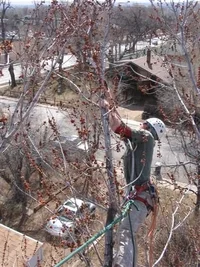
(Sorry, forgot to resize the pic - here it is. photo credit - Tom D).

Again, I'm not arguing with the goal of helping some trees play stronger roles in natural systems, just talking about trees in areas with high value targets.
 

Attachments

  • 105003-IMG_3321_2(Small).webp
    105003-IMG_3321_2(Small).webp
    61.8 KB · Views: 104
Nice pic Fred, and nice hat--I wear that model too.

[ QUOTE ]
As to crown reduction, what is wrong with light-moderate, (say, 1" -3" diameter cuts) instead of aggressive?

[/ QUOTE ]Nothing wrong with it, but 2 reasons why it does not happen:

1. Hard for many to climb that high. Learning new techniques will help, but still that level would be a challenge for many climbers.

2. Lack of pole tool usage. Yes a handsaw can make a clean cut, but so can a polesaw or poleclip.

Here's a post-storm pic, but the same decisions apply. I could have made shredding cuts at the break, aka coronet style, to increase surface area and adventitious bud formation and decay. That did not occur to me at the time. Instead I angled it to the upright lateral on the right.

It had good orientation--room to grow--, a good buttress for stability, and good vitality so it could take the terminal role. All these were more important than its lack of size, so the 1/3 guideline was not followed. I'm due to return to that neighborhood next month and will take a 5-year later aftershot.

ky, good point on cause and effect. I'd like to see some data on that too.
 
[ QUOTE ]
that's all good for preserved woodlands, where beetles and fungi have a higher importance. I love visiting these areas, like the Olympic peninsula, and Appalachia.

But what does it have to do with caring for landscape trees in urban areas?

[/ QUOTE ]

i think perhaps the fact that all 3 of the trees posted were/are removal candidates has been lost in the heated dialogue about coronet cuts/retrenchment pruning. the maple is HUGE, and left alone had the ability to hit 3 houses. when we are through with it, it will not be w/in striking range of any of the buildings and i think (guessing of course) will have the wherewithal to live at least another 20 yrs.

so, guy, to answer your question: dramatic height reduction to main stems w/no suitable side branches in sight were required. leaving 10 ft "stubs", ie not cutting back to the original topping cuts, was in my opinion the best way to slow the spread of rot which was inevitable given the pruning we were doing. having offended my own born & bred ISA certified ideas by so much already, it was but a small hop to "hey, let's leave more habitat".

my crew is so unused to height reduction, because i HATE it, that i nearly had a mutiny on my hands that morning. i do not intend to make coronet cuts and/or retrenchment pruning a habit, and will continue to resist even more accepted crown reduction techniques when there is no hazard present.

the tree is still alive. the alternative was not alive. i guess what i'm looking to do is create a little grey zone between the black of Prune it and the white of Remove it. keep some select trees limping (safely) along for another decade where possible. who knows, might even slow down global warming.
k.
 
[ QUOTE ]
Kathy- I hope you don't take this as a criticism of your work. I have alot of respect for you as an arborist and I know you have the best interests of trees in mind.

[/ QUOTE ]

thanks for the faith. no offense taken. dialogue, as mentioned previously, is the way toward professional growth. i don't even mind criticism, when respectfully delivered.

another redletter day for treebuzz - a fiendishly interesting geek dialogue, uninterupted by human bad behaviour. love that $hit.
cool.gif

k.
 
[ QUOTE ]
The thread is really about how far should we compromise when a valued client makes an ethically challenging request/demand.

[/ QUOTE ]

i guess that's one way to look at it, though i think it's about a lot more than that. when i first started doing treework, i needed a really good reason to kill a tree if i was to walk away feeling ok about it. now, after a decade plus of commercial tree work, most removals don't hurt my feelings anymore. every now and then, i'll decline to bid on a removal because the tree is too awesome or the reason is just too stupid, but killing trees has become just another part of my job. many if not most of them are perfectly ok trees that piss somebody off for one reason or another.

some neighborhoods in seattle (not many) have tree protection ordinances, and you need a permit and a defendable reason to remove anything over like 6" diameter. what if every neighborhood nationwide had such an ordinance? how many "overmature" trees, currently on or about to be on the chopping block, would be pruned and cabled? how much more urban forest would be left?

i think we (americans) often treat trees in the urban forest the same way we treat grocery stores: when they are kind of old looking and need a lot of work, we tear them down and put up another one. i don't think they do that so much in europe. i just think about that sometimes when i look at old trees. what's wrong with being old-looking? since when is my time too valuable to invest in a dying tree, and why do we insist on new shiny things all the time?

(did i mention i majored in philosophy in college?)
biggrin.gif

k.
 
Kathy I think you bring up an interesting point.
We as humans, and as arborists, tend to attempt any and all means to 'save' at tree. When in fact, culling then replacing, is the most logical alternative.
As arborists we are in the hot seat.

Which is fine, I signed up for the job and I accept the challenges, however our industry could gain much if the general public gave us more credit....

And the hacks just backed off a bit.....
 
Kathy, I think that Fred nailed the original premise of my posted pictures(Great, well articulated,logical post Fred) The thread has moved into other aspects of extreme pruning rationales-which I think is marvelous. While arboriculture means "tree care" the reality of being an arborist is often trying to find an accomodation for the owners of trees. We manipulate growth or eliminate trees entirely in order for tree owners to get what they percieve as the most benefit from their property. It certainly is not all black and white and covered by any set of rules. As Arborists we have to think,consider possibilities,and make judgements ....and we have to do that within a realm bounded by the wishes/mandates of clients.
 
[ QUOTE ]
....and we have to do that within a realm bounded by the wishes/mandates of clients.

[/ QUOTE ]

Further, we have to do all that with folks comparing us to medical doctors. These folk will do all and everything to save a life. It is to our challenge to attempt to achieve the same for the trees in our care....
 

New threads New posts

Back
Top Bottom