hi guy, i think you forgot the attachment.
the bmp for pruning says:
"reduction cuts commonly are used in structural pruning or when reducing tree size. a stem is cut back to a lateral capable of sustaining the remaining limb and assuming the terminal role. a common rule of thumb is that the remaining lateral branch should be at least 1/3 to 1/2 the diameter of the removed portion" (p21 2002 edition)
so there's the 1/3 rule reference, though not strictly prescribed. additionally, on p 13: "when a limb on a mature tree is cut back to a lateral, no more than 1/4 of its foliage should be removed".
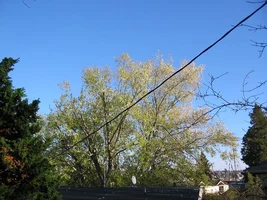
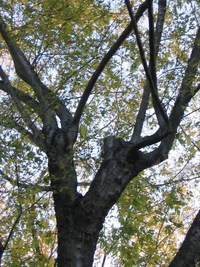
this tree, remember, was a removal candidate due to hazard, and the amount of height/weight we had to take out of the main stems often left us with 1/2 inch limbs to take over the terminal role of a 6 inch stem. my understanding of the logic behind these pruning guidelines (supported by my field experience) is that if we chose to prune back to an unsuitably small lateral, we would prompt a flush of epicormic growth that would likely have poor strength and structure thus leading to future problems. given that we didn't have the 1/3 to 1/2 laterals to prune back to, the choices if we wanted to achieve the hazard abatement goal were to 1) remove those stems back to their point of origin or 2) make a cut that would promote crappy epicormic growth. i figured option 1 would create even more rot in the "hydra head" of the old topping cut, in addition to making huge holes in the canopy of a fairly weak-wooded tree. option 2 would create lots of new foliage in the short term, making up for excessive foliage removal of the tops, and in the long run at least prolong the further compromising of the wood at and below the old topping cuts.
felt pretty crappy to leave this kind of cut in a tree, but seemed like the most intelligent option. since the new growth was likely to occur below these cuts anyway, and since that would leave ugly saw cut dead stubs up there anyway, i figured this was a good place to experiment with creating habitat with coronet cuts. i can't find any specs on this type of pruning, so i'm going on what i remember from neville's class in seattle last year.
the veteran tree preservation mindset i was trying to take here, is aiming at creating a secondary canopy lower down in the tree which will keep the tree alive as the (reduced) tops die. cables in the meanwhile hold the massive main stems together.
i dunno. like i said, it's an experiment for me. the alternative truly was to remove the tree. it's safer now, and despite the large percentage of live foliage we had to remove i don't think the tree will give up the ghost any time soon.
clear as mud?