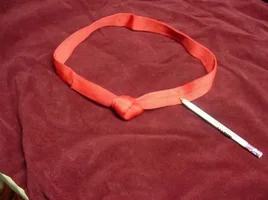
Beer knot Question?

Came across an interesting way to tie a beer knot in webbing on a rock climbing site. Can anyone think of reasons not to use this knot in rigging aps. One concern might be not being able to fully inspect the knot??? It consists of tying a loose overhand knot the feeding the webbing into itself 12 inches or more to form the loop. Then slide the overhand knot down over this section and pull tight. I have played with it a little and I like being able to keep my loops nice and neat but it is hard to really get a clean knot because the section that gets fed in gets bunchy and wont go completely flat. This might cause some strength issues in the knot? Any comments?
 

Attachments

  • 172439-beerknot.webp
    172439-beerknot.webp
    22.2 KB · Views: 186
I've used the BK in tubular webbing for a long time. After tieing it I tack the ends in place on my sewing machine. If the overlap milks or the tacking stitches tear I would know if the knot was slipping. After setting the BK securely I've never had one slip.

Read ON ROPE for strength issues. A purchased sling with proper machine made bar tacks will be stronger but costs more. Do a proper risk assessment to decide which path to take.
 
I think it is a really slick knot. The common alternative, the overhand follow-through, is known to undergo micro slippage under repeated loading and ultimately comes apart. I read somewhere that the beer knot behaves much better in that regard, but Tom's stitching method should completely remove slippage from the equation.

I once showed the BK to a friend of mine who belonged to a high-angle rescue team (they used slings tied with the overhand follow-through). She had never seen the BK before, but thought it was absolutely the bee's knees.
 
i tension min with a come a long lightly before use. i haven't had one slip yet. i use a coat hanger fid to "splice" mine together. tom and kathy's bar tacks sound like a good idea too.
 
you've had some get loose? possibly from the shock loading?
confused.gif
 
Just to clarify something...

A bar tack is a stitching that is done by an industrial machine. What you see on a sling may look like a set of concentrated zig zag stitches but they aren't. True bar tacks can only be made with a specific sewing machine.

What I do is add a couple of rows of plain stitching to tack or lock the tail in place. Mine have no relative strength but keep things in place under light loads.

A tack could be made by hand with a Speedy Stitcher too. the book ON ROPE has an excellent section on hand sewing gear.
 
[ QUOTE ]
I've had one get loose, it went from having about 9" of buried tail to 3". I couldn't tell you how or why. Definitely sew'em.

[/ QUOTE ]

1) In what material?

2) With what sort of loading/usage?

3) Did the UNburied end slip, at all?

Thanks!

(In the tests I'm familiar with, 1" tubular webbing tied in a Water Knot
did NOT exhibit the cyclical, low-load slippage that was seen in some
3/4"(?) solid, and some HMPE webbing. And none of them slipped after
being heavily loaded. AND it was the *exterior* end--only--that had
slippage.)

*kN*
 
A figure eight might work but have you tried to tie one like a beer knot?

I wonder if a buried F8 would be weaker because of the resulting odd bunching and turns.

Then, in the end, what would you call it? Do you know the story of how the beer knot was named? It replaced the water knot, and, what is better than water...??? Beer of course...!!!

True story :)
 
[ QUOTE ]
Do you know the story of how the beer knot was named? It replaced the water knot, and, what is better than water...??? Beer of course...!!!


[/ QUOTE ]
That's awesome.
 
[ QUOTE ]
[ QUOTE ]
Do you know the story of how the beer knot was named? It replaced the water knot, and, what is better than water...??? Beer of course...!!!


[/ QUOTE ]
That's awesome.

[/ QUOTE ]

I'll second that!!!
 
[ QUOTE ]
what if instead of tying an overhand knot you tied a figure of eight knot? would that help the slippage at all?

[/ QUOTE ]

The Fig.8 bend seems if anything less secure--i.e., in staying
tight when slack--than the Water knot; but it does enable one
to have the ends both interior, which might preclude the
cyclical slippage.

I asked about the nature of the use of the reported-slipped
Beer knot above, to try to understand what mechanism might
be at work in that--as there, unlike with the Water knot, it
was the interior end what was reported to have slipped (albeit
"interior" in a different, and more-deserving-of-that-term way!).
So, I'd like to know the answers to those questions.

What I've not seen proposed (or tested) is the Dble.Water Knot,
or maybe we should call it "Strangle Bend"--a dbl.overhand
traced like the single is in the Water knot.

What I have seen--in fact, discovered/designed myself--and have
had tested (3 breaks, of 6 knots, 9/16" tubular nylon climbing tape),
is a Symmetric Water Knot. In being symmetric, both ends are
made to lie interior, which presumably precludes the cyclical
slippage observed in some cases of the Water Knot. (That aspect,
however, has not been tested in any material, yet.)

-----
As for finding sewn slings cheaper than the raw material to tie
one's own, I'd like to see some quotes on that--webbing is typically
pretty cheap, and sewn slings NOT.

*kN*

 
Sorry I was thinking of the price for 2" webbing versus 1" sewn slings.

Sewn slings really aren't expensive though compared to a lot of other gear.

12" $2.90
24" $4.30
48" $6.75
 
[ QUOTE ]
I've had one get loose, it went from having about 9" of buried tail to 3". I couldn't tell you how or why. Definitely sew'em.

[/ QUOTE ]
Blinky, it would really be helpful to know:

1) In what material?

2) With what sort of loading/usage?

3) Did the UNburied end slip, at all?

*kN*
 

New threads New posts

Back
Top Bottom