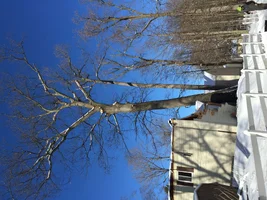
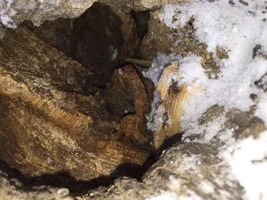
beech tree trunk colonization

There is a lot more going on with your tree than what you have stated.

First I do not believe that is hen of the woods (Grifola) but something else, I have never seen Grifola so bright yellow. It is likely another species (that I am not going to ID by poor photo) that is called a parasite and saprophyte causing cubical brown decay. If it is CBD this will not result in much indication of change in the tree (i.e. no bottleing).

Second the Ganoderma is small but it is in a column of deadwood that may (or may not) show extensive decay, more investigation is needed

Third between the first and second buttress roots to the right is another column of dead as evidenced by the vertical crack in the bark.

It appears to me that there is at least three columns of decay (that may have coalesced in the heart wood) on the compression side of the tree.

Fourth I would want to look closely to the tension side of the tree.
 
Why 2 climbers for that little tree? Not Z required.

3 hours total pruning time is generous. Natural crotch rigging of the one piece that might need it. Can't see anything hard about that tree, from here...

" It is likely another species (that I am not going to ID by poor photo) that is called a parasite and saprophyte causing cubical brown decay. If it is CBD this will not result in much indication of change in the tree (i.e. no bottleing)."

What makes that likely? O and if it is a saprophyte it cannot be a parasite, can it? And here's another TLA that conveys more understanding than exists; CBD??? Defect-centrism run amok.
 
Guy is once again spewing garbage. Guy you are absolutely right you cannot see anything. We don't know much about the tree or the situation except from a few photos and the descriptions of the OP.

Nobody has a true idea as to the extent of the defect or the extent of holding wood, this is one of the most basic things to investigate. Without a fungal ID we don't know if it is a lignin, cellulose, or sequential degrader or one that happens to posses (and use) lignin and cellulose degradative enzymes. Further we don't know if it is parasitic or not, let alone the rate of decay (aggression) of the fungi.

The OP asked for help, we can only point to things that need investigation to aid a judgement. If Baumeister wants to give his opinion without further investigation that is his right, if Baumeister wants to climb a 100 foot tree without a rescue climber on site and do the whole job in three hours that again is his right.

Baumeister if you have asked questions here then you need to clarify the situation with the decay pockets etc. and then make a judgement, do not accept that some hollow trees can stand as a answer for your situation. Generalities are fine but you owe it to yourself to learn more about this trees (and have more experience for next time), you owe it to your customer, and you even owe it to the tree.
 
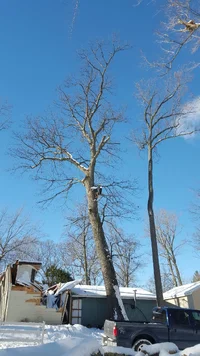
Thank you gentlemen. I hope we can all get along when we meet at a conference lol. As for the tree size, the pictures do it no justice. ( as always ). Guy, you are quite generous with you crew or you money. I applaud your optimism and your input. I appreciate your perspective on the reduction. I have no doubt this tree will need a reduction, however, my gut tells me there is more and that is why I posted this info.

I said earlier in this post my gut puts it at a low failure. I now know that I have to quantify what exactly that low failure looks like. I will go back to the site and reevaluate this tree, get definite ID on the fungus and hopefully talk the client Into some tomography.

I have walked away from many a tree saying they are "still strong" and have yet to get into trouble in my effort to "save trees. ". I have also warned clients about looming hazards that then did fail within short periods of time. My experience tells me this tree needs a very detailed inspection if I am going to retain it.
 
Good heavens, let's be nice. It's VERY good to honestly admit "We don't know much about the tree or the situation except from a few photos and the descriptions of the OP." :)
But then to leap out onto a very weak conceptual limb by stating opinions about what negative conditions aka defects are "likely" smells dishonest to my nose. Especially while omitting or downplaying positive indicators and possibilities.

In 49 years I have never specified a rescue climber being present, though a few times I was glad there was one. Shall we also require an ambulance idling in the driveway? Or maybe a helicopter? sometimes i have a groundy who climbs ok, often not.
No generosity involved in the 3-hour estimate; .5 to ascend, 2 to prune, .5 to descend and pack up. I seldom do cleanup, and on this tree there would be very little. If this tree's 100', I'm a millionaire with a foot-long hot dog.

It is certainly good to quantify more by direct inspection, starting with clearing the flare--Job 1! Use your boot--don't call for a Level III! Calling for the kitchen sink does not seem warranted. As much as I like doing tomography, it seems sufficient to say it will be much/less likely to fail after pruning.
The qualitative TRAQ approach is based on low risk tolerance. This leads us to "likely" speculations, with many flimsy assumptions and low/high guesses. Too far from the facts observed on site, and too convoluted for tree owners to follow.
On a tree like this (from our limited view), practice tree care. KISS, imo.
 
Last edited:
Oh, btw, went to get mushroom samples the other day and found this:
image.webp
image.webp

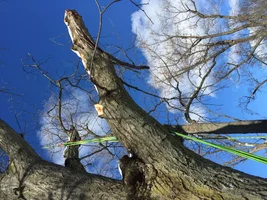
In the foreground you see snow covered logs barely visible. Above i mentioned an ash tree that had succumbed to eab. It went over onto the garage. Tree belonged to the neighbor. Broke out one limb on the oak. Here are more pics for those interested.
 
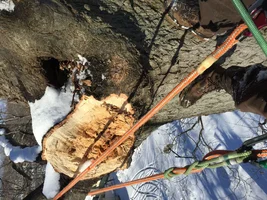
The oak limb torn off all the way to the trunk? Really?
What's the report on the wound?

That plus the additional exposure would change the pruning spec.

How do the conk samples look? Not sure how relevant ID on the lower one is (the one in the sinus was Ganoderma, right?).
 
The wound clearly indicates the decay of cellulose fibres. Tree limbs do not shear if there is no decay involved, intact cellulose will tear and hinge often leaving long toothpick/chopstick sized pieces as evidence.

Even when limbs pop out of sockets we expect to see torn fibres.
 
image.webp


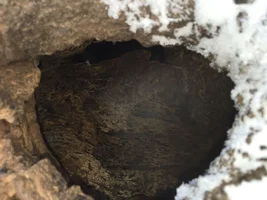
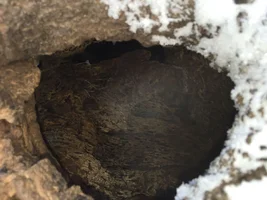
Not the best picture but a clean hollow up in the trunk. This is not the hole next to the fresh torn amputee. This is further down the trunk. If you look at the pic with me in the the tree i am at that hole.
image.webp image.webp
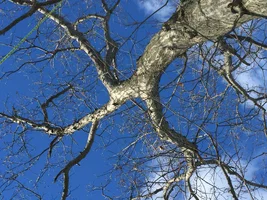
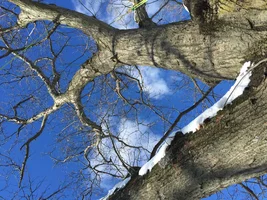
Some of the canopy
image.webp Well there you have a bunch of pictures to look at. I have to say I am apprehensive about posting pictures as this tree in particular needs to be seen in person.
 

Attachments

  • image.webp
    image.webp
    346.5 KB · Views: 1
The wound clearly indicates the decay of cellulose fibres. Tree limbs do not shear if there is no decay involved, intact cellulose will tear and hinge often leaving long toothpick/chopstick sized pieces as evidence.

Even when limbs pop out of sockets we expect to see torn fibres.
The ash tree came down on the garage and tore several limbs off the oak.
 
So you are finding more holes, more decay and what appears to be evidence of Osmoderma beetles. Add this to you investigation.
 
That limb was tore off by 4 tons of fraxinus. The limb was an epicormic shoot and therefor did not have a normal connection to the trunk. (Which can be seen in the way the break happened and by the placement of the limb on the trunk. Where do you see decay of cellulose fibers?
 
Trees break by splintering rather than shearing if wood is intact. The lack of splintering points to decay.

This is a pretty large shoot (what maybe 25 years old) and certainly has a normal connection to the trunk. While an adventitious shoot has no trace to the pith an epicormic will. In either case layers of xylem build over the years in a rather predictable and normal fashion.
 
Sorry I had my lingo wrong. I assumed the lack of splintering was due to an adventitious shoot. Thank you for correcting me. That to me does look like an adventitious shoot and I don't see how it could have a connection to the trunk having grown on wound wood. But ok, let's say you are right, what exactly are you inferring then. Active fungal activity in living tissue up there would certainly give me cause for pause.
 

New threads New posts

Back
Top Bottom