Beech Leaf Disease

This is just a subjective report (the science is beyond me) from SE Massachusetts on my hundred or so beech trees (the primary species). This assessment covers my property only as the surrounding areas do not include large beech populations. So, strangely, that might mean my yard, while a small subset, IS a good measure!

So, about the trees:
1. About 20% have died off to where I've started clearing small numbers of them.


View attachment 94595

2. About 20% keep their original leaves and seem to survive.

View attachment 94596

3. About 50% bring on a second set of leaves, notably different in color, shape, and size, and gathered in small clusters (all seeming methods of protection).

View attachment 94597

4. About 9% of those with the second set of leaves don't do especially well--but do not die.

5. The remaining 1% becomes furniture; the backrest is an old bed-slat.

(I'll report back on the bench's natural rot-resistance.)

View attachment 94594

Take care, all!
John
The leaves do not look like BLD. I think you have something else; but I'm not a disease expert.
 
This is just a subjective report (the science is beyond me) from SE Massachusetts on my hundred or so beech trees (the primary species). This assessment covers my property only as the surrounding areas do not include large beech populations. So, strangely, that might mean my yard, while a small subset, IS a good measure!

So, about the trees:
1. About 20% have died off to where I've started clearing small numbers of them.


View attachment 94595

2. About 20% keep their original leaves and seem to survive.

View attachment 94596

3. About 50% bring on a second set of leaves, notably different in color, shape, and size, and gathered in small clusters (all seeming methods of protection). These trees seem to hang in there, so far.

View attachment 94597

4. Another 9% push out the second set of leaves but don't do especially well. That said, they do not die.

5. The remaining 1% becomes furniture; the backrest is an old bed-slat.

(I'll report back on the bench's natural rot-resistance.)

View attachment 94594

Take care, all!
John
Alleopathy to the Beech, from the Red Oak in the direct overstory?

I agree with Tom, I don't really see the Banding on the Beech leaves.

I wonder what the Calcium % (tissue test would confirm this) is on those affected Beech leaves in your photo JCB?

Tannins from Oak (acids) can mobilize upper soil horizon Calcium, and it will move down faster....

I'm curious on this one......
 
  • Like
Reactions: ATH
Those thinning canopies look pretty classic to BLD. Possibly they are second flush and free of the banding, or maybe that happened the previous year resulting in thinner canopies but less symptomatic leaves.

I do believe we have collected samples that were positive for BLd with no banding. But don’t quote me on that.
 
Almost forgot...another email from Rainbow about a treatment protocol webinar.. Copied and pasted from email, I think those links will work.

Upcoming Webinar (2 Time Options):​

Systemic Beech Leaf Disease Management Protocol​

IMG_1167.jpg
Join Rainbow Ecoscience for an update on our systemic Beech Leaf Disease protocol. During this webinar we will unpack two years of research data and the results with Arbotect (Thiabendazole) injections. Another topic we will be covering is a refresher on macro-infusion best practices and we will close with an open Q&A session. ISA CEUs pending.
Option #1 - Mid-Day:
Jul 23, 2024
12:00 - 12:45 PM EST​
Option #2 - Evening:
Jul 23, 2024
6:30 - 7:15 PM EST​
 
Alleopathy to the Beech, from the Red Oak in the direct overstory?

I agree with Tom, I don't really see the Banding on the Beech leaves.

I wonder what the Calcium % (tissue test would confirm this) is on those affected Beech leaves in your photo JCB?

Tannins from Oak (acids) can mobilize upper soil horizon Calcium, and it will move down faster....

I'm curious on this one......

Thanks!

The veining and curling are very evident on the first set of leaves and remain so on many of the trees. This is easier to see in my post from 2022: https://www.treebuzz.com/forum/threads/beech-leaf-disease.33333/post-714132

The second set of leaves, as I described, are mutated in several ways, and the veining is less apparent to nonexistent.

As for the oak's effect, I have dying beeches (some of the best specimens) in areas with no oaks nearby. They'd all gotten along fine until recent years. But perhaps alleopathy takes place at a certain stage or age?

I'm certainly not disavowing/disputing your opinions, as I said I know very little to nothing.

And I appreciate your interest.

 
Thanks!

The veining and curling are very evident on the first set of leaves and remain so on many of the trees. This is easier to see in my post from 2022: https://www.treebuzz.com/forum/threads/beech-leaf-disease.33333/post-714132

The second set of leaves, as I described, are mutated in several ways, and the veining is less apparent to nonexistent.

As for the oak's effect, I have dying beeches (some of the best specimens) in areas with no oaks nearby. They'd all gotten along fine until recent years. But perhaps alleopathy takes place at a certain stage or age?

I'm certainly not disavowing/disputing your opinions, as I said I know very little to nothing.

And I appreciate your interest.
That is all 100% BLD. @JCB is showing the full range of leaf destruction, the leaf banding symptom is just the first round after the initial attack on the wintering over leaf buds. You're seeing the variety of responses to the bud nematode, all of the secondary effects, some of which are probably not documented and published online.
-AJ
 
That is all 100% BLD. @JCB is showing the full range of leaf destruction, the leaf banding symptom is just the first round after the initial attack on the wintering over leaf buds. You're seeing the variety of responses to the bud nematode, all of the secondary effects, some of which are probably not documented and published online.
-AJ
BLD symptoms look far less obvious this year in my area north of Boston. Anybody else notice this?
 
This is just a subjective report (the science is beyond me) from SE Massachusetts on my hundred or so beech trees (the primary species). This assessment covers my property only as the surrounding areas do not include large beech populations. So, strangely, that might mean my yard, while a small subset, IS a good measure!

So, about the trees:
1. About 20% have died off to where I've started clearing small numbers of them.


View attachment 94595

2. About 20% keep their original leaves and seem to survive.

View attachment 94596

3. About 50% bring on a second set of leaves, notably different in color, shape, and size, and gathered in small clusters (all seeming methods of protection). These trees seem to hang in there, so far.

View attachment 94597

4. Another 9% push out the second set of leaves but don't do especially well. That said, they do not die.

5. The remaining 1% becomes furniture; the backrest is an old bed-slat.

(I'll report back on the bench's natural rot-resistance.)

View attachment 94594

Take care, all!
John

Follow-up on untreated Beech-wood's rot resistance when exposed to weather: It has none.

The untreated wood developed black mold very quickly. I had to paint the bench to save it.
 
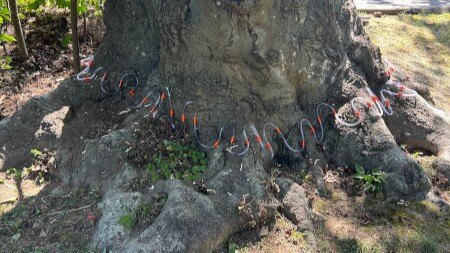
I had a known PHC company look at a large beech in a wooded area of my property. They recommended a pruning / thinning of the canopy to allow more light and air penetration. They also recommended Phosphite fertilizer be applied twice. No trunk injections available at this time and canopy spraying not feasible due to size and other trees in vicinity (it’s the woods). I’ve not heard before that the pruning would be beneficial, but, if that’s something being done, so be it. The pruning is something I can easily do myself. I know nothing about plant healthcare when it comes to chemicals and fertilizer though. I’ve always heard that soil should be tested before any type of fertilizer is applied. There was no soil test in this case. I know that tree receives water from septic systems and has large amounts of organic matter around the root zone. I’m just having a really hard time knowing how to proceed.
 
I had a known PHC company look at a large beech in a wooded area of my property. They recommended a pruning / thinning of the canopy to allow more light and air penetration. They also recommended Phosphite fertilizer be applied twice. No trunk injections available at this time and canopy spraying not feasible due to size and other trees in vicinity (it’s the woods). I’ve not heard before that the pruning would be beneficial, but, if that’s something being done, so be it. The pruning is something I can easily do myself. I know nothing about plant healthcare when it comes to chemicals and fertilizer though. I’ve always heard that soil should be tested before any type of fertilizer is applied. There was no soil test in this case. I know that tree receives water from septic systems and has large amounts of organic matter around the root zone. I’m just having a really hard time knowing how to proceed.
Look into Davey’s research in regards to Potassium Phosphite fertilizers for management of BLD. While you’re not actually treating the nematodes you will be strengthening the trees natural ability to be more robust and resistant to pests and diseases. It’s not a bad recommendation without a soil test in my opinion. Daveys data is compelling, but it’s not directly treating the nematodes like fluopyram or thiabendazole does.

I would hold off on any pruning aside from deadwood. The tree is going to need those resources. Thinning may make matters worse depending on severity. There is some anecdotal evidence that sheeting Beech is a form of BLD management but it’s not wildly accepted or recommended; just something a few of us have noticed. Otherwise there is no pruning being prescribed for BLD suppression/management that I’m aware of.

What state are you in?
 
  • Like
Reactions: ATH

New threads New posts

Kask Stihl NORTHEASTERN Arborists Wesspur TreeStuff.com Teufelberger Westminster X-Rigging Teufelberger
Back
Top Bottom