Beech Leaf Disease

Interesting...It looks like Ohio also has a Section 24(c) label for Arbotect as well.

What a quick Google search did not turn up was a study suggesting efficacy of thiabendazole for Beech leaf disease. With most labels, the product does not need to be effective against a specific pest to be listed...just not harmful to the environment if applied as described. However, it is my understanding that for 24(c) labels, the requesting locality needs to demonstrate that the "special need" is effectively addressed by the product and that special need is not well addressed by other products. Most of what I have seen suggests Phosphites provide the most promise...as of now. So that seems to fill the niche meaning a 24(c) label wouldn't be necessary. Not to sound too cynical, but do I smell a marketing push here?

Would be curious if anybody has resources showing it is effective against BLD.
I did some searching as well on Scholar, but I don't see anything posted as of yet in the way of a Study.

I too am always skeptical of new results and consider the Marketing angle as well ATH.

Still did not hear back from Rainbow on NY Labeling. Hopefully more approvals will happen soon, so we PHC professionals can manage this BLD issue, within our Urban Forests and Landscapes.

Stay tuned!
 
I did some searching as well on Scholar, but I don't see anything posted as of yet in the way of a Study.

I too am always skeptical of new results and consider the Marketing angle as well ATH.

Still did not hear back from Rainbow on NY Labeling. Hopefully more approvals will happen soon, so we PHC professionals can manage this BLD issue, within our Urban Forests and Landscapes.

Stay tuned!
Rainbow isn't shy about marketing....but in fairness, they do a lot of their own research and I don't think they push ineffective products. I'm wondering if they have some private research that hasn't hit public domain yet? I sent a note to local Rainbow rep. Got a quick reply - but it sounds like they haven't gotten their internal communications yet.
 
Got an email today from Growth Solutions advertising a product called Bio-SAR claiming to control BLD.


Anybody know anything about that product or the AI Chitosan being used?

@Basswood did any of the studies you were involved in do anything similar?
 
Got an email today from Growth Solutions advertising a product called Bio-SAR claiming to control BLD.


Anybody know anything about that product or the AI Chitosan being used?

@Basswood did any of the studies you were involved in do anything similar?
None that I have been on but I know it’s being looked at. No idea of it’s efficacy.
 
Wondering why Phosphites as a Basal Bark Spray can't be considered as an effective control when a soil drench is? I've been effectively applying Agrifos/Reliant as a Basal Bark application with great results dealing with Phytopthera.

Both techniques work as a stimulant correct? Basal spray is just way more cost effective .
 
Wondering why Phosphites as a Basal Bark Spray can't be considered as an effective control when a soil drench is? I've been effectively applying Agrifos/Reliant as a Basal Bark application with great results dealing with Phytopthera.

Both techniques work as a stimulant correct? Basal spray is just way more cost effective .
Good question... I wonder if it's a matter of what has been researched? They can only do so many things at once, it takes a few years to confidently report results and treatment research is pretty new.
 
I’m a little perplexed by the phosphite programs. Daveys research data is promising, although it was only done on small diameter trees (I think 7”?) and as far as I know those products don’t treat the nematodes themselves. You need ALOT of water to properly apply these products to the soil, so big trees become a problem.
 
Last edited:
Is anyone effectively treating BLD? I’ve heard about success with polyphosphite 30 applied as a soil drench. I’m not into PHC but have a beautifully massive beech on my property that I want to save from this damned nematode.
The Beech I care for are still "Clean" from BLD symptoms. Within a couple miles of these areas, BLD IS active. I have not gotten a call as of yet, to come out and have a look at a BLD Infested Beech.

What I will share is what I have been doing to the Beech under my care, and a suggestion to your Concern with your Old Growth Beech tree.

Phytophthora (bleeding canker) can be pretty bad in my area, and as an annual preventative , those Beech are all getting a Basal Bark Spray from the Ground up, to 5 - 6 feet up to the point of runoff, with Reliant mixed at 50% Reliant/50% water to point of runoff, out of a 2 Gallon Solo tank @ 20 PSI (Very coarse droplets) so no spray back on the applicator on a DRY day. (no sprinklers/irrigation can or should ever hit tree trunks)

I don't add pentra-bark, and the Reliant mix works/penetrates just fine without it. A Gallon of the mentioned "finished mix" gets (me) about 80 DBH, and Triggers the plants defense/immune response I.S.R. (induced systemic resistance)

The timing of when I do it is around Late June/Early July when the soil temps are above 65F and the Phytophthora zoospores can be active, when wetter conditions are right for the host Beech to get infected.

"Perhaps" this timing coincides with the BLD causing Nematode, AND IS the nematode being suppressed by the ISR response, and the persistence of the (Reliant) potassium phosphite in the vascular system of the treated tree.???

I have the idea the potasium phosphite lasts a while, as I fall micro-inject Sycamore trunks with Reliant, for the following Spring season's Anthracnose potential (as an example) and that works well too.

So perhaps a Basal Bark Spray to your Old Growth Beech in July.........

Keep in mind also Treeaddict, that your Beech will not die after the 1st season of a BLD infection alone (from all I have read) and consider that IF potassium phosphite does not give you the results of a healthy Beech, you will have another option, of a MACRO INJECTION of Arbotect 20-S (IF Labeled for use in your State) and that Syngenta product is proven for 2 year protection of BLD.

Don't panic just yet, keep and eye on the beauty and Consider a Basal Bark Spray of Potassium Phosphite for Plant Health.

Pieter
 
The Beech I care for are still "Clean" from BLD symptoms. Within a couple miles of these areas, BLD IS active. I have not gotten a call as of yet, to come out and have a look at a BLD Infested Beech.

What I will share is what I have been doing to the Beech under my care, and a suggestion to your Concern with your Old Growth Beech tree.

Phytophthora (bleeding canker) can be pretty bad in my area, and as an annual preventative , those Beech are all getting a Basal Bark Spray from the Ground up, to 5 - 6 feet up to the point of runoff, with Reliant mixed at 50% Reliant/50% water to point of runoff, out of a 2 Gallon Solo tank @ 20 PSI (Very coarse droplets) so no spray back on the applicator on a DRY day. (no sprinklers/irrigation can or should ever hit tree trunks)

I don't add pentra-bark, and the Reliant mix works/penetrates just fine without it. A Gallon of the mentioned "finished mix" gets (me) about 80 DBH, and Triggers the plants defense/immune response I.S.R. (induced systemic resistance)

The timing of when I do it is around Late June/Early July when the soil temps are above 65F and the Phytophthora zoospores can be active, when wetter conditions are right for the host Beech to get infected.

"Perhaps" this timing coincides with the BLD causing Nematode, AND IS the nematode being suppressed by the ISR response, and the persistence of the (Reliant) potassium phosphite in the vascular system of the treated tree.???

I have the idea the potasium phosphite lasts a while, as I fall micro-inject Sycamore trunks with Reliant, for the following Spring season's Anthracnose potential (as an example) and that works well too.

So perhaps a Basal Bark Spray to your Old Growth Beech in July.........

Keep in mind also Treeaddict, that your Beech will not die after the 1st season of a BLD infection alone (from all I have read) and consider that IF potassium phosphite does not give you the results of a healthy Beech, you will have another option, of a MACRO INJECTION of Arbotect 20-S (IF Labeled for use in your State) and that Syngenta product is proven for 2 year protection of BLD.

Don't panic just yet, keep and eye on the beauty and Consider a Basal Bark Spray of Potassium Phosphite for Plant Health.

Pieter
Thank you for your detailed response. I’m glad to see the beech’s you’re treating are holding up well. Now would be the time for Potassium phosphite application based on your soil temp advice. I am glad that it’s not a “1 season death sentence”. It’s crazy how fast it spread though. Our neighborhood and nearly every beech, deep into biking trails in several state parks, are infected. Last year, nothing. This year, everything. That’s a lot of spread happening very quickly considering how the nematode is basically immobile on its own.
 
Rainbow did a webinar update on treatment research. Worth a watch/listen (I just listened while planting trees that day. Paused once or twice to take a screenshot to have the info easier).

Excellent ! Thank You for Posting !

Nematodes are now accepted as at least a major contributor to BLD.
Are there any other potential suspects being investigated ?
 
Thank you for your detailed response. I’m glad to see the beech’s you’re treating are holding up well. Now would be the time for Potassium phosphite application based on your soil temp advice. I am glad that it’s not a “1 season death sentence”. It’s crazy how fast it spread though. Our neighborhood and nearly every beech, deep into biking trails in several state parks, are infected. Last year, nothing. This year, everything. That’s a lot of spread happening very quickly considering how the nematode is basically immobile on its own.
I agree that it's quite amazing how crazy fast it appears, in parks I have walked through...One spring leaf out season clean, and the next BOOM!!! BLD.

The Video that ATH shared is quite valuable, and brings a lot to the current Table for BMP's with BLD. Thanks for sharing that ATH!

It's worth considering the Reliant Bark Basal Spray Treeaddict, in the coming weeks and observe 2025 leaf out on the Big Beech and note any changes.

IF in fact you do not see any reduction in the leaf pattern from BLD, Plan on a Macro Injection with Arbotect 20-S at the higher rate of application.
 
Be careful with the highest rates and phytotoxicity, for us it’s untested. Seeing good results 1.6 Oz per inch of DBH so no need to risk it or use more product right now.
Understood Basswood. Thanks for sharing that.

This is from the NY label on the Arbotect 20-S

"For each 5 inches of trunk diameter, inject 2-8 fl oz of Arbotect 20-S. (One-part Arbotect 20-S should be diluted with between 16 and 32 parts water). For large trees, inject up to 12 fl oz of Arbotect 20-S per 5 inches of trunk diameter."

So you are saying that even with the LARGE trees stick with the 1.6oz per DBH to avoid Phyto?

10-4 :)
 
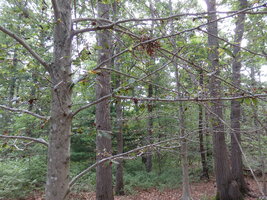
This is just a subjective report (the science is beyond me) from SE Massachusetts on my hundred or so beech trees (the primary species). This assessment covers my property only as the surrounding areas do not include large beech populations. So, strangely, that might mean my yard, while a small subset, IS a good measure!

So, about the trees:
1. About 20% have died off to where I've started clearing small numbers of them.


die.JPG

2. About 20% keep their original leaves and seem to survive.

living.JPG

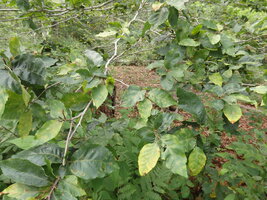
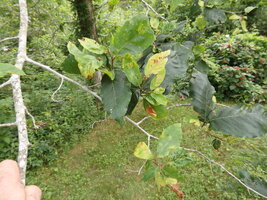
3. About 50% bring on a second set of leaves, notably different in color, shape, and size, and gathered in small clusters (all seeming methods of protection). These trees seem to hang in there, so far.

2ndset.JPG

4. Another 9% push out the second set of leaves but don't do especially well. That said, they do not die.

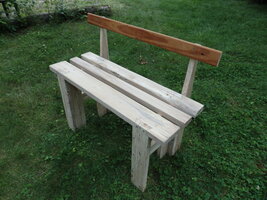
5. The remaining 1% becomes furniture; the backrest is an old bed-slat.

(I'll report back on the bench's natural rot-resistance.)

P7150001.JPG

Take care, all!
John
 
Last edited:

New threads New posts

Kask Stihl NORTHEASTERN Arborists Wesspur TreeStuff.com Teufelberger Westminster X-Rigging Teufelberger
Back
Top Bottom