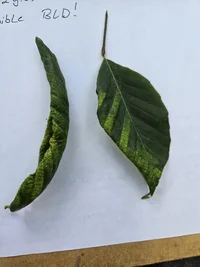
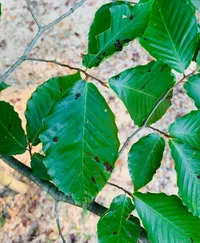
Beech Leaf Disease

I just inspected a relatively young 18" DBH Fagus sylvatica in Boston. Last year it was becoming symptomatic throughout the crown. This year it looks better, many less leaves affected. I'm wondering if the hard cold snap January into March 2025 caused nematode mortality? Or is this another cycle? This was not second flush.
-AJ
Did you check for injection sites? Or was treated with the foliar option?
 
Did you check for injection sites? Or was treated with the foliar option?
Tree has not been treated, property owner doesn’t spend money on trees. I used to live in the building where the tree is. Watched it grow from a small tree for 40 years ;-) Landlord at the time wanted to cut it down when it was 6” caliper, I convinced him not to, it outlived him.
-AJ
 
Tree has not been treated, property owner doesn’t spend money on trees. I used to live in the building where the tree is. Watched it grow from a small tree for 40 years ;-) Landlord at the time wanted to cut it down when it was 6” caliper, I convinced him not to, it outlived him.
-AJ
Interesting. Not sure then if it’s not from second flush or treatment. It’s possible id imagine disease severity can ebb and flow depending on the trees reserves and ability to fend off disease pressure. Maybe there is a factor environmentally that effects viability of nematodes like last years drought?
 
Interesting. Not sure then if it’s not from second flush or treatment. It’s possible id imagine disease severity can ebb and flow depending on the trees reserves and ability to fend off disease pressure. Maybe there is a factor environmentally that effects viability of nematodes like last years drought?
That could be. Tree looked good last year except for the leaves looking further advanced with BLD than this year. Maybe other New England arb workers have also noticed a little bounce back in untreated trees in forest settings or untreated landscape trees. This would be trees that were in the first year or two of symptoms, not already 2 years+ defoliation and second flush response. It's probably a symptomatic niche of no consequence, interesting though.
-AJ
 
Just on observation for me in NE Ohio:

I first saw BLD on my property in June 1916. (Geauga County)
It was first observed in 1912 on an adjacent county (Lake county)
I have posted several times that there are "good" years & "bad" years for the beech.

This is BY FAR the worst for my the Beech on my 12 acres of woods. :(
 
Last edited:
Just on observation for me in NE Ohio:

I first saw BLD on my property in June 1916. (Geauga County)
It was first observed in 1912 on an adjacent county (Lake county)
I have posted several times that there are "good" years & "bad" years for the beech.

This is BY FAR the worst for my the Beech on my 12 acres of woods. :(
You first saw it in 1916? How old are you by now? You might be the oldest living person, and I’m impressed by your mental fitness at your age!
 
Lots of typo's; sorry !
BLD found in 2012.
Found mine in 2016.
only 76 old. Is that an excuse ?
:)
That’s what I was guessing, but I had to kid you a bit. I didn’t realize you were 76, good for you! That’s not old though, keep cooking and stay young!
 
Are you droughty there @GregManning ? It's pretty dry most areas here...but I was in a nearby town today and all the lawns were bright green (not the kinda place everyone waters...), so it's amazing how spotty it can be sometimes.
 

New threads New posts

Kask Stihl NORTHEASTERN Arborists Wesspur TreeStuff.com Teufelberger Westminster X-Rigging Teufelberger
Back
Top Bottom