Beech Leaf Disease

Look into Davey’s research in regards to Potassium Phosphite fertilizers for management of BLD. While you’re not actually treating the nematodes you will be strengthening the trees natural ability to be more robust and resistant to pests and diseases. It’s not a bad recommendation without a soil test in my opinion. Daveys data is compelling, but it’s not directly treating the nematodes like fluopyram or thiabendazole does.

I would hold off on any pruning aside from deadwood. The tree is going to need those resources. Thinning may make matters worse depending on severity. There is some anecdotal evidence that sheeting Beech is a form of BLD management but it’s not wildly accepted or recommended; just something a few of us have noticed. Otherwise there is no pruning being prescribed for BLD suppression/management that I’m aware of.

What state are you in?
I’m in Maryland. Yeah, I agree that pruning didn’t strike me as prudent. The tree will have enough trouble trying to feed itself, so I don’t see why further limiting its food source would be advantageous. Google searching did reveal that some sources are recommending pruning, but I really don’t like that idea.
 
  • Like
Reactions: ATH
I’m in Maryland. Yeah, I agree that pruning didn’t strike me as prudent. The tree will have enough trouble trying to feed itself, so I don’t see why further limiting its food source would be advantageous. Google searching did reveal that some sources are recommending pruning, but I really don’t like that idea.
Injections are legal in MD. Find yourself a company that can do macro injections and have it scheduled from full leaf expansion to end of July. Any later and you see reduced efficacy.

MD SLN label:
 
Great news. They said they were working with the state to get something approved. Glad to see it’s available. Thank you!!!!

Is there no freedom to use off label?
 
I had a known PHC company look at a large beech in a wooded area of my property. They recommended a pruning / thinning of the canopy to allow more light and air penetration. They also recommended Phosphite fertilizer be applied twice. No trunk injections available at this time and canopy spraying not feasible due to size and other trees in vicinity (it’s the woods). I’ve not heard before that the pruning would be beneficial, but, if that’s something being done, so be it. The pruning is something I can easily do myself. I know nothing about plant healthcare when it comes to chemicals and fertilizer though. I’ve always heard that soil should be tested before any type of fertilizer is applied. There was no soil test in this case. I know that tree receives water from septic systems and has large amounts of organic matter around the root zone. I’m just having a really hard time knowing how to proceed.
Do a soil test and report back for advice
 
Great news. They said they were working with the state to get something approved. Glad to see it’s available. Thank you!!!!

Is there no freedom to use off label?
First thing you learn in pesticide class "the label is the law". If it's not on the label, no...you cannot. Especially as a commercial applicator.

For example: people want to use vinegar to kill weeds (let's argue about that efficacy in another thread). If you hired me to kill your weeds, it would be illegal for me to get regular vinegar from the kitchen and spray weeds with it. It has to be labeled for that use (there is horticultural vinegar for that purpose).

So, that Rainbow product isn't labeled for beech leaf disease (because it didn't exist when the labeled the product, and research showing it works is new (they had special permission to use it for research)). However, the special use label is approved state-by-state making it allowable in a specific circumstance. Reason: changing the label is a major event. This is a temporary approval while the wheels are set in motion if it is decided that change is a good idea. The EPA has determined minimal threat is posed in the short-term while that is happening. They could still decide to refuse the permanent label. So when they issue that special use, it is allowable ONLY in the state where the Section 24(c) label has been issued You could have a state surrounded by approved states, and it is not legal in that state if there isn't a special use label approved.

Sounds burdensome...but it's to protect from unrestricted release of pesticides into the environment.

 
First thing you learn in pesticide class "the label is the law". If it's not on the label, no...you cannot. Especially as a commercial applicator.

For example: people want to use vinegar to kill weeds (let's argue about that efficacy in another thread). If you hired me to kill your weeds, it would be illegal for me to get regular vinegar from the kitchen and spray weeds with it. It has to be labeled for that use (there is horticultural vinegar for that purpose).

So, that Rainbow product isn't labeled for beech leaf disease (because it didn't exist when the labeled the product, and research showing it works is new (they had special permission to use it for research)). However, the special use label is approved state-by-state making it allowable in a specific circumstance. Reason: changing the label is a major event. This is a temporary approval while the wheels are set in motion if it is decided that change is a good idea. The EPA has determined minimal threat is posed in the short-term while that is happening. They could still decide to refuse the permanent label. So when they issue that special use, it is allowable ONLY in the state where the Section 24(c) label has been issued You could have a state surrounded by approved states, and it is not legal in that state if there isn't a special use label approved.

Sounds burdensome...but it's to protect from unrestricted release of pesticides into the environment.
Thank you for the thorough explanation! Hopefully approval will be swift to prevent loss. Maryland is one of those highly regulated states though so we’ll see. Kind of a shame that an intelligent and proficient applicator is so restricted as it could stifle innovation. I understand the point of environmental concerns though.
 
Thank you for the thorough explanation! Hopefully approval will be swift to prevent loss. Maryland is one of those highly regulated states though so we’ll see. Kind of a shame that an intelligent and proficient applicator is so restricted as it could stifle innovation. I understand the point of environmental concerns though.
Treeaddict,


As a PHC Specialist, in your situation I would suggest the Potassium Phosphite drenches 2x per season in the meantime....Don't just do nothing.

Here is a Link you may find useful with Info how you can apply/method/proper rate per D.B.H, without a Pesticide license yourself.

PolyPhosphite 30 has no EPA Reg. number.


A boost for your Beech.
 
Just to clarify, a commercial applicator CAN currently apply Arbotect in Maryland to control beach leaf disease. That is the 24 (c) label that @Basswood linked above. You may have already understood that, but I wanted to make sure you're aware that that is a viable option at this point.
 
Just to clarify, a commercial applicator CAN currently apply Arbotect in Maryland to control beach leaf disease. That is the 24 (c) label that @Basswood linked above. You may have already understood that, but I wanted to make sure you're aware that that is a viable option at this point.
I did not know that. The company I consulted told me that they were working with the state of Maryland on a substance for trunk injection. They did not say what that substance was though. I will probably call them to discuss further or possibly talk to the competitor.
 
  • Like
Reactions: ATH
I did not know that. The company I consulted told me that they were working with the state of Maryland on a substance for trunk injection. They did not say what that substance was though. I will probably call them to discuss further or possibly talk to the competitor.
I would be hesitant to use a company unaware that it is currently in use in MD. Macro injection is a bit of a “lost art” and not many companies do it right.
 
Pretty good study on efficacy of Arbortect 20-S to control BLD, in the newest copy of Arboriculture and Urban Forestry. Sounds like it’s a pretty good option.
There’s a discrepancy in the results based on timing of treatment as well- the treatments applied on Aug 7 and July 11 performed better than those applied Aug 30- they think it’s likely because that’s prior to the peak of Lcm dispersion. It didn’t stop dieback completely even in its best trials, but did significantly reduce it in some cares.

I don’t have any experience with BLD here but I’m anticipating it will arrive at some point, so trying to understand it better.

 
Basswood,

Do you have an Opinion on using a Potassium Phosphite (Reliant, ect) at the bark spray rate, onto the Macro Injection HOLE sites directly after Macro injecting Arbotect-20, During that warmer Phytophthora (Bleeding Canker) period as a Best Management Practice?
 
Basswood,

Do you have an Opinion on using a Potassium Phosphite (Reliant, ect) at the bark spray rate, onto the Macro Injection HOLE sites directly after Macro injecting Arbotect-20, During that warmer Phytophthora (Bleeding Canker) period as a Best Management Practice?
We don’t do it and don’t see the need. The bleeding from injection sites we often see is more bacterial or more along the lines of bleeding similar to pruning certain species in the spring. I’m pretty sure we have sampled the bleeding and confirmed it’s not Phytophthora. I prefer to, and train people to inject on the sides of the root flares and even uncovering the root collars even further to inject as low as possible. That’s seemed to really curtail the bleeding and cracking.

As far as those being an entry point for pathogens that’s always a risk when making injections and we need to do thorough inspections of trees before recommending them as a good candidate for injection. And then weigh the risk vs reward based on that assessment.
 
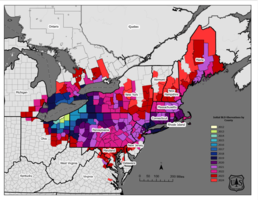
beech leaf disease progression 2025 map of north America

As I have stated previously, my Beech cycle each year between "getting better/ stable" to "getting worse".
This year they are the WORST ever in NE Ohio, since I observed it in 2014.

1749394606749.png
 
Last edited:
What a wild disease. It has affected the beech here incredibly fast, we also have beech bark disease so mortality may be worse. Id'd it '23 so early days still.
 
I wonder if the ebb and flow some are noticing is related to beech aborting severely affected leaves and putting out the second flush which is fairly common in the advanced stage. And I wonder further if that second flush temporarily decreases the nematode populations as a result.
 
Last edited:
I wonder if the ebb and flow some are noticing is related to beech aborting severely affected leaves and putting out the second flush which is fairly common in the advanced stage. And I wonder further if that second flush temporarily decreases the nematode populations as a result.
Not second flush, in my experience. In most years the leaves of mature tree don't fall. Infant trees just die.
 
I wonder if the ebb and flow some are noticing is related to beech aborting severely affected leaves and putting out the second flush which is fairly common in the advanced stage. And I wonder further if that second flush temporarily decreases the nematode populations as a result.
I just inspected a relatively young 18" DBH Fagus sylvatica in Boston. Last year it was becoming symptomatic throughout the crown. This year it looks better, many less leaves affected. I'm wondering if the hard cold snap January into March 2025 caused nematode mortality? Or is this another cycle? This was not second flush.
-AJ
 

New threads New posts

Kask Stihl NORTHEASTERN Arborists Wesspur TreeStuff.com Teufelberger Westminster X-Rigging Teufelberger
Back
Top Bottom