Basic Flaws in Mr. Rigguy's Cabling Design

Re: Basic Flaws in Mr. Rigguy\'s Cabling Design

now, most of the old cables were way too low in the tree for todays standards.

two or three were up higher, almost where they should be.

One was a rusted old thing.

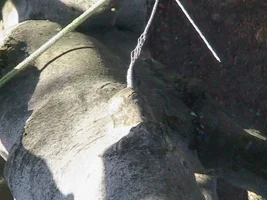
Another was a newer, galvanized common grade cable. It was still old enough, that the eye had been grown over. and guess what? it was broken, right at the point it was going in the wood. this picture shows a little bit, see the hanging end?
 

Attachments

  • 168835-ObeechOldCableGrowth4.webp
    168835-ObeechOldCableGrowth4.webp
    99.6 KB · Views: 64
Re: Basic Flaws in Mr. Rigguy\'s Cabling Design

Another cool pic Xman!

If that is the opposite cable termination to the tree udder pic with the cable in it, then the original cabler was smart to leave that much eyebolt sticking out to escape being encapsulated like it's partner was on the other end. As long as the alignment is true, leaving excessive eyebolt allows sideloading to be sbsorbed at the thimble eyebolt ring longer, rather than transferring those forces onto the cable itself once encapsulated in new wood.

That would have been an interesting tree to dissect and make cross sections of the cabled wood out of Xman, great pics, keep em comin buddy.

Was there a thimble on that eyebolt in the pic prior to you cutting it off the tree? Cable attachments without thimbles will eat through a cable far faster.

jomoco
 
Re: Basic Flaws in Mr. Rigguy\'s Cabling Design

another really old one rusted away.

this was the only one that hadn't callused over the hardware well.

this beech had cankers all over it and many looked like they have been there for 50, 75 or more years. Well, i guess this one hardware site got infected with the same fungi. perhaps as it tried to grow over the eye, the movement kept damaging the tissue.

so, see the mushroom shaped odd callus.

cable is simply rusted away right down the middle. this one was up higher in the tree.
 

Attachments

  • 168837-rustedawayandcanker.webp
    168837-rustedawayandcanker.webp
    121 KB · Views: 50
Re: Basic Flaws in Mr. Rigguy\'s Cabling Design

[ QUOTE ]
now, most of the old cables were way too low in the tree for todays standards.


[/ QUOTE ]

In a tree that old, you can bet that at the time the original cables were installed, they were bingo on the button at 3/4's out on each leader, but after 20-30 years go by, that distance out now only represents 1/4 of the overall leader.

I see this alot in old trees with old cables myself.

Have you seen my cabling alignment tubes Xman?

http://www.youtube.com/watch?v=DNy6SdUFdEk

jomoco
 
Re: Basic Flaws in Mr. Rigguy\'s Cabling Design

[ QUOTE ]
Another cool pic Xman!

If that is the opposite cable termination to the tree udder pic with the cable in it, then the original cabler was smart to leave that much eyebolt sticking out to escape being encapsulated like it's partner was on the other end. As long as the alignment is true, leaving excessive eyebolt allows sideloading to be sbsorbed at the thimble eyebolt ring longer, rather than transferring those forces onto the cable itself once encapsulated in new wood.

jomoco

[/ QUOTE ]

i guyed a big oak in maybe 2002 or 03 and posted the pictures on the buzz. As a new guy on the buzz, i got slammed for leaving the 3/4" rods long and not having the amon eyes up against the wood. this was a 3 to 4 foot diameter oak that wasn't moving in the wind, just potentially uprooting and falling into a river. i was told in short that i had no idea what i was doing and i was going to metal fatigue those rods like that.
Looking back on it, they were a little too long for looks anyway, but yes, i think we should not want the eye to be callused over quickly.
 
Re: Basic Flaws in Mr. Rigguy\'s Cabling Design

[/ QUOTE ]

In a tree that old, you can bet that at the time the original cables were installed, they were bingo on the button at 3/4's out on each leader, but after 20-30 years go by, that distance out now only represents 1/4 of the overall leader.


[/ QUOTE ] exactly. most of these would have been close to right on in their day, of a smaller tree. the only one I remember doubting was a really low one.

BTW, most of these cables were for v crotches in the main trunk.
 

Attachments

  • 168840-ObeechKboomCable.gif
    168840-ObeechKboomCable.gif
    148.8 KB · Views: 40
Re: Basic Flaws in Mr. Rigguy\'s Cabling Design

[ QUOTE ]


That would have been an interesting tree to dissect and make cross sections of the cabled wood out of Xman, great pics, keep em comin buddy.


jomoco

[/ QUOTE ]

We will likely be taking it down and I will dissect, (and likely sacrifice some saw chain) and get some good pictures.

[ QUOTE ]
Was there a thimble on that eyebolt in the pic prior to you cutting it off the tree? Cable attachments without thimbles will eat through a cable far faster.


[/ QUOTE ] none was hanging on that eye, but the feeling i have about the previous arborist (after seeing the remnants of his work) was that he would have been the kind of guy to put in thimbles. we will find out if i get to dissect the other stuff.
 
Re: Basic Flaws in Mr. Rigguy\'s Cabling Design

[ QUOTE ]


Have you seen my cabling alignment tubes Xman?

http://www.youtube.com/watch?v=DNy6SdUFdEk

jomoco

[/ QUOTE ]

awesome! great idea.

you know, part of being a business owner and always competing against other companies, makes me not want to share everthing that i know or do. But when i learn something on the buzz i feel like i should then give something too.

I like that alignment tube idea.

But here is mine that I had thought up a while back.

mount a green laser on the drill, modify the button so you can click it and keep it on. While drilling, the laser points in the opposite direction and you keep it lined up on the intended location for the other anchor point.

on that big oak guy job, i simply used rope stretched tight to give me an idea on the correct drill angle.
 
Re: Basic Flaws in Mr. Rigguy\'s Cabling Design

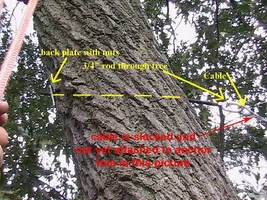
i dug up a picture of that oak that i guyed years ago, here is a picture of one of the rods through the tree.

the buzzers at that time tore me up, at least in my mind they did. i was trying to show something that i was proud of and they torn it apart. hmmmm, kinda like i did to family tree huh. hmmm, sorry FamilyTree. It's like the beaten abused kid grows up to be abusive himself.
bangtard.gif


i'm choosing to show one of the better pictures, the other rods were actaully longer looking...
crazy.gif


like i said, that was in 2002 or 2003 i think.

Looking back, i don't mind the long rods as i do not believe they are being fatigued as they are pretty much in line with the cables and that tree simply does not seem to move.

Looking back, i don't know if i like the big steel plates. At the time, I was worried the washers and nuts might get pulled through the tree with such a heavy tree. I think the steel plates might kill too much cambium. I checked on it last summer, things looked good. There was oozing from around the plates on the anchor trees.
 

Attachments

  • 168843-oldguyingjob.webp
    168843-oldguyingjob.webp
    302.8 KB · Views: 62
Re: Basic Flaws in Mr. Rigguy\'s Cabling Design

Having the eye nut snugged up against the tree is the proper installation method. This practice doesn't come from arborculture. This is the way that machine assemblies are designed.

If there is movement expected the rotation will take place at the eye where there is a u'joint type connection. Go back to the original post in this thread. The concern is that the individual strands will be cycled to failure like a paper clip/coat hanger. Having the through bolt is no different but now all you have is one strand.

Threaded rod is NOT meant to have side loads. It's designed to be loaded length wise. In fact, if the engineering is worked through the whole cabling system we'd find that the threaded rod that we use is the weak link in the system. Not that the sizing is TOO weak though.

After dissecting old cable installs I have a much better idea of how trees react to proper and improper installations. I took every old install and cut the anchor portion short. I made sure that there wasn't any decayed wood showing on the end of the cut. Then I would align a splitting wedge with the hardware to split it open. The split line would align with the threads of the lag or the rod. BUT!!! On every sample I split I found that the new wood that grew around the hook/eye/splice split in a way that reminded me of a branch collar. The wood stuck together nicely.

The pics of all of this stuff is buried in boxes :(
 
Re: Basic Flaws in Mr. Rigguy\'s Cabling Design

[ QUOTE ]
On every sample I split I found that the new wood that grew around the hook/eye/splice split in a way that reminded me of a branch collar. The wood stuck together nicely.

[/ QUOTE ]I've noticed this too, in most cases. Some trees that were low on vitality did not react that well, when the holes were drilled at internodes.

That's why I now install them at nodes, because that's where the branch protection zone with phenols and callus ready to codit.

concern about cambial death by big washers or plates can be abated by countersinking into the bark, so the cambium can start spreading over the fastener sooner.
 
Re: Basic Flaws in Mr. Rigguy\'s Cabling Design

"concern about cambial death by big washers or plates can be abated by countersinking into the bark, so the cambium can start spreading over the fastener sooner."

Guy, I thought this practice was recommended against several years ago through evidence of more advanced decay from countersinking... Enlighten if I am wrong?

-Tom
 
Re: Basic Flaws in Mr. Rigguy\'s Cabling Design

Counter sinking right to the cambium layer has yielded fantastic results with quick wound coverage for me literally hundreds of times.

Not doing so would screw up the cable tension enough to slacken the cable just enough to get the dreaded jackhammer effect in wind events in my opinion.

jomoco
 
Re: Basic Flaws in Mr. Rigguy\'s Cabling Design

[ QUOTE ]
Having the eye nut snugged up against the tree is the proper installation method. This practice doesn't come from arborculture. This is the way that machine assemblies are designed.

If there is movement expected the rotation will take place at the eye where there is a u'joint type connection. Go back to the original post in this thread. The concern is that the individual strands will be cycled to failure like a paper clip/coat hanger. Having the through bolt is no different but now all you have is one strand.

Threaded rod is NOT meant to have side loads. It's designed to be loaded length wise. In fact, if the engineering is worked through the whole cabling system we'd find that the threaded rod that we use is the weak link in the system. Not that the sizing is TOO weak though.
(

[/ QUOTE ]

Which is why I prefer the Chicago drop forged galvinized steel eyebolts in all my cabling, including rodding splits together, they are far more durable and corrosion resistant than any all thread rodding in my experience cabling.

Maintaining the flex junction at the thimble and eye for as long as possible increases the durability/longevity of cabled branches and leaders in my opinion.

jomoco
 
Re: Basic Flaws in Mr. Rigguy\'s Cabling Design

[ QUOTE ]
Chris,
Do you take the Cobra specs to mean no use on ANY inclusions? I thought it was appropriate for supporting unions with included bark that showed no sign of structural failure like cracking or weeping and stuff.


[/ QUOTE ]

I thought that all dynamic cable was innappropriate for inclusions...but, I'm not taking a position either way. I'm just asking.
 
Re: Basic Flaws in Mr. Rigguy\'s Cabling Design

[ QUOTE ]


[/ QUOTE ]
"I believe these Rigguy newfangled wirestop systems have a fatal engineering flaw that will result in a recall and replacement of their ill thoughtout venture into the realm of professional cabling."
jomoco

[/ QUOTE ]


Do you have any idea who developed this system?

[/ QUOTE ]

Jomoco, I talked to Steve at Rigguy today and asked him about this concern. He said they did a test with a through lag at one end and a wire stop at the other. The system wasput in a back and forth motion in 8 second intervals. He said after 16,682 jolts the through bolt finally broke and the wire stop had no ware at all. He claimed even if you didnt have it lined up right that it still would not lose any strength. Now dont quote me but this is what he said. I found that worthy of posting on the thread. Take it how you may, I ordered 50 more sets.
Has anyone heard of varmits in trees chewing on cobra systems? It has been coming up at work, just thought I maight ask....
 
Re: Basic Flaws in Mr. Rigguy\'s Cabling Design

I may use dynamic cables in a situation where I think the tree may benefit from moderate movement, even in the presence of inclusions. There are some situations that it may be good to allow the tree to continue developing healthy reaction wood, even in the presence of weakness or decay at the union.
 
Re: Basic Flaws in Mr. Rigguy\'s Cabling Design

[ QUOTE ]


But here is mine that I had thought up a while back.

mount a green laser on the drill, modify the button so you can click it and keep it on. While drilling, the laser points in the opposite direction and you keep it lined up on the intended location for the other anchor point.

on that big oak guy job, i simply used rope stretched tight to give me an idea on the correct drill angle.

[/ QUOTE ]

It's a good idea Xman.

It's funny because I was kinda arguing with JPS at AS about your idea when the cabling alignment tubes idea popped into my head.

The problem I see with the green laser idea is that to be successful the first hole drilled has to be perfectly aligned to the other target branch in order for the laser to hit the other branch from that first hole.

And getting perfect alignment by eye is next to impossible.

Even using the alignment tubes was problematic until I figured out that the pilot drill bit had to be a triangular flat bit with a needle sharp point in order to avoid drill bit deflection at acute angles throwing the alignment out of whack.

This is the modified wood drill bit that solved my acute angle deflection problem.

DSCI0026.jpg


My last 3 cabling jobs have the most perfectly aligned cables that I've ever achieved in my entire cabling experience.

jomoco
 
Re: Basic Flaws in Mr. Rigguy\'s Cabling Design

Cabling and bracing, for me, boils down to:

Any sort of cabling is better than none.
An adequate installation is more important than a perfect installation if the perfect installation is beyond the abilities of the installer.

There is a post oak right out the back door of the place that I'm renting that is a two-stem that split right at ground level. The center is decayed so it would fall apart easily. But...it is still standing and the tree is probably 80 years old. Since I didn't want to live here and have the tree fail I but in a loop of retired static line to support the tree. I looped the rope around both stems and tied a triple fisherman's with as little sag as I could. The sling will prevent the tree from moving very much without pulling the other leader. This will eliminate failure except in a load that would be causing catastrophies all around. Wind or ice would be ripping off roofs and causing lots of other failures so I'm not concerned about this tree failing.

This acreage is up for sale and will become a suburban subdivision. When that happens 95% of these post oaks will die anyway. By supporting this tree it will live until the bulldozers arrive on site and start changing things.
 

New threads New posts

Back
Top Bottom