
Navigation
Install the app
How to install the app on iOS
Follow along with the video below to see how to install our site as a web app on your home screen.
Note: This feature may not be available in some browsers.
More options
You are using an out of date browser. It may not display this or other websites correctly.
You should upgrade or use an alternative browser.
You should upgrade or use an alternative browser.
Basic Flaws in Mr. Rigguy's Cabling Design
- Thread starter jomoco
- Start date


Gerald_Beranek
New member
- Location
- Ft. Bragg, Ca.
Re: Basic Flaws in Mr. Rigguy\'s Cabling Design
A lot of variables there, Tom. As I'm sure you know. In recent years I've noticed more cabling systems in local trees. Whether for true preventive measure or liability it's toss up sometimes. But it is a service nonetheless.
A lot of variables there, Tom. As I'm sure you know. In recent years I've noticed more cabling systems in local trees. Whether for true preventive measure or liability it's toss up sometimes. But it is a service nonetheless.

Re: Basic Flaws in Mr. Rigguy\'s Cabling Design
[ QUOTE ]
likewise, where the cable comes out of the branch there is typically not that much lateral movement. this can be designed for by overspeccing size of cable, and adding another when there is doubt.
[/ QUOTE ]
Hi Guy,
The fact that there is enough lateral movement in wind events to bend the cable repeatedly is the very justification for thimble eyebolt unions being used successfully for a long long time now.
To replace a proven successful system that isolates multi-directional dynamics to a proven high wear tolerance union for atleast 5-10 years before being engulfed in new wood and translating those dynamic forces onto the cable itself, makes no logical sense in terms system durability and longevity.
I can make the case that the amount of lateral dynamic forces being exerted on the wirestop system, however little, results in a cone of wear at the cable entrance hole, the result of wood on cable wear that does not occur with the old school techniques using thimbles and eyebolts to absorb that wear rather than doing further damage to the cabled stemwood.
How do you feel about J lags being used in softwood trees Guy?
jomoco
[ QUOTE ]
likewise, where the cable comes out of the branch there is typically not that much lateral movement. this can be designed for by overspeccing size of cable, and adding another when there is doubt.
[/ QUOTE ]
Hi Guy,
The fact that there is enough lateral movement in wind events to bend the cable repeatedly is the very justification for thimble eyebolt unions being used successfully for a long long time now.
To replace a proven successful system that isolates multi-directional dynamics to a proven high wear tolerance union for atleast 5-10 years before being engulfed in new wood and translating those dynamic forces onto the cable itself, makes no logical sense in terms system durability and longevity.
I can make the case that the amount of lateral dynamic forces being exerted on the wirestop system, however little, results in a cone of wear at the cable entrance hole, the result of wood on cable wear that does not occur with the old school techniques using thimbles and eyebolts to absorb that wear rather than doing further damage to the cabled stemwood.
How do you feel about J lags being used in softwood trees Guy?
jomoco
Re: Basic Flaws in Mr. Rigguy\'s Cabling Design
[ QUOTE ]
A few weeks after Erk Brudi had his booth at Expo showing Cobra cabling I had installed the first, as far as I know, Cobra system in Minnesota, in a silver maple in my backyard. Over the years I could watch the tree and the system to see how it worked.
One day a storm front came in with 30-40 mph winds ahead of it. The light was good and there wasn't any rain. I stood out in the alley to watch my cabled tree and my neighbors uncabled silver maple. The neighbor tree was a bit larger but a similar structure. Somewhere I have the video that I shot of the two trees. Mine moved in a nice, flow and sway, like a ballroom dancer. The neighbor's tree did a real herky jerky dance and jumped all over the place. It was pretty evident that the dampening of the Cobra cables was a benefit to the tree.
I would really like to watch a static cabled tree sometime. I'm going to guess that it would move a lot like mine even with the static system.
[/ QUOTE ]
cool, that would be neat to see.
i watched my parents big silver maple with steel cables, only 3, in the tropical storm isabell. 45-60mph. yes, it moved every which way, except for separation.
[ QUOTE ]
A few weeks after Erk Brudi had his booth at Expo showing Cobra cabling I had installed the first, as far as I know, Cobra system in Minnesota, in a silver maple in my backyard. Over the years I could watch the tree and the system to see how it worked.
One day a storm front came in with 30-40 mph winds ahead of it. The light was good and there wasn't any rain. I stood out in the alley to watch my cabled tree and my neighbors uncabled silver maple. The neighbor tree was a bit larger but a similar structure. Somewhere I have the video that I shot of the two trees. Mine moved in a nice, flow and sway, like a ballroom dancer. The neighbor's tree did a real herky jerky dance and jumped all over the place. It was pretty evident that the dampening of the Cobra cables was a benefit to the tree.
I would really like to watch a static cabled tree sometime. I'm going to guess that it would move a lot like mine even with the static system.
[/ QUOTE ]
cool, that would be neat to see.
i watched my parents big silver maple with steel cables, only 3, in the tropical storm isabell. 45-60mph. yes, it moved every which way, except for separation.

- Location
- Retired in Minneapolis
Re: Basic Flaws in Mr. Rigguy\'s Cabling Design
Very clever hauling setup.
A concern I have about setups like this is that it would eliminate a quick exit and descent from the tree in case of emergency. I know
 we never expect to ever have to make a quick exit. Using some small diameter cord or 'junk rope' is all that would be needed to keep all of the climber's rope available.
Very clever hauling setup.
A concern I have about setups like this is that it would eliminate a quick exit and descent from the tree in case of emergency. I know

- Location
- Titirangi, Auckland, NZ
Re: Basic Flaws in Mr. Rigguy\'s Cabling Design
"i think everyone should go out and witness one of their cabled trees in a 45 to 60 mph storm though. It's really amazing to watch all that goes on. "
This is a critically important point I think, we should never forget or devalue the lessons we have learnt in years of climbing about how the tree canopy moves under wind loading.
Those who still go out to climb and work during wind storms, will have first hand knowledge of the range and variety of movement in trees.
"i think everyone should go out and witness one of their cabled trees in a 45 to 60 mph storm though. It's really amazing to watch all that goes on. "
This is a critically important point I think, we should never forget or devalue the lessons we have learnt in years of climbing about how the tree canopy moves under wind loading.
Those who still go out to climb and work during wind storms, will have first hand knowledge of the range and variety of movement in trees.
Re: Basic Flaws in Mr. Rigguy\'s Cabling Design
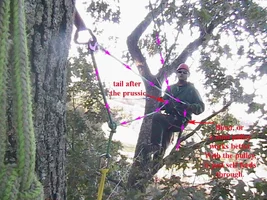
untying that simple loop in the line would be the only thing needed to repel. what 20 seconds.
we at first thought we'd use a separate line too, but in reality, it didn't make productivity sense, hauling another line the whole time from point to point. the climbing line tail is there with you the whole time.
I know, next someone is going to say the climbing line should only be used for the climber. Well, i say it is used to support a 250lb load (probably a maximum man's weight), as long as you use it for weights under this, it's fine. we use it for the dewalt drill transfer and cable transfer. 8lbs?
untying that simple loop in the line would be the only thing needed to repel. what 20 seconds.
we at first thought we'd use a separate line too, but in reality, it didn't make productivity sense, hauling another line the whole time from point to point. the climbing line tail is there with you the whole time.
I know, next someone is going to say the climbing line should only be used for the climber. Well, i say it is used to support a 250lb load (probably a maximum man's weight), as long as you use it for weights under this, it's fine. we use it for the dewalt drill transfer and cable transfer. 8lbs?

tomthetreeman
Participating member
- Location
- Rhode Island
Re: Basic Flaws in Mr. Rigguy\'s Cabling Design
The fact that trees move, even with cables installed, is enough to raise major concerns with rigguy systems. The anchor point is at the OUTSIDE of the system. I asked this a long time ago in a different thread... "HOW IS THE TREE EXPECTED TO HEAL OR COMPARTMENTALIZE OVER THE CABLE, IF IT IS INCLUDED IN THE MOVING PART OF THE SYSTEM?" The anchors need to be FIXED, with the 'moving' system between the fixed points. At least that's my opinion, until someone better explains this to me.
Everyone is talking about the cable moving and bending... What about the tree with the hole in it with this cable sliding in and out and around every time the wind blows??? How can it be expected to stabilize at the point where the cable enters?
-Tom
The fact that trees move, even with cables installed, is enough to raise major concerns with rigguy systems. The anchor point is at the OUTSIDE of the system. I asked this a long time ago in a different thread... "HOW IS THE TREE EXPECTED TO HEAL OR COMPARTMENTALIZE OVER THE CABLE, IF IT IS INCLUDED IN THE MOVING PART OF THE SYSTEM?" The anchors need to be FIXED, with the 'moving' system between the fixed points. At least that's my opinion, until someone better explains this to me.
Everyone is talking about the cable moving and bending... What about the tree with the hole in it with this cable sliding in and out and around every time the wind blows??? How can it be expected to stabilize at the point where the cable enters?
-Tom

TreeCo
Carpal tunnel level member
Re: Basic Flaws in Mr. Rigguy\'s Cabling Design
[ QUOTE ]
A few weeks after Erk Brudi had his booth at Expo showing Cobra cabling I had installed the first, as far as I know, Cobra system in Minnesota, in a silver maple in my backyard. Over the years I could watch the tree and the system to see how it worked.
One day a storm front came in with 30-40 mph winds ahead of it. The light was good and there wasn't any rain. I stood out in the alley to watch my cabled tree and my neighbors uncabled silver maple. The neighbor tree was a bit larger but a similar structure. Somewhere I have the video that I shot of the two trees. <font color="red">Mine moved in a nice, flow and sway, like a ballroom dancer. The neighbor's tree did a real herky jerky dance and jumped all over the place. It was pretty evident that the dampening of the Cobra cables was a benefit to the tree.</font>
I would really like to watch a static cabled tree sometime. I'm going to guess that it would move a lot like mine even with the static system.
[/ QUOTE ]
I believe the whole tree moving in unison makes it much more likely that the whole tree get blown over. Parts of the tree moving in different directions disapates a lot of energy while the whole tree moving in unison is much like an organized 'heave ho' attempting to toss the tree.
So instead of saying the cable system was a benefit to the tree it might be more accurate to say the cable system was a benefit to the limbs and leaders of the tree. (Yes it's a nit pick but IMO an important nit to pick.)
I've seen videos of trees in high winds and there is no doubt that a lot of energy is disapated by parts of the tree moving in different directions reducing the overall force on the tree trying to push it over.
[ QUOTE ]
A few weeks after Erk Brudi had his booth at Expo showing Cobra cabling I had installed the first, as far as I know, Cobra system in Minnesota, in a silver maple in my backyard. Over the years I could watch the tree and the system to see how it worked.
One day a storm front came in with 30-40 mph winds ahead of it. The light was good and there wasn't any rain. I stood out in the alley to watch my cabled tree and my neighbors uncabled silver maple. The neighbor tree was a bit larger but a similar structure. Somewhere I have the video that I shot of the two trees. <font color="red">Mine moved in a nice, flow and sway, like a ballroom dancer. The neighbor's tree did a real herky jerky dance and jumped all over the place. It was pretty evident that the dampening of the Cobra cables was a benefit to the tree.</font>
I would really like to watch a static cabled tree sometime. I'm going to guess that it would move a lot like mine even with the static system.
[/ QUOTE ]
I believe the whole tree moving in unison makes it much more likely that the whole tree get blown over. Parts of the tree moving in different directions disapates a lot of energy while the whole tree moving in unison is much like an organized 'heave ho' attempting to toss the tree.
So instead of saying the cable system was a benefit to the tree it might be more accurate to say the cable system was a benefit to the limbs and leaders of the tree. (Yes it's a nit pick but IMO an important nit to pick.)
I've seen videos of trees in high winds and there is no doubt that a lot of energy is disapated by parts of the tree moving in different directions reducing the overall force on the tree trying to push it over.
- Location
- Retired in Minneapolis
Re: Basic Flaws in Mr. Rigguy\'s Cabling Design
I didn't mean for my comment to come across that I was busting your chops
It is perfectly acceptable for a climber to use their rope to haul light tools into the tree. That's written into the Z too.
I didn't mean for my comment to come across that I was busting your chops
It is perfectly acceptable for a climber to use their rope to haul light tools into the tree. That's written into the Z too.
- Location
- Retired in Minneapolis
Re: Basic Flaws in Mr. Rigguy\'s Cabling Design
Last week I saw a cable in a tree across from one of my jobs. After I talked with our crew I walked over to look. It was interesting and has some potential.
The tree had three cables in it. Someone had used plastic coated, 3/16", stranded/aircraft cable. They drilled through the stems in the best possible location. Then the cable was threaded through, a large diameter washer put on the cable, the cable made into a five inch diameter loop and the loop was secured with a U-clamp. The washer and U-clamp took the place of the Rigguy or Preformed strand clamp.
If the plastic sheath were stripped before the U-clamp were installed I could see using a similar setup. The right number and size clamps would be needed. This bears some consideration.
Last week I saw a cable in a tree across from one of my jobs. After I talked with our crew I walked over to look. It was interesting and has some potential.
The tree had three cables in it. Someone had used plastic coated, 3/16", stranded/aircraft cable. They drilled through the stems in the best possible location. Then the cable was threaded through, a large diameter washer put on the cable, the cable made into a five inch diameter loop and the loop was secured with a U-clamp. The washer and U-clamp took the place of the Rigguy or Preformed strand clamp.
If the plastic sheath were stripped before the U-clamp were installed I could see using a similar setup. The right number and size clamps would be needed. This bears some consideration.
- Location
- Retired in Minneapolis
Re: Basic Flaws in Mr. Rigguy\'s Cabling Design
When I watched the two silver maples neither of them moved as a whole. Each of the major leaders moved individually. In mine the movement of the leaders and the tree as a whole was much more rhythmic and less herky jerky.
Think of the difference between slam-dunk rigging and dynamic rigging.
When I watched the two silver maples neither of them moved as a whole. Each of the major leaders moved individually. In mine the movement of the leaders and the tree as a whole was much more rhythmic and less herky jerky.
Think of the difference between slam-dunk rigging and dynamic rigging.
TreeCo
Carpal tunnel level member
Re: Basic Flaws in Mr. Rigguy\'s Cabling Design
[ QUOTE ]
When I watched the two silver maples neither of them moved as a whole. Each of the major leaders moved individually. In mine the movement of the leaders and the tree as a whole was much more rhythmic and less herky jerky.
Think of the difference between slam-dunk rigging and dynamic rigging.
[/ QUOTE ]
I follow you Tom but I'm saying the rhythmic movement puts more peak forces on the root plate as a whole. The root plate usually does not move at all and often when it does it fails totally in one movement.
[ QUOTE ]
When I watched the two silver maples neither of them moved as a whole. Each of the major leaders moved individually. In mine the movement of the leaders and the tree as a whole was much more rhythmic and less herky jerky.
Think of the difference between slam-dunk rigging and dynamic rigging.
[/ QUOTE ]
I follow you Tom but I'm saying the rhythmic movement puts more peak forces on the root plate as a whole. The root plate usually does not move at all and often when it does it fails totally in one movement.
- Location
- Retired in Minneapolis
Re: Basic Flaws in Mr. Rigguy\'s Cabling Design
[ QUOTE ]
...the rhythmic movement puts more peak forces on the root plate as a whole.
[/ QUOTE ]
More than the herky jerkies? I disagree strongly. Explain how this can be. Let's go ice skating...I'll play 'Crack the whip' using bungee cord then change and use any sort of rope. I know what will happen...you're going to go flying off the rope because I can transmit more energy to your 'rootplate/skates'
[ QUOTE ]
The root plate usually does not move at all and often when it does it fails totally in one movement.
[/ QUOTE ]
Can you back this up? How does cabling or not have any effect on the rootplate? Look at the studies that the Germans have done about crown height reduction and the reduction in loads on the trunk.
If I was ever concerned that any tree, cabled or not, couldn't survive typical winds I would be doing some crown reduction.
Ken James has used load cells in trees to record movement and loads in the wind. After seeing his work I have a much clearer understanding of how trees transmit wind loads.
[ QUOTE ]
...the rhythmic movement puts more peak forces on the root plate as a whole.
[/ QUOTE ]
More than the herky jerkies? I disagree strongly. Explain how this can be. Let's go ice skating...I'll play 'Crack the whip' using bungee cord then change and use any sort of rope. I know what will happen...you're going to go flying off the rope because I can transmit more energy to your 'rootplate/skates'
[ QUOTE ]
The root plate usually does not move at all and often when it does it fails totally in one movement.
[/ QUOTE ]
Can you back this up? How does cabling or not have any effect on the rootplate? Look at the studies that the Germans have done about crown height reduction and the reduction in loads on the trunk.
If I was ever concerned that any tree, cabled or not, couldn't survive typical winds I would be doing some crown reduction.
Ken James has used load cells in trees to record movement and loads in the wind. After seeing his work I have a much clearer understanding of how trees transmit wind loads.
TreeCo
Carpal tunnel level member
Re: Basic Flaws in Mr. Rigguy\'s Cabling Design
Tom what I am saying is that the limbs moving around in a jerky motion disapates some of the wind energy that is attempting to push the tree over.
Look at it like a bunch of smaller sails.....and what you are seeing as the jerky motion is some of the sails not being directly into the wind. Trees move like this and it reduces the overall sail of the tree.
I contend that in some cases cabeling can hold the tree more rigid and present a larger sail to the wind force.
Presenting a possible larger wind sale and increasing the likelyhood of a whole tree blow over should be weighed againt the damage a tree suffers when limbs get damaged due to not being cabeled.
Cables are not always a win/win. Tree limb failure is often perferred over whole tree failure and limb failure is likely an evolutionary advantage.
Tom what I am saying is that the limbs moving around in a jerky motion disapates some of the wind energy that is attempting to push the tree over.
Look at it like a bunch of smaller sails.....and what you are seeing as the jerky motion is some of the sails not being directly into the wind. Trees move like this and it reduces the overall sail of the tree.
I contend that in some cases cabeling can hold the tree more rigid and present a larger sail to the wind force.
Presenting a possible larger wind sale and increasing the likelyhood of a whole tree blow over should be weighed againt the damage a tree suffers when limbs get damaged due to not being cabeled.
Cables are not always a win/win. Tree limb failure is often perferred over whole tree failure and limb failure is likely an evolutionary advantage.
Re: Basic Flaws in Mr. Rigguy\'s Cabling Design
Will one of you cabling experts throw down on whether using J lags in softwood trees is a big fat no no?
Step right up folks!
jomoco
Will one of you cabling experts throw down on whether using J lags in softwood trees is a big fat no no?
Step right up folks!
jomoco

- Location
- Home of the New Jersey Devils
Re: Basic Flaws in Mr. Rigguy\'s Cabling Design
I wouldn't use J-lags ever. What is the real benefit? I would only use them when you really didn't need them to hold too much, so again, why?
I wouldn't use J-lags ever. What is the real benefit? I would only use them when you really didn't need them to hold too much, so again, why?
Re: Basic Flaws in Mr. Rigguy\'s Cabling Design
All right MC!
Clean logical linear thought that I agree with based on firsthand witness of literally hundreds of J lag failures for whatever reason over my career.
Old school throughbolt cabling with the new cable grips are still the hands down best and longest lasting way to mitigate a tree's structural faults in my opinion.
jomoco
All right MC!
Clean logical linear thought that I agree with based on firsthand witness of literally hundreds of J lag failures for whatever reason over my career.
Old school throughbolt cabling with the new cable grips are still the hands down best and longest lasting way to mitigate a tree's structural faults in my opinion.
jomoco

- Location
- BC, Canada
Re: Basic Flaws in Mr. Rigguy\'s Cabling Design
I've only done a couple dozen cabling jobs, and I'll admit the closest I've come to the rigguy system is watching their online video demos, but I've got to ask:
HOW does one inspect a rigguy termination? Isn't the area you most want to inspect permanently out of view?
Northwind
I've only done a couple dozen cabling jobs, and I'll admit the closest I've come to the rigguy system is watching their online video demos, but I've got to ask:
HOW does one inspect a rigguy termination? Isn't the area you most want to inspect permanently out of view?
Northwind
New threads New posts
-
test
-
-

-
 Alternatives to standard asphalt around roots
- Started by southsoundtree
- Replies: 19
-
-

-

