Basic Flaws in Mr. Rigguy's Cabling Design

Re: Basic Flaws in Mr. Rigguy\'s Cabling Design

Tom I've done that looping thing several times, too. O and if you ever unpack those boxes, the pics of trees' reaction to hardware would be interesting to see...and publish!

Countersinking into bark is good, into wood is bad. read the bmp's, please.

I'm with Wags; dynamic when you want movement, static when you do not. With inclusions you generally do not want movement. Simple enough, as a general guideline...

Shov thanks for passing on Steve's test results--sure wish he would get some of those published.
 
Re: Basic Flaws in Mr. Rigguy\'s Cabling Design

"Countersinking into bark is good, into wood is bad. read the bmp's, please."

Thanks for the clarification, Guy.

-Tom
 
Re: Basic Flaws in Mr. Rigguy\'s Cabling Design

I believe this thread could go on and on. To all of you involved, thanks for the input. We use this forum at work as discussion points. Keeps everyone in the game. Again, thanks for sharing all the knowledge.
 
Re: Basic Flaws in Mr. Rigguy\'s Cabling Design

My first hybrid install was in a wishbone shaped locust that had split. To start, I used a come-along up top to pull the split together. then I did some weight reduction on the droopers and extended limbs. The pruning would have been normal pruning even if the tree hadn't split. It was really interesting to see how much slack I had in the come-along after the pruning.

Next, snug up the crack a little more.

Through bolt and double nut/washer according to A300 specs with 5/8" threaded rod.

To get more static support of the trunk I knew that I needed a brace. But, the two sides were too far apart to install a rod. I chose to use EHS and through bolts. This became a dynamic brace and not really a cable if you get what I mean. There would be little movement except inline with the cable. The cable-brace was pretty low.

Then, in the crown I installed a three-leg dynamic system. If memory serves me I used Guardian, use which ever system you choose. Like I said, any cabling is better than none.

If I ever get back to Minneapolis I'm going to pay a visit to a couple of my hybrid installs and see how they're working. I'm pretty confident that the trunks will have generated callous over the cracks and started to rebuild strength.
 
Re: Basic Flaws in Mr. Rigguy\'s Cabling Design

the rigguy cabling system and the preformed wedge grip cabling system were adapted from the post tension concrete industry, where higher and more consistent loads are encountered. although maintenance and inspection are required on any permeant load bearing cable. there isn't a system that doesn't require maintenance in existence. on post tensioned concrete they have to inspect and retighten cables annually due to permanent cable stretch and periodically replace cables that are past their prime. that should also apply to the tree industry where loads are more dynamic and the range of motion is higher. if you think you can out design an engineer and come up with a permanent unmaintained cabling system you should sell it to the construction industry and become a millionaire. hell, suspension bridges require annual maintenance. my $5.00 worth.
 
Re: Basic Flaws in Mr. Rigguy\'s Cabling Design

thats why every install should be checked from time to time to make sure the tree is not failing and all is secure.
 
Re: Basic Flaws in Mr. Rigguy\'s Cabling Design

[ QUOTE ]
Having the eye nut snugged up against the tree is the proper installation method.

Go back to the original post in this thread. The concern is that the individual strands will be cycled to failure like a paper clip/coat hanger. Having the through bolt is no different but now all you have is one strand.


[/ QUOTE ]

exactly, I was hoping someone would say that.

Shovelhead, thanks for posting about the test of the cable and rod being cycled. Cool. The system is probably just fine.

I just questioned the metal fatigue failure of rigguy systems because of the idea of no movement except for in the cable, but more importantly, where I see old cables broken. If it's a cable that isn't rusted away and it is broken, it's almost always where the cable meets the wood. Maybe there is another reason for breaking here. I haven't thought of it though.

cool discussions guys, wish i had more time to contribute and discuss further.

I'd love to see someones elses cabling pictures here, come to think of it, I haven't seen a single one on treebuzz before.

here's a siberian elm, tree had numerous leaders and an incredible amount of tight V crotches. It's got lots of cables now. all j-lags. (cuttenwolf in the pic)

thinking about the j-lags vs. the through bolts. I agree that through bolts are definitely stronger, so maybe i should always supply the stronger system by always using through bolts. just what i've been thinking lately. i do have a nice new gas powered stihl drill that would help in that.
 

Attachments

  • 169259-163_6400.webp
    169259-163_6400.webp
    170.9 KB · Views: 59
Re: Basic Flaws in Mr. Rigguy\'s Cabling Design

[ QUOTE ]
[ QUOTE ]


But here is mine that I had thought up a while back.

mount a green laser on the drill, modify the button so you can click it and keep it on. While drilling, the laser points in the opposite direction and you keep it lined up on the intended location for the other anchor point.

on that big oak guy job, i simply used rope stretched tight to give me an idea on the correct drill angle.

[/ QUOTE ]

It's a good idea Xman.


The problem I see with the green laser idea is that to be successful the first hole drilled has to be perfectly aligned to the other target branch in order for the laser to hit the other branch from that first hole.

And getting perfect alignment by eye is next to impossible.


[/ QUOTE ]

I don't think you are fully understanding what i'm saying here.

the lazer is mounted on the drill and stays on the drill. Turn the lazer on, drill the hole while keeping the lazer pointed on the other limb. so, you aren't barely looking at the limb you are drilling in, you are keeping that green dot on the opposite limb. The lazer will only be about 1 inch off of center.

other climber could mark that spot, or simply, when you go to the opposite limb, now line up the lazer dot on the lag you just installed.
------------------------
big cracked white oak, two threaded rods installed, 2 or 3 cables? -i forget
 

Attachments

  • 169261-White-Oak-split-bolt,-cable.gif
    169261-White-Oak-split-bolt,-cable.gif
    483.2 KB · Views: 47
Re: Basic Flaws in Mr. Rigguy\'s Cabling Design

I get it, it drills one way and shoots a green laser the opposite way, in alignment with the drill bit center point.

Interesting.

Could be problematic in line of sight terms, you'd almost need a mirror on the drill or perhaps the brim of your hat like a bicyclist.

Should be easy to prototype!

Not like JPS's idea with the green laser.

I misunderstood you Xman.

Nice save on that big white oak!

jomoco
 
Re: Basic Flaws in Mr. Rigguy\'s Cabling Design

cool.


---------------------------------------

this was a nice old beech. 2006.

i told them to cable and thin out a little.

they only went with the thinning and did not listen to my advice to add support the the V crotch.

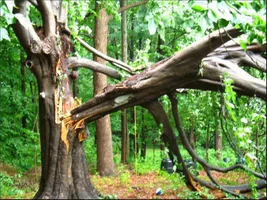
1 year later, it split in rainstorm, fell heavy on the house. House was for sale and the closing was within one week. Closing did not happen with that buyer.

they are a devoted customer now.
 

Attachments

  • 169268-beechtightvcrotchfailure.webp
    169268-beechtightvcrotchfailure.webp
    251.8 KB · Views: 52
Re: Basic Flaws in Mr. Rigguy\'s Cabling Design

gives you an idea of the size here. (no, i'm not under that load).

tree is still standing today actually. other half leans towards woods, so not too big of a deal.

At that time of the clean-up, I told them and wrote up that it would likely get sun scalding, since it happened in the summer.

In 2008 I climbed again and took out some dead limbs for the new homeowner.

It sure got plenty of sun damage on most of the upper limb surfaces.
 

Attachments

  • 169270-beechcleanupfromonhouse.webp
    169270-beechcleanupfromonhouse.webp
    179.6 KB · Views: 74
Re: Basic Flaws in Mr. Rigguy\'s Cabling Design

[ QUOTE ]
It sure got plenty of sun damage on most of the upper limb surfaces.

[/ QUOTE ]Yeah beeches scald easily. White latex paint is handy to use.

Reeeally nice pic bracing that split oak!

I'll post a pic when the sun comes up. Cabled one maple yesterday-- and will do one tomorrow.
 
Re: Basic Flaws in Mr. Rigguy\'s Cabling Design

[quote White latex paint is handy to use.


[/ QUOTE ]

awesome, yeah, thanx.
 
Re: Basic Flaws in Mr. Rigguy\'s Cabling Design

Yeah, I bought myself the gas drill a few years ago. Nice for those big jobs. Mostly, I use my Ridgid cordless, though, since the 2/3 rule usually puts me up into <10" stuff, which it handles easily.

-Tom
 
Re: Basic Flaws in Mr. Rigguy\'s Cabling Design

[ QUOTE ]
I get it, it drills one way and shoots a green laser the opposite way, in alignment with the drill bit center point.

Interesting.

Could be problematic in line of sight terms, you'd almost need a mirror on the drill or perhaps the brim of your hat like a bicyclist.

Should be easy to prototype!

Not like JPS's idea with the green laser.

I misunderstood you Xman.

Nice save on that big white oak!

jomoco

[/ QUOTE ]

I'm glad i had mentioned this, because today it was on my mind a little and i came up with a MUCH better idea. I'm going to be contacting an arborist supply company with the idea. i will hopefully be able to share with you all soon.
 
Re: Basic Flaws in Mr. Rigguy\'s Cabling Design

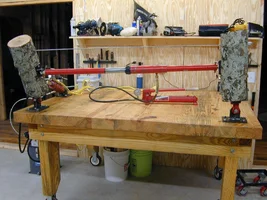
There are answers to Jomoco's concerns.
1. Try to fatigue the same paper clip moving your hands 4 feet apart.
2. Changing the point of fatigue does make a difference.
3. In 35 years I have never seen a cable fail mid strand. The failures I have seen have always been in the terminal hardware. Pre-forms in the apex of the bend, lags next to the threads.
4. Wire Stops have been in trees for over seven years with no fatigue failures reported.
5. In multiple wind simulation tests I have performed, the eye bolt, thimble, and pre-formed wrap move together after the system is loaded to 500-700 lbs. The thimble does not swivel rather the bolt moves at the base. In these tests, the bolt failed at a little faster rate than the strand.
For more information call Rigguy at 706.340.1288

Steve
 

Attachments

  • 170311-Windtest.webp
    170311-Windtest.webp
    299.7 KB · Views: 44

New threads New posts

Back
Top Bottom