Backing up petzl ascender

Final one.

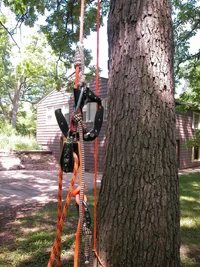
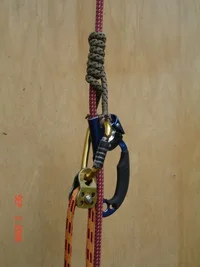
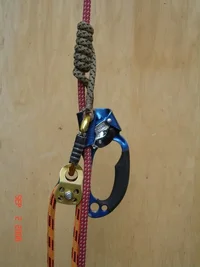
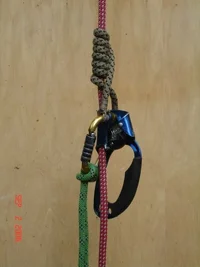
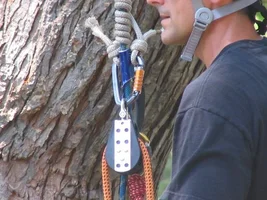
The first two photos showed a doubled rope with a pulley for a floating false crotch attached to the carabiner. But the carabiner/ascender/friction hitch could be set up in the same way and then have a cord/tether (rather than the doubled climbing rope) attached to the carabiner and then to the climber. This shows a (doubled) Prusik cord on the carabiner.

I took these in order to show the setup a little more clearly. Basically the carabiner is attached to both the friction hitch and the ascender so it is sort of like putting a handle on your friction hitch. The ascender is backed up at all times—the cam could even be released from the rope and the hitch would still hold. This might even be a good method for working off of this system—-release the cam, so that the teeth don’t constantly dig into the rope, and put a stopper knot below to back up the friction hitch.
 

Attachments

  • 56114-DSC01716_rotated_resized_25%.webp
    56114-DSC01716_rotated_resized_25%.webp
    38.7 KB · Views: 235
Is it OK to put the load on the Ascender above the cam? I thougt that hole was for if the ascender was to be possibly twisted off the rope in a traverse type situation? When loaded, does it do anything funny? So far that seems to be an efficent way to back one up though.
 
See image 6 in this link

http://en.petzl.com/ProduitsServices/B17%20ASCENSION%20B17502-F1.pdf

The climber has their 'biner clipped into the top hole so that the ascender will trail up the rope without binding. If the climber were to slip they would fall below the ascender and load the cam from above.

Note that in the photos that I showed the aascender is loaded by the handle when the climber is ascending. If the climber slips they will load the cam from above in the same manner as shown in the Petzl drawing (#6). The cam would also be loaded in the same way (from above) if the climber were to work off of the ascender, but it would be acceptable, and probably preferable, to release the cam and put the load on the friction hitch.
 
A common thing that I see in most of the backups in these floating FC systems is a lot of distance between the stopper or backup and the main TIP.

When I look at them it seems that if the main TIP were to fail there would be a drop which could lead to a severe slam dunk load on the backup point.

What do you users think about this concern?
 
I guess it depends on how much rope is out when it drops. The more the better, less impact force. Seems like a smooth type cam is better to work off then a toothed one. I like the original weapon set up. I had Sherill splice two rings on either end of the prussick, kinda like a cambium saver. I've never been able to get it to slip when weighted, even if the lower part of the access rope is pulled really hard. If the Ascender were to chop the rope a back up knot would be pointless. The upper friction hitch might slip over the cut rope. The rope would probably suffer severe sheath damage rather then being completly cut. The probability of this is really low under bodyweight conditions. Altough, if your climbing far out from the ascender the risks become greater. I think we should all be very aware of the risks of ascenders and working from them.
 
Mahk,

I edited your set-up of Kathy’s system, and connected the prussic to the carabiner, which is attached to her ascender and climbing system. Would this system been something you would had been more comfortable with? This would include a back-up knot as well, of course

Also, after reading through the Ascender Use rules, it does appear that Kathy’s system did meet the requirements. However, after looking at the system, I probably would have some concerns about it, as well.

Maybe the rules need a clearer statement, explaining exactly how the back-up system needs to be connected to the working system.

Mike
 

Attachments

In Kathy's sytem, what way is it backed up? The handled ascender is not backed up. With no biner in the upper hole capturing the rope, if the cam were to fail, the ascender would come off the rope.
The wording in 2.2.26 has to change to: ......or a pliable prusik cord that is placed above and <font color="red"> </font> linked to the mechanical ascender.....

not pickin on ya Kathy.
 
I agree with ya', Norm. Sometimes words are difficult to translate into a mental picture, or can be perceived completely different than what is written in the rules. It appears that Kathy felt that her system was properly backed-up, because of the stopper knot below the ascender, although Mahk’s pictures clearly indicate that the system was not properly backed-up.

I think the ITCC Rule Book should include a picture/diagram of a properly back-up, ascender, working system. I know there are a number of variations to back-up an ascender/working system, but a diagram might give a better understanding of how a properly backed-up system should look. Just my opinion, though.

Mike
 
If things are defined too closely it inhibits innovation. Requiring a back up is appropriate but whether a "back-up" is an acceptable one really needs to be evaluated on a case by case basis. Unfortunately that means that some things that I would rule it out might get a go-ahead and things that make perfect sense to me might get quashed. The really important thing is for all involved to keep thinking and learning. We can get better at looking at a system and seeing its strengths and weaknesses...and major safety risks.
 
What we should really be looking at is 'Why' we need to back up.

Two cams is an accepted safety measure in many fields. It is how they are utilised. Why do they need backing up? Normally because they could come off the rope or slip. If used as designed for, they will function correctly.

There are issues the way we use them. Footlocking with one ascender has issues, because the cam could come off if the top holes aren't secured around the rope. There is also the issue of high fall forces with a slip because of the amount of slack footlocking generates. If set up for aerial rescue in the ITCC, the DdRT is used as the lanyard also. Thats zero stretch to absorb any fall. A chest ascender doesn't have such isses with fall forces, and is backed up by a second ascender.

For these reasons, accessing with sound SRT (backed up chest ascender)and running the DdRT off a Knot in the access line, should be scored higher than running a DdRT system off an ascender.

I can find no info from Petzl that says tying in to the top holes is unsafe. In fact, they also condone self belaying from one ascender clipped to the top holes only. Obviously, then there is no issue about loading this way. I can add one though, as the cam is loaded the handle cants into the groin if the wrong way around - ouch! The cam isn't being loaded any differently - it is the frame that takes the load. It would be wise to run a work system through a krab in the bottom hole as well for rescue, however, because as the rope runs out along a branch, it cants the frame out of alignment. This is easy to do - Tie in to top holes and redirect line through the bottom hole.

Or just be sensible and hardly slower, by clipping the work line into a knot below.

The emphasis on speed in the comps is disproportionate to the risks, and can encourage poor work practice as much as good. /forum/images/graemlins/cool.gif

 
[ QUOTE ]
not pickin on ya Kathy.

[/ QUOTE ]

yah, no worries. i don't feel picked on, just because an entire thread has been devoted to dissecting a rig i never even came up with but was told to use..

just to be clear: i approached 3 judges/techs at gear inspection on friday, describing a floating false crotch system where there WAS a biner through the upper hole, from which my system was suspended. all 3 agreed that i had to use the lower hole to suspend my rig. then right before i entered the A/R ring i told the judge/tech who was doing the pre-climb gear inspection what i planned to do - the reconfiguration of my original system suggested the previous day. he too said, sure sounds good.

so it's not just a matter of the wording being clear. it's a matter of each person down the line with the power to decide being clear on each variation, and if they're not clear ASKING the technical advisor. i was misled, and then penalized for it. just for the record.
k.
k.
 
Very interesting thread.
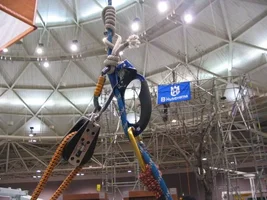
Just for your interest, here is a beter shot of the system that Mark used for his masters climb.
 

Attachments

  • 56342-IMG_0202.webp
    56342-IMG_0202.webp
    53.9 KB · Views: 181
Then typically Mark being Mark, he shares his ideas with everyone at the tradeshow. A real sport ! Here's another photo.
 

Attachments

  • 56343-IMG_0249.webp
    56343-IMG_0249.webp
    55.4 KB · Views: 168
Hey Kathy,
Do you find the time taken for a SRT setup with floating crotches etc.to be quicker or slower than a DRT setup with floating crothes etc ? From what i saw at MN none of the guys had a SRT at the aerial rescue event !
 

New threads New posts

Back
Top Bottom