back-guying decayed leaner for removal

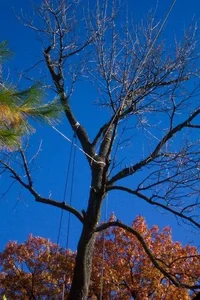
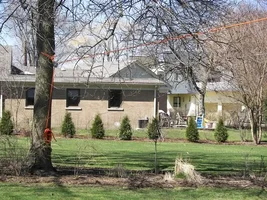
I had a maple leaner last fall in a residential back yard.
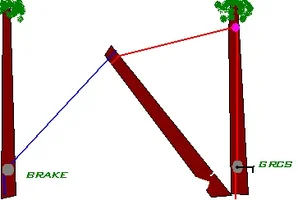
The top was rigged over to the tree with the brake then the red guy was used to slowly lower the rest of the tree with the brake preventing any swing.

110538-lowering.PNG
 

Attachments

  • 110538-lowering.webp
    110538-lowering.webp
    7.4 KB · Views: 50
Kathy, we are a bit confused without pics, but it sounds like that your life line, the lowering line and the guy rope are all attached to the same tree (deodar). This causes us some concern.

Generally on trees we have removed that have had potential of failure I will isolate the life line if at ALL possible from rigging and guy loads so if the rigging system or tree fails, it doesn't.

It sounds like you are guying this oak tree because of the concern of the potential for failure of the root system. This type of failure would put the entire weight of the oak on the deodar (where you are attached). Leaving you no place to go. With the ground being saturated (as it sounds like) this tree may not have the support ability that you are counting on.

From what you have stated, I would use the deodar for your highline and do all the rigging and lowering from the oak itself, being as careful as you can and avoiding shock loading. Can you guy the oak to a different tree? At least with these methods you are protected. Again, we state that without actually seeing the situation we cannot know how helpful this advise is in your circumstances.

Good luck.

D and S Mc
 
[ QUOTE ]
hey norm, forgot to say i'd love to see any of that training material or photos of what you pros use if it's handy!k.

[/ QUOTE ]

I can post some Monday. Like I said, they are all on my laptop and it's layin on my desk at work. Sorry
 
This is 1 we did a couple of years ago. The roots of this ash were cut approx. 3 feet out from the trunk for an addition (on the back side of the lean). We did a "V" rig tie back to some trees in the front yard.
 

Attachments

  • 110794-Ashguylines.webp
    110794-Ashguylines.webp
    58.1 KB · Views: 136
This is how we tie them back 90% of the time. Leave enough room to tension with a come-a-long or 5 to 1 MA system.
This is a different tree we did last year. We had 3 ropes to hold this 1 back. The 3/4" DB was cleat hitched off to the port-a-wrap then the excess rope wound around the porty to keep it off the ground. This was in a nabors tree. Didn't want the rope laying on the ground overnite. We rigged up all the guy lines the day before, just myself and 1 guy. The next day we had a 5 person crew. Looonnnnng brush drag.
 

Attachments

  • 110796-splitwillowbacktieashclsup.webp
    110796-splitwillowbacktieashclsup.webp
    105.4 KB · Views: 145
hey norm,
thanks for posting the pics. i like the look of that block 10 ft up, w/ room for a 5/1. i think we're gonna bite the bullet and do it w/o a crane this week. like i said, if i feel like it's the last tree i'm ever gonna climb, you know i'll be heading for the ground to call the crane co.

thanks for all the replies and advice guys - i'll let you know how it works out.

k.
 
45 is about 70% leveraged. Tree will force a thicker hinge therefore i think. The back guying can be problematic in that it gives a backward pull on tree, and perhaps doesn't lower quick enough, to offer enough relief(could swivel around too etc.). If i did that; i'd have to chain the tree to the stump; back cut; then clear out and pull it over with another line. Also would look to triangulate to 2 wide spread trees at rear if possible, rather than 1, single centered one.
 
Ken, I think Kathy plans on taking this one down in pieces.
When dropping one as you describe the tree has a good chance of swinging if the hinge breaks but if the butt hits the ground it won't matter as long as the tip is secured to something out front or from both sides acting as a hold line.
The back yard I was working in had some things built into the ground and dropping the tree in a controlled fashion was the best way to go in my case using the brake and the GRCS.
The size of tree you are dealing with will determine if this can be a method to consider but the control can't be beat.

It doesn't take much force to tension a tree from the back and I can usually feel the need for a guy just from the way the tree reacts to movement.
When they have a considerable lean a guy takes the play out of them and gives me that added piece of mind and security.
For twenty or thirty minutes worth of work ...and usually less, guys are well worth the effort in my opinion.
 
i'd hope so; i was just reading the pics! i still like triangulated support. Guying does give the complication of not hitting your guy wires; and also placing them low enough that you don't get 'trapped' with them too high.

Also, in working a guyed tree; i like having compression of 5/1, come-along etc. piggybacked on to the guys. Then tighten, then anchor guyropes, and slip the compression gear up to extend it fully. That way; as you work and unload the lean; the lines can be retightend on the fly to keep you safe. Sometimes a separate side guy is imposed too; so it can oppose the dynamics of your rigging and even hinging to the opposite side.
 
Can you use a floating TIP or double TIP? I did a removal of a spiral cracked willow in a ravine in Toronto. I was able to do a double that positioned me on the backside of the tree. From that situation I was able to take it down in small pieces without any attachment or weighting of the willow itself.

Got to agree that I'd be seriously looking for a way to keep myself attached to another tree then the one I'm rigging from.

Is there any sign of decay at the root crown? or have you been able to ascertain the % of holding wood at the point of concern? What about the root plate away from the lean? Does it show any sign of lifting?

For the rigging could a zip line or load transfer system be set up?
 
[ QUOTE ]
This is how we tie them back 90% of the time. Leave enough room to tension with a come-a-long or 5 to 1 MA system.

[/ QUOTE ]

We frequently do this with our GRCS when we want the ropeman out of the action.
 
[ QUOTE ]
[ QUOTE ]
This is how we tie them back 90% of the time. Leave enough room to tension with a come-a-long or 5 to 1 MA system.

[/ QUOTE ]

We frequently do this with our GRCS when we want the ropeman out of the action.

[/ QUOTE ]

How do you secure the end if it's on the GRCS? You can only tighten 1 rope then, right?
 
[ QUOTE ]
Can you use a floating TIP or double TIP? I did a removal of a spiral cracked willow in a ravine in Toronto.

[/ QUOTE ]

Double TIP I understand. What is this 'floating TIP'?

[ QUOTE ]
For the rigging could a zip line or load transfer system be set up?

[/ QUOTE ]

Zip line good idea if Anchor tree is a separate tree for this specific job. High forces and forces that are hard to account for with Zip lines.
 
A floating tie in point would employ a tensioned line run between two high points. Preinstall a block on it, using a midline knot, and position it wherever desired. Run lifeline through the block/pulley. If the fixed point needed to be adjusted, groundmen could move the line back and forth, while the climber is safetied in, of course.
 
I knew what was being alluded to. I just found it to be vague and open to interpretation. One with less industry exposure might call a Floating False Crotch a 'floating TIP'.

Treehumper is well aware of how fond/experienced I am with Traverse Line suspended TIP.

Some in Ontario feel that such a setup should be considered a Horizontal Lifeline. By law, a horizontal lifeline has to be certified by an engineer in Ontario.

It is a tool necessary to consider to save worker's lives.


To the topic at hand:

Kathy you have the skill, talent, experience to execute this job safely, professionally and profitably. Work with this confidence and keep in tune with your intuition, and you will have an extraordinary portfolio job.

Good Luck!
 
[ QUOTE ]
A floating tie in point would employ a tensioned line run between two high points. Preinstall a block on it, using a midline knot, and position it wherever desired. Run lifeline through the block/pulley. If the fixed point needed to be adjusted, groundmen could move the line back and forth, while the climber is safetied in, of course.

[/ QUOTE ]

We have also installed a 'floating TIP' on a static horizontal line using a prusik, a link and a pulley or friction saver. Both ends of the anchored rope were 'back tied' to adjacent trees or a ground anchor. Lot's of forces involved with this type of set up.
 

New threads New posts

Back
Top Bottom