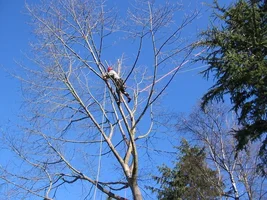
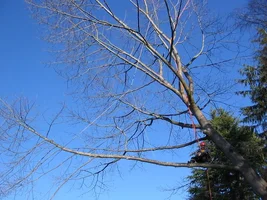
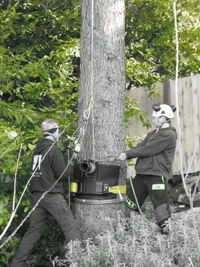
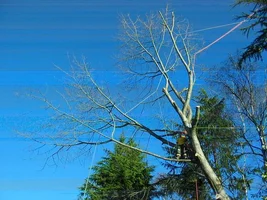
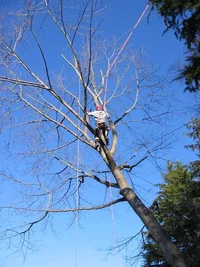
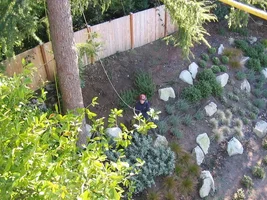
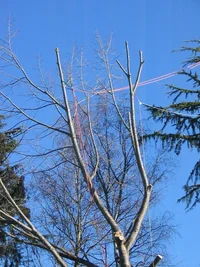
back-guying decayed leaner for removal

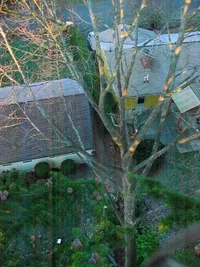
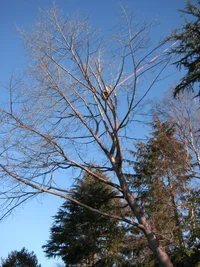
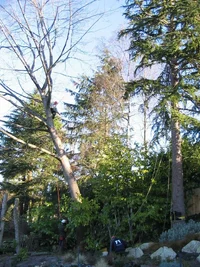
ONCE; we had a fairly detioriated; loose tree; with other trees around it but not too helpfully close; no access. It was medium-small; over garage, fence etc.

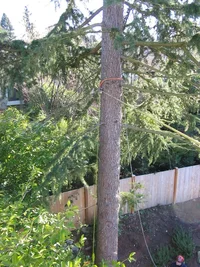
i guyed 3 ways with ropes from ground; and firmed it into the ground to stabilize; kept my balance centered. Then ran rig lines out of the other trees high; then 50' across to the lower tree; to let the higher angle supports take sum of the rigging loads, then ran the ropes on lowering. The rig lines where hardware nylon 3/8 for more elasticity/ shock dampening (by elastic rating and by virtue of 'violating' more of their tensile strength than our 7k lines).

Everything went fine; but wouldn't want to do it everyday.
 
[ QUOTE ]
The rig lines where hardware nylon 3/8 for more elasticity/ shock dampening (by elastic rating and by virtue of 'violating' more of their tensile strength than our 7k lines).

[/ QUOTE ]

Hey Spyder, that's really interesting that you chose hardware nylon to use for its stretch properties. It makes alot of sense too, when used it the right situations, with not too heavy of a load.

We have been taught to only use arborist rated lines, as ANSI states, but maybe there's other lines that may be used too if necessary?
 
well today was the day, and of course the crane cancelled because boeing needed my 50T all-terrain. can't hold a candle to boeing. i decided to go ahead and do it w/o the crane, w/ the back-guys and all my original plan. everything went to plan and the trunk wood was sound and not discolored all the way to the ground. i find it hard to believe there could be much root rot w/no sign in the wood - anyone know about that?

as a bonus, i wound up bringing a geezer back from the comp to help me out - posts under the name whiz. we shared some tricks and yakked a lot and called it a good training day.

pictures to come...
k.
 
Excellent, glad to hear that one's on the ground. I hope you didn't work the Whiz too hard... he IS getting old now.

About the root rot and the tree showing no signs. I don't think the roots have to be completely punky to fail on a leaning tree... it's the WAY they are stressed. It's different if the tree is vertical because the stress around the support roots is uniform.
A big leaner though puts downward shear on the compression side roots and upward shear on the tension side. Without plenty of healthy reaction tissue to beef them up, roots under shear are dealing with stresses they weren't made for.

When my tree fell, it was effectively leaning because I'd removed two other stems that served as counter-balance... no reaction wood to support the lean. It did have some rot where it was scarred on one side but it didn't look significant. It had a thin layer, maybe five years of growth around the outside that was healthy; it felt like good live wood to the spikes... but inside it was toast.

It was great to meet and climb with you in Florida. I hope we meet again soon.
 
[ QUOTE ]
i find it hard to believe there could be much root rot w/no sign in the wood - anyone know about that?

[/ QUOTE ]
Kathy,
Google Shoestring Root Rot. I've seen it in Oak trees and sometimes it's hard to detect without digging around the roots. I've also seen some pretty horrific damage to houses from large oaks affected by that. glad your tree went well.
RD
 
setting two doublebraid back-guys to trees behind the lean - each was run through a block 10-15 ft off the ground tensioned with a 5-1 and anchored (portawrap & rescue 8)
 

Attachments

  • 113685-setguys.webp
    113685-setguys.webp
    290.2 KB · Views: 103
main back-guy redirect detail. this line is anchored to a portawrap on the back side of the deodar. the lowering device on the front of the deodar was used for the lowering line.
 

Attachments

  • 113686-bkgy.webp
    113686-bkgy.webp
    279.5 KB · Views: 92

New threads New posts

Back
Top Bottom