
Arborists Know Veteran Tree Management

[ QUOTE ]
...I also think that the older folks get, the more likely they are to opt for a removal. The leaves, the randomly falling twigs and debris, storms, it all becomes too much of a headache.

[/ QUOTE ]Ain't this the truth. I cabled an oak 8 years ago, and just got a call to reassess it. The couple are aging, and paranoia is striking deep. It took a whole lot of discussion and negotiation for them to let me prune the tree again, which I'll do Sunday (after the thaw). My bad for not calling in the interim and checking in, and selling the needed work before fear set in, with age.

I've retrenched several public trees, and a whole lot more private trees. I think that 'target rating', like 'defect', has been hammered into our heads so much that even we the tree guys start our assessments with a negative frame of mind. The great majority of my clients are willing to keep these trees, when they get some help understanding the fine points of both the benefits (see treehumper's posts), and the affordable work involved, by writing specs a la A300.

Phil, you're totally right about static pull tests--just one indicator. But if I can't override a client's paranoia over seeing a hole in the tree, and help them understand tree risk a little better, I'm not following my company's policy.

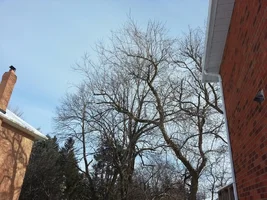
o and heres the resized boxelder with NO ice damage.
 

Attachments

  • 382398-redversretrench140129.webp
    382398-redversretrench140129.webp
    368.4 KB · Views: 32
[ QUOTE ]
...if I can't override a client's paranoia over seeing a hole in the tree, and help them understand tree risk a little better, I'm not following my company's policy.

[/ QUOTE ]

I appreciate your perspective and insight on this, but I am less inclined to voluntarily transfer their monkey (tree risk) onto my back, and become anxious every time a major storm or (frequent) high wind event occurs! Your experience with holey trees gives you a greater latitude in advocating for preservation. If a client expresses a concern which I consider justified, then my company's policy (absolute reduction) obviates paranoia. I like really big trees with cavities,crooks, cracks and hollows. I wouldn't feel secure nesting under one, so telling a client that a bit of periodic pruning will keep the old critter hale and hearty isn't gonna fly.
 
Given the free consultation time factor during a removal bid call, I just shrug and tell em if a hurricane comes through every tree will break. Then there's the obvious immediate failure. Between that it's kind of a style decision.
 
What are the ethics involved in removing healthy trees after the conversation has been had with the client to try and convince them otherwise? We preserve as many as possible and literally stake our name on it but in the end the client has the last word. Not always are veteran trees removed because of safety, but for light penetration, prevalence for lawn over canopy, annoyance with litter and construction. Do any of you guys turn down a removal? I don't. I have a family to feed. I don't like it but I figure if we do the work at least we will have done it safely and maintain the client relation so that future tree work will hopefully be preservation oriented.
 
[ QUOTE ]
From 1995-2007 there were 407 deaths due to wind-related tree failures. That doesn't amount to much over 33/yr. To put it into perspective the numbers of fall deaths according to the Home Safety Council amounts to 6000/yr.

[/ QUOTE ]

To put it into perspective......how many hundreds (or thousands?) of serious injuries resulted from wind-related tree failures? How many near misses? How many injuries / deaths from non wind-related tree failures; for example sudden branch drop? How many insurance claim payouts that could have been avoided?
 
Pelorus, while I get where you're coming from it doesn't lessen what I'm trying to say here. We are at a point in the development of our profession where we need to move completely away from the old school tree surgeon to the more science based arborist. If we wish to be taken seriously then we need to be elevating our own levels of knowledge. We are the experts. Tree owners approach as such, But experts in what? Taking down a tree safely or cheaply?

Like any field of study, it is ever changing and amassing new information that affect our practices. We have an obligation (thus the CEU requirement of certification) to continuously educate ourselves to better serve our clientele. Michael raised a good point about ethics of removal of a healthy tree.
As to your other point, here's a link to a California website for collecting data on failures.

http://ucanr.edu/sites/treefail/Post_a_Question/Archives/

The numbers are from 1987 to 2010. A total of 4651 failures, of which 1656 were branch failures. That's over a 23 yr period.

Another report "Tree Hazards Recognition and Reduction in Recreation Sites" http://na.fs.fed.us/spfo/pubs/hazardtrees/treehazards/thazards.pdf

The data is for 1965-80 in recreation sites in Colorado, Wyoming, Kansas, Nebraska & South Dakota. Totals there are 1306 with only 45 causing an accident.

The New York Times recently reported that tree-related deaths are a real problem. In the last decade, 10 lawsuits brought against the city have to do with the injuries and deaths from individuals in the park system. The report indicates that three people died because of falling tree branches in the city. Numerous others sustained serious injuries resulting from branches or trees falling. New York City paid millions in damages for these claims.
NYC study, $5.60/1 in benefits to costs for trees.

2.9 million people were injured and 42,636 people killed. About 115 people die every day in vehicle crashes in the United States -- one death every 13 minutes. And there is no stat for near misses in cars.

Here's a white paper from the ISA that really points at one of the problems we face, a lack of empirical data. But it does a good job covering the issue.

"Trees & Risk Researcher Summit White Paper"
http://www.isa-arbor.com/education/resources/educ_Portal_Risk_Whitepaper.pdf


Marlinspiker, the insurance industry is another target for us to educate on proper risk mitigation. What the h do they know???
 
Something like this: Deal with the danger of the tree crushing you now or suffocate from lack of fresh air, later. Not to mention at some point the winds and erosion are going to sweep all the good soil away leaving us in a desert. How would you tactfully communicate this message so the responsibility is on that particular individual at that moment so as to spark some thinking of the value of the tree.

The key is most people take the position of it's my tree and there are others. But as we know the trees are the ones feeling the loss most of all.
 
Jeez Bob, you're in an upbeat mood today....
crazy.gif


Taking trees down lead to the very problem you refer to.

And yes, there is the "it's my tree and I can do what I want" mentality to overcome. That's part of our job. We know and the research, nevermind common sense, shows that trees' influence and benefits extend well beyond the property boundaries and in real terms affect a community as a whole. But even that has it's problems with many people caring even less about anything beyond their property lines. Thus the need to educate them about how it does come back to them in the form of lower costs for their community equates to reduced need for tax increases (I won't even suggest a reduction in taxes).

We amount to order takers when all we do is what the customer thinks, in their uninformed, fear motivated mind, is what is best. Here lies the golden opportunity for us. Put together a tree monitoring and maintenance plan sold on an annual basis or longer. Look at the industries that are doing that now. HVAC companies do this. Pay for an annual plan and they'll do the basic maintenance, cleaning and troubleshooting. For any work required you get a discount on parts and labor. In an emergency, you're bumped to the top of the list and will also receive a discounted rate. Note, they don't get the work done for free.

I guess the problem with this is we actually have to get out and sell. My point about being business people first and tree guys second.

Trees function preferably as a collective and will rebound long after we've managed to destroy the environment sufficiently to kill ourselves. Like George Carlin said, "The planet is fine. The people are f*çked."
 
Great posts, Treehumper!
I enjoy these kinda discussions. Taking down trees safely, efficiently and at reasonable prices has ended up becoming a customer-driven cornerstone of my business since inception. Plus doing an excellent cleanup job afterwards of course...makes it look like the zapped tree was never there. Gonzo!!!
We advertise doing other work, of course, incl. concrete cavity filling, organophosphate pest control, topping, and flush cut pruning (to create future animal nest cavities).
grin.gif


In a more serious vein, probably my most soul- satisfying job over the course of the last year involved some vista pruning / deadwooding for improved waterfront sightlines for an older couple. Not very profitable, but they were thrilled with the results, and had us back twice later to do some additional work.
 
The scary thing is you posted what looks like many yellow page ads around here!

I just drove by a regular pruning job to reduce the hazards of the tree. I'll have to take a pic and post but let's just say it's a 40' hat rack now. Unlike the other site where the yard looks like a pile driver went crazy.
 
th, the first lines in that white paper shows the depth and extent of our problem.

"All trees have the potential to fail. In the absence of a target, this failure is without consequence."

If the ISA is telling people that the loss of a tree is without consequence, then the ISA is the first thing to fix here. This problem was raised early in the Risk BMP review process, but it wasn't until late that the contradiction was dealt with/brushed aside by that TRAQ juggernaut, back on the bottom of page 78 somewhere.

Corporate dominance of the industry leads to hypercautious standards and practices, as instituted by our 2 big orgs. The little guys have little say, and no power to change things, unless they start speaking up.

Pel, yes there is risk transfer when formerly high- and now moderate- or low-risk trees are retained, but that's managed by owner control, professional work, and disclaimers. I've left a lot of hollow or cracked trees and sleep fine. o and marlin i only do removals if i need firewood; the rest get subbed out. but mine is a small biz.
 
Guy, yes agreed. With the research on tree benefits that is available this statement is false but, it reinforces the mindset that we're up against.

ISA and TCIA represent us all equally, at least in theory. Davey, Asplundh, Bartlett's and the rest have no more of a vote than small companies do. They just make sure their interests are represented across the board.

Small companies need to realize we are moving toward a more science based approach to trees. Time to step up their game or they'll be the ones seen as hacks.
 
Pelorus, I left out: Yes, anyone can gain experience with holey trees by checking out your local ones, and also vicariously by seeing and citing what other arbs are doing. This will give you a greater latitude in advocating for preservation. If a client expresses a concern,ask them for some details; which part do they fear? When?

absolute reduction obviates paranoia, but it also removes the asset, and depresses property values, quality of life, and your ability to ever make another dime on the tree. I like really big trees with cavities,crooks, cracks and hollows. I would feel quite secure nesting under one, but not in a Category 3 or more.

Most of my clients come to understand that a bit of periodic pruning, root care, etc. will keep the old critter hale and hearty, as reliably as many other elements of our infrastructure. Our role is to bring in a balanced view of tree time, from the tree's pov.
 
Thanks Guy.
Sometime this winter/spring I hope to photograph and post photos of two large sugar maples on clients properties that I consider beyond redemption! Each has shed a major limb during the last two years. One owner would definitely like to have his tree removed, but is procrastinating (financial constraints). The other owner is wealthy, and has a terrific risk tolerance, and will likely forgo a removal decision till such time that the tree fails or dies.
 
Ian Bruce did an incredible cabling job on a black walnut in Richmond Hill. It was an old farmstead beside the mill pond, 4th gen owner. I lived across the street at one time and knew the tree. it was a monstrous beauty. if it were taken down the property wouldn't have been the same, in aesthetics or value.

do some research on possible mitigation solutions and propose them.
 
[ QUOTE ]
Jeez Bob, you're in an upbeat mood today....
crazy.gif


Taking trees down lead to the very problem you refer to.


[/ QUOTE ]

Just offering a suggestion for arborist to communicate to customers as far as removal vs. restoration. Remove now and be safe but your childrens children might need the oxygen in the future. My post didn't get that across?

Air in NYC is already a problem. Look at Canadian cities they are surrounded by forest that filter the air. NY has Newark to rely on. I'm worried. Trees depend on each other for survival. At some point they'll all become sickened and we will have a desert. I'm serious not in a bad mood.

I think arborculture needs to do some tv spots.
 

New threads New posts

Back
Top Bottom