Any Fellow Woodworkers?

Have you found a way to stabilize or preserve the red in the box elder? I cut down a BE and had the wood milled. A lot of the color oxidized and disappeared while it was drying. later, I learned that this is normal...and tragic :(
 
There were no flesh wounds in the making of these products.
grin.gif


Well Tom, I hope the red doesn't fade. We spent a lot of time trying to keep as much of the red as we could in each bowl. Are you sure it wasn't just the out side of the boards that had contact with the light?

We used Olive oil for the final buffing.
 
Those are really nice. Where did you obtain the box elder? I have used olive oil also with good success, on other species. Each type is unique, right down to the cellular level.
 
I was taking down the Boxelder for one of my clients, when red saw dust came out of a cut. It looked like confetti shooting out the back of my chain saw. Anyways I saved it and had it laying around my garage since December.

The interesting thing about the red is that it started at an improper pruning cut.
 
I've heard that submerging in water will even keep whole logs from checking. The goal is to slow drying. I've been putting on many coats of linseed oil on as soon as possible. I oil them rough and while carving. I'm guessing the olive oil is for bowls that will be eaten out of? Or is it the non-checking secret?
 
Limb wood, and smaller pieces will check easier than trunks and bigger straight logs. The limb wood has a "memory" and wants to bend as it had in the tree. Keep the wood out of the sun and rain. The more consistent the conditions (humidity temp,airflow,etc), the less likely they are to check.

Nice bowls. I am just drawing up a stock for my .410 on a slab of black walnut we took down 2 years ago. I have got an granberg alaskan mill and have sawn white cedar, english oak, and american elm. Keep up the good work, wood working is very rewarding.
 
I turn the bowls green; usually as soon as I can get the wood on the lathe. The trick is to turn the bowl around an inch thick or so. Let it dry and hope that it warps instead of cracks. A few of my bowls started to crack so I put supper glue in the small cracks and it prevents them from growing. I keep monitoring the ruff turned bowls for cracks so I can fill them with glue until they dry. Then after a few months I put the bowl back on the lathe and finish it.

Another important trick to keep the bowls from cracking is to turn the bowl so there is no center grain. I'm not talking about the heart wood, I am talking about the very center of the tree. That is where cracks start during the drying process. I make sure to keep at least 1" away from the center.

I hope that helps
 
Hey Bevin,

The Olive oil is just a food safe finish that I happen to put on some of the salad bowls I make. it brings out a luster and protects the wood from absorbing water.

The bowl recently pictured has several gloss polly coats on it.

I am currently drying a huge salad bowl that I ruff turned from the crotch of a White Oak tree. It has some amazing grain pattern so I can't wait to finish it. That bowl measures 131/2" in diameter.
 
I've never liked the Bore nickname. Male pig, hole driller, boring, mmm, could be based on reality. Just call me Bevin. Boreal would sound kinda lofty.

ps Thanks for changing that.
 
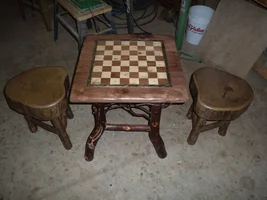
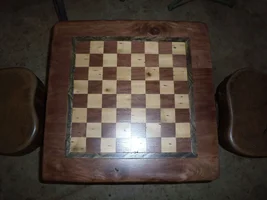
Here is a Custom 2" thick walnut chess board with inlayed poplar. The legs are made of Mountain Laurel. The stools are made of locust.
 

Attachments

  • 342663-DSCN1731.webp
    342663-DSCN1731.webp
    266.5 KB · Views: 80
Regarding the straight-grain slab checking question:

I have super limited experience - a couple big black walnut logs and a few Wych Elm logs all slabbed between 6/4 and 12/4. The thickest ones checked least and dried truest, though I wasn't exactly limiting my drying time (Denver,Colorado, in an uninsulated attic through the heat of the summer 95* and the cold of the winter 10*). I second that they won't really dry until they're slabbed out - these had sat at the shop for two plus years and were green as the day they were cut when I slabbed them. My strategy is to let the slab do what it wants and "fix" the checks using George Nakashima style butterflies to prevent them from getting any wider. Other than that, there's an incredible amount of force in a big slab of wood. I talked to a guy who had built big steel frames to try to control warping in big slabs. The wood just bent the steel like it was pipe-cleaners! I still ended up with mostly workable material, though. Nothing really moved that much for me, so I think my strategy will remain "slab thick, finish to desired thickness".

I'm using an alaska mill as well, just fyi.

 
"The red in the boxelder looks awesome. Better explain to any dinner guests that no humans were harmed in the making of those bowls..."


Or just tell them it was only a flesh wound... really just a few stitches.....

I need to find somewhere to turn. I've got a norway maple burl and a white ash gall. There's a big black locust burl I'm hoping to get my hands on.
 

New threads New posts

Back
Top Bottom