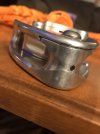
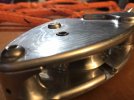
I was thinking of a more empirical approach. Maybe put a go pro on the enforcer with a known mass on the other side. I would be curious to see how flattering of certain ropes would affect the friction as well.The only way I can see doing something like this is with a load cell at the lowering point, known weight of load, and a shit ton of super advanced math to figure the force on the control end.

Navigation
Install the app
How to install the app on iOS
Follow along with the video below to see how to install our site as a web app on your home screen.
Note: This feature may not be available in some browsers.
More options
You are using an out of date browser. It may not display this or other websites correctly.
You should upgrade or use an alternative browser.
You should upgrade or use an alternative browser.
Another aerial friction rigging device?
- Thread starter JMerritt
- Start date
Merle Nelson
Been here much more than a while
- Location
- SF Bay Area, CA
Just saw a Morgan Block in the wild again today. I can't wait to get one and have it available all the time.

JMerritt
Branched out member
- Location
- santa cruz
I’ve had the enforcer between the block and the sling in a dynamic rigging setup. We got a reading of around 550lbs on some medium size oak limbs. It doesn’t tell us how much of that was held by the man on the end of the rope vs the friction at the block, but it was no problem to hold by hand.I was thinking of a more empirical approach. Maybe put a go pro on the enforcer with a known mass on the other side. I would be curious to see how flattering of certain ropes would affect the friction as well.

Evo
Been here much more than a while
- Location
- My Island, WA
what was the weight of the limb?I’ve had the enforcer between the block and the sling in a dynamic rigging setup. We got a reading of around 550lbs on some medium size oak limbs. It doesn’t tell us how much of that was held by the man on the end of the rope vs the friction at the block, but it was no problem to hold by hand.
There must be some kind of curve to measure loading at the sling. say it takes 5 lbs to hold 100 static the rigging point is 105 lbs
Now drop that load and shock load it by dropping it at a measured distance and snub it off. Then do the same with the device. This would give you a theoretical amount of force applied to the control side? Granted it would still be a guess..
Or just tie weights on the control side and start dropping known weights from known heights. IT would be interesting to get one of the college labs to pick this up as a study.
Does your apparatus have enough room to tie the enforcer in-line on the side “held by the man?” I think it would be easy to attach a go pro on a controlled drop.I’ve had the enforcer between the block and the sling in a dynamic rigging setup. We got a reading of around 550lbs on some medium size oak limbs. It doesn’t tell us how much of that was held by the man on the end of the rope vs the friction at the block, but it was no problem to hold by hand.
Have you held everything by hand or has a porty been employed as well? Are you dropping loads on the system or mostly exploring static situations? The portawrap would help to normalize the resistance. By using 1/2 wrap increments and just letting the tail run without being held, you’d have variability with consistent tension applied. How many times have we heard lowering efforts qualified by the number of wraps it replaces for an existing device? Just a thought...

Flying~Squirrel
Participating member
- Location
- NH
I've been using aerial friction a little more lately, and it's more useful than I thought it would be. I'm definitely in the market for a device like this when it comes out, if I can be patient and not just buy a rigging wrench.
I tested a climbing device I made a few years ago and I was getting hitch force at the hand vs how much the device was holding. I had the advantage of putting one cell between my bridge and the setup and one cell at my SRT rope anchor on the ceiling. With that I could see the overall support force spike with dynamics and concurrently see the amount at my bridge, the difference being how hard I was "tending?" the hitch with my hand. Then I could measure quantitatively what I felt with my arm/hand.
A problem I had was the noise filtering of the amplifiers which are usually designed to give a nice static digital readout without 60 Hz hum messing up the works. I also had two different amplifiers with different filtering. I massaged the filters to let in more noise but respond faster to catch the transients without rounding them off. I was reasonably satisfied in the end but it wasn't perfect.
The enforcer says 500 samples per second so it is probably limited to 250 Hz bandwidth or less on the signal, probably less like 100 to 200 Hz its a grey zone design decision. 100 Hz would catch any transient in a rope. You shouldn't get any huge waveform distortion falsehoods. One time many years ago I struggled to make F = m x a on a jig because of filtering issues.
If you've got two enforcers, maybe a rig like I described to Mark for measuring SRT basal and tip forces. If you set up for limited travel (so a load cell doesn't try to run through any device), put one just above the ground guy's grip, inline, couple inline alpine butterflies or whatever, then put one enforcer similarly right where you tie the log/weight. Since the rope makes a 180 at the device you just add the two readings (graphs) for the tip force and divide them to get the hand force amplification factor. The only glitch is the mass of the enforcer load cells, which if the log takes off quickly, will generate some force of their own accelerating themselves or the portion on whichever side of their sensor. You'll also measure accelerating the rope. If you do a calibration run with a block, you'll also measure accelerating the pulley and the pulley friction/rope bend friction, so use a magical bigger radius pulley thats light I.e don't use a huge heavy steel pulley. If you use a 2" it might give you rope bend force comparable to the bend radius of your gizmo. You could do some extra figuring or ciphering with that info perhaps. Yeah, I've been watching the Beverley Hillbillies lately. Comic relief.
All clear as mud? Draw a careful picture to cipher with.
Lucky guess at x5! I can see it reasonable to vary x5 to x10 etc. Makes sense.
Edit - I just remembered that I also had a string on a pulley/potentiometer so I simultaneously recorded my descent onset/travel/stop to identify breaking initial hitch lock, then dynamic and then how the stopping action behaved. Also, each enforcer is independent or can you synchronize the data? You could tweak or snap the line to make a synchronization spike in the recorded data before the data run. Maybe whack the rope with a stick.
A problem I had was the noise filtering of the amplifiers which are usually designed to give a nice static digital readout without 60 Hz hum messing up the works. I also had two different amplifiers with different filtering. I massaged the filters to let in more noise but respond faster to catch the transients without rounding them off. I was reasonably satisfied in the end but it wasn't perfect.
The enforcer says 500 samples per second so it is probably limited to 250 Hz bandwidth or less on the signal, probably less like 100 to 200 Hz its a grey zone design decision. 100 Hz would catch any transient in a rope. You shouldn't get any huge waveform distortion falsehoods. One time many years ago I struggled to make F = m x a on a jig because of filtering issues.
If you've got two enforcers, maybe a rig like I described to Mark for measuring SRT basal and tip forces. If you set up for limited travel (so a load cell doesn't try to run through any device), put one just above the ground guy's grip, inline, couple inline alpine butterflies or whatever, then put one enforcer similarly right where you tie the log/weight. Since the rope makes a 180 at the device you just add the two readings (graphs) for the tip force and divide them to get the hand force amplification factor. The only glitch is the mass of the enforcer load cells, which if the log takes off quickly, will generate some force of their own accelerating themselves or the portion on whichever side of their sensor. You'll also measure accelerating the rope. If you do a calibration run with a block, you'll also measure accelerating the pulley and the pulley friction/rope bend friction, so use a magical bigger radius pulley thats light
I.e don't use a huge heavy steel pulley. If you use a 2" it might give you rope bend force comparable to the bend radius of your gizmo. You could do some extra figuring or ciphering with that info perhaps. Yeah, I've been watching the Beverley Hillbillies lately. Comic relief.All clear as mud? Draw a careful picture to cipher with.
Lucky guess at x5! I can see it reasonable to vary x5 to x10 etc. Makes sense.
Edit - I just remembered that I also had a string on a pulley/potentiometer so I simultaneously recorded my descent onset/travel/stop to identify breaking initial hitch lock, then dynamic and then how the stopping action behaved. Also, each enforcer is independent or can you synchronize the data? You could tweak or snap the line to make a synchronization spike in the recorded data before the data run. Maybe whack the rope with a stick.
Last edited:

dsptech
Branched out member
- Location
- North East
Haven't been paying attention but saw the vids realized this thing would be great for solo rigging.It works great as a speed line control break. Also works on the tail end of the speed line to hold tension. It can be used in a 2 or 3:1 pulling setup to pull and hold tension when felling. It works well as a rigging control line for slowing down a big swing or in a two rope rigging scenario. It can be slung to the base of the tree and used like a traditional basal mounted friction device. It can be rigged in a double whip tackle setup to lift limbs or rigg heavy pieces...
I'd like to have a go at one so add me to the list as well.
I would be interested in the Morgan block as well. Seems like a well thought out, yet simple design. That will be very handy to have especially for solo rigging applications. And if you are running a lean crew. You could continue to work the tree out while your ground man is hauling brush or wood.
Last edited:
Flying~Squirrel
Participating member
- Location
- NH
I was just on the Thompson website and saw that the Morgan block is listed as "sold out." Does that mean it actually went on sale at some point? Or has it always been that way? Either way, I'm eagerly awaiting...
JMerritt
Branched out member
- Location
- santa cruz
Just getting readyI was just on the Thompson website and saw that the Morgan block is listed as "sold out." Does that mean it actually went on sale at some point? Or has it always been that way? Either way, I'm eagerly awaiting...
Merle Nelson
Been here much more than a while
- Location
- SF Bay Area, CA
I'm ready too.
JMerritt
Branched out member
- Location
- santa cruz
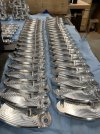
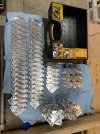
Merle Nelson
Been here much more than a while
- Location
- SF Bay Area, CA
Aren't those pretty.....all that sped up rigging pent up and just waiting to be released.

Reach
Been here much more than a while
- Location
- Atglen, PA
If I may ask, why the texture, style or some purpose?
edit - my apologies, it became clear when I re-watched the video they're just surface textures. Spectacular effect on the camera, though. A little buff and they're pretty much gone I'm sure.
edit - my apologies, it became clear when I re-watched the video they're just surface textures. Spectacular effect on the camera, though. A little buff and they're pretty much gone I'm sure.
Last edited:

They are machining marks from the endmill used to remove stock. No tool change from a rough pass, what type of machine are you using?If I may ask, why the texture, style or some purpose?
JMerritt
Branched out member
- Location
- santa cruz
My brother ran them on his cnc mill. Can’t remember the brand but it is a beast from the 80s-90sThey are machining marks from the endmill used to remove stock. No tool change from a rough pass, what type of machine are you using?
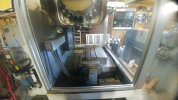
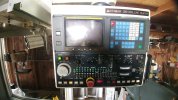
Assuming it wasn't a ball nose or similar end mill, but a normal end mill, is it basically the mill marks fooling the camera and it's flat to the touch? I've found that mill marks can really mess with trying to see witness scribe lines when placing holes etc. You've got to move your light and tilt your head just right to see them. Looks like you get your proclivity for machining honestly as it runs in your family.