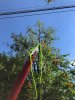
Am I just being a baby about this TIP?

Solid advice all around. To save time as well, why not use that "better" TIP to the right and pre-direct over to the side you need to retrieve dead from? That way you are spreading load and going straight to the area of tree you need to work in.

As Evo so eloquently phrased it "What the fuck is that?". And as mentioned, first question is "species?"

Here's summing up and adding my probable rope path, everyone will skin it differently.

Green circle is my initial base anchor/reidirect TIP. Red circle is where I'd probably advance to and set a simple mechanical redirect. If it was easy enough (looks to be so) I'd lanyard in and natural crotch (I love pulling rope!) or mechanical redirect through the limb to the right to improve the load angles on the upper redirect, and set to walking! Might have my Hook on me so why not throw it out to ends of the target work area and have a cushy walk.

I'm having trouble getting the scale of the tree from the photo. It could be super easy to get out to that end, Hook would be overdoing it in that case.

50043395593_ae9014773c_b.jpg


-AJ
 
Last edited:
Main thing is you have a plan then you adjust as you go based on what you find, continual assessment as you progress. For example you might find out that the upper leader where I put the redirect has a major structural flaw/rot, whatever, that you can't see from the ground. For me it's always conservative on the access TIP for a tree I've never been in before. Once I'm up there I can check out the quality of the upper crown parts and make a plan from there.
-AJ
 
I'm with the idea of tying in to the right. I wouldn't bother with an SRT redirect, I'd just scale up the middle and toss a 2nd DRT system or long lanyard out to the limb you penned. when you load that climbing system, the limb will be more in compression. much safer IMO.
 
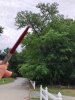
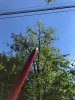
Thanks, everyone, for the great advice above and thanks @moss for taking the time to illustrate the suggestion. Here's the initial pic again and also a shot from 90 degrees across the street with the pen pointing to the same suspect TIP.
TIP.jpg 90 deg.jpg
It looks like more of an angle than I thought to get to the other branch if I want to redirect there but, as @colb said, I'll just have to up my throwline game :)

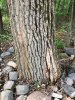
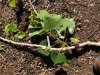
BTW, to answer a few questions at once, the suspect TIP is at 62' and the tree appears to be a cottonwood, (not winning any strength awards) but I'm eager for contrary opinions as I'm not a tree-ID champ. Here's a shot of the trunk which doesn't look all that great and another shot of the leaves:
Base.jpg Leaf.jpg

You know, I just wanted to point out what a great place the Buzz is. Lots of helpful people here and, unlike other forums, no drama. Thanks guys. I'm actively working on my thank-you present to you guys, my break testing machine, and it's getting close. I'll post a separate thread when it's done and we can start doing plenty of testing.
 
That limb is an ideal bucket job, btw. Us climbers don't always have to be the best way. Think about how often buckets encourage bad behaviour. It's possible that the inverse is true and you should sub that limb to a bucket operator. If you're still considering climbing it, I would consider pull testing further out the branch, then engaging in your preferred strategy at a point further in from the pull test. I'm unsure if I should mention that my strategy would be to place my line in 6 inch wood (4 inch if it was an oak branch with good attachment) so I can prune in 3 inch wood without having to advance at all. As you get close to the TIP, there is less line to absorb shock, so I would climb more fluidly. I would have a second line in the other spar for your Extreme Bailout Season 1 Episode 1. I don't prune in cottonwoods much - only one to date - since they are scarce in my area. I know the wood is brittle AF, so that has to be part of the strategy. Consider a pole saw for reach, and consider larger reduction cuts since the limb is pretty overextended and the target occupancy is low (if it is just the street?) so the consequences of limb failure from a larger cut are not so bad. Since cottonwoods fail so much and are kind of "habitat" trees, a larger wound can be part of the ecosystem rather than a hazard over a high occupancy, high value target. Communicate your approach, the philosophy behind it, and how that compares to the ANSI Standard in writing to the client, listen to their feedback and collaborate on that plan. Arborist safety is a must. Do not go up that without a plan for safety, and professionalism.
 
Sigh... if you're worried about limb failure, you'll have to back up your TIP at a couple points lower on the main trunk because if the limb breaks, so will the high TIP. If the high TIP breaks, you're back to square one unless you have installed something on the main trunk. This is a good situation for a base tie to the canopy anchor to allow for backup anchor points, and a canopy tie to the second line installed in the branch of concern to alleviate a potential 2:1 from the bending moment of the branch breaking the coefficient of friction associated with a base tie where the rope is not secured to the branch above, but just draped over it. But really, if we're all talking about it like this, just get a bucket on it and come back another year when you've got more experience and may better know whether or not you want to climb it then. I'm not going to judge you unless you do something outside your comfort zone.
 
Sigh... if you're worried about limb failure, you'll have to back up your TIP at a couple points lower on the main trunk because if the limb breaks, so will the high TIP. If the high TIP breaks, you're back to square one unless you have installed something on the main trunk. This is a good situation for a base tie to the canopy anchor to allow for backup anchor points, and a canopy tie to the second line installed in the branch of concern to alleviate a potential 2:1 from the bending moment of the branch breaking the coefficient of friction associated with a base tie where the rope is not secured to the branch above, but just draped over it. But really, if we're all talking about it like this, just get a bucket on it and come back another year when you've got more experience and may better know whether or not you want to climb it then. I'm not going to judge you unless you do something outside your comfort zone.

Sound technique. Something I have to do often when confronted with topped trees and long branches that have continued to grow are now the high points of the tree, and reach a long way from the trunk, and aren’t always going to hold up to climbers weight
 
Sigh... if you're worried about limb failure, you'll have to back up your TIP at a couple points lower on the main trunk because if the limb breaks, so will the high TIP. If the high TIP breaks, you're back to square one unless you have installed something on the main trunk. This is a good situation for a base tie to the canopy anchor to allow for backup anchor points, and a canopy tie to the second line installed in the branch of concern to alleviate a potential 2:1 from the bending moment of the branch breaking the coefficient of friction associated with a base tie where the rope is not secured to the branch above, but just draped over it. But really, if we're all talking about it like this, just get a bucket on it and come back another year when you've got more experience and may better know whether or not you want to climb it then. I'm not going to judge you unless you do something outside your comfort zone.
What a thoughtful couple of responses. I like the dual system idea. Thanks @colb. Luckily this tree is on my own property and I’m using it as a problem to solve (slowly and safely) and learn from since it’s not straightforward like all the white oaks around me that are more or less textbook trees and are wicked strong. I can take my time and if it still doesn’t feel right, bail and forget about it (maybe make it the power company’s problem!) Like you said, it’s not like it’s over a house or something. And, there’s not even much dead wood to get at all. I’m just trying to learn the more advanced techniques like you guys are sharing. Thanks again.
 
Definitely a Cottonwood.

I was thinking it was a Populus genus tree in the original photo from the way the leaf "clusters" looked. I've climbed up into a few epic Eastern Cottonwood. It's doable and safe with consideration and care. But wow yes, a completely different animal, you can break stuff with your hand not much effort, pop-off small branches like it's nothing.

110' floodplain Eastern Cottonwood with a monster spreading crown. It's now on the ground uprooted, taken out by 90 mph gusts overnight during a wind event late October, 2019, leaves were still on the tree. Amazingly the crown was busted up only when the trunk hit the ground

3373621913_7791d4c76f_b.jpg


2009, DdRT for upper crown climbing, was using SRT for access only.
3374410318_4231d70405_b.jpg


-AJ
 
Even knowing it's a cottonwood I stand by my initial TIP recommendation (the green circle), it's solid all else being equal (the tree passes initial careful inspection from the ground). What's next is based on ongoing assessment as you go.
-AJ
 
This looks like a standard it sucks and they never taught us this tree. If Moss's high tip to the right is also overhung as much as it seems, SRTing up to it and DRT/long lanyarding out to the left may be in question, as it only becomes reinforced once both systems are loaded. Then it seems a best option is an amazing throw-line shot which gets both tips, or a two stage two shots throw-line placement to get both crotches and then place your rope, if the tree center is clear enough to let the center rope span pull up from the ground. Or fight your way up towards/near the right high tip as far as comfortable, set a redirect/sling tip and then fight your way back out to the left.

This, in other forms like just really high tips, is the reason for my SOP of at least dual tip to vector spread the load and give me not 100% probability for my life on one tip. And enabling more access. If I'm in a center stemmed tree, I'll go with a single tip if there's non-isolated catch branches below it and I don't need super outer edge access.

All good advice in the thread.
 
...a “safe” word... a "danger" word...

Allow me to clarify, to put your mind at ease. Whenever women, children or mentally challenged persons approach a clown or his vehicle they should be aware of the safe words and the danger words that clowns often use.

SAFE WORDS: when you hear these, you can trust that the clown is only interested in your welfare and safety.

"Want some candy, little girl?"
"Put on your happy face and hop in!"
"I have some cocaine!"
"Do you like my balloons?"

"Get in the van, bitch!"

DANGER WORDS: when you hear these, immediately run away from the clown/vehicle as fast as you can.

"You're a trans-WHAT???"
"Oh, shit! The cops are coming!"
"Is that your daddy?"
"You don't have any cocaine? Piss off!"

"That seems a little high. Do you take Mastercard?"

As you can clearly see, it's quite simple. Pay attention and avoid sudden movements, like reaching for a gun.
 
This looks like a standard it sucks and they never taught us this tree. If Moss's high tip to the right is also overhung as much as it seems, SRTing up to it and DRT/long lanyarding out to the left may be in question, as it only becomes reinforced once both systems are loaded. Then it seems a best option is an amazing throw-line shot which gets both tips, or a two stage two shots throw-line placement to get both crotches and then place your rope, if the tree center is clear enough to let the center rope span pull up from the ground. Or fight your way up towards/near the right high tip as far as comfortable, set a redirect/sling tip and then fight your way back out to the left.

This, in other forms like just really high tips, is the reason for my SOP of at least dual tip to vector spread the load and give me not 100% probability for my life on one tip. And enabling more access. If I'm in a center stemmed tree, I'll go with a single tip if there's non-isolated catch branches below it and I don't need super outer edge access.

All good advice in the thread.
All good advice for sure.

I’m halfway there now. I ended up taking moss’s advice (who wouldn’t?) and got the high right TIP with my big shot. It was about 75’. I checked it for integrity as best I could with binoculars from the ground. Then I worked the bag over the other big limb below it as a worst-case safety and base tied since there was too much scrub to isolate and canopy tie.

Once I got up close to the TIP I inspected the limb and didn’t find any damage. I wanted to have a backup through the trunk and change the angle like colb suggested though so at the TIP I pulled a bunch of slack and used an alpine butterfly to cinch my line with a steel biner. That let me descend back to the trunk on a canopy tie and take the base-tied tail with me. Once there I ran it through the main union and just pulled the AB cinch back to me and untied it. I ended up redirecting the base tie without having to untie it which I’m sure is common practice to you guys but was pretty cool to me.

I ran out of time and couldn’t make it out to the other side of the canopy for the trimming so I came down and pulled a throw line through my new rope path. I’ll get back to it soon. At least I have a solid anchor point now that I feel good about. Thanks again fellas.
 
All good advice for sure.

I’m halfway there now. I ended up taking moss’s advice (who wouldn’t?) and got the high right TIP with my big shot. It was about 75’. I checked it for integrity as best I could with binoculars from the ground. Then I worked the bag over the other big limb below it as a worst-case safety and base tied since there was too much scrub to isolate and canopy tie.

Once I got up close to the TIP I inspected the limb and didn’t find any damage. I wanted to have a backup through the trunk and change the angle like colb suggested though so at the TIP I pulled a bunch of slack and used an alpine butterfly to cinch my line with a steel biner. That let me descend back to the trunk on a canopy tie and take the base-tied tail with me. Once there I ran it through the main union and just pulled the AB cinch back to me and untied it. I ended up redirecting the base tie without having to untie it which I’m sure is common practice to you guys but was pretty cool to me.

I ran out of time and couldn’t make it out to the other side of the canopy for the trimming so I came down and pulled a throw line through my new rope path. I’ll get back to it soon. At least I have a solid anchor point now that I feel good about. Thanks again fellas.

Nicely done. The careful incremental approach is a winner.
-AJ
 
90 deg_LI (4).jpg

Since you're using this for a learning experience, take a another run at it trying to hit both front and back crotches in one shot. Those shots are pretty easy if you get the right starting angle. A 10oz ball with 1.75mm line and it flies like a bullet. You'll probably have to work the ball some to get some small branches out of your rope path, but in the end, you can ascend straight up to your target crotch. It will take a little gymnastics work to get up through the crotch if that's your goal, but you can use foot loops or brute strength or whatever. If you're working that damaged limb, then you're good to go without going up and through. The green is the climb line and orange is the throw line path.

We just did and oak limb Thursday that was pretty similar. One shot through 3 good crotches (2 intended and 1 a bonus), some throw ball work to clear some twigs and refine the rope path, base anchor. Solid going up. Unpack, setup, climb up and through, remove limb in large pieces (35-40ft, 16" butt, swung the last two pieces), down and pack up, 2 hours 15 minutes, $200 to me to climb it for a guy who sat on his ass and collected $350 from customer and told me I could've had it done in an hour and half. LOL, he's a old timer who's been handing me all his customers except for this little old lady.

But just to clarify something. I didn't see mention of what limb(s) you're working up there, just that you want a particular TIP. I'm assuming you are looking at cleaning up that broken limb. IF you're intending to remove that limb where your TIP is, then I would definitely look for 2 additional crotches besides it to put your rope through for safety.
 
Last edited:

New threads New posts

Back
Top Bottom