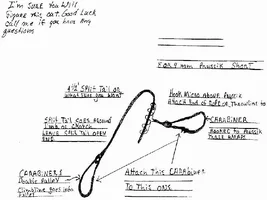
adjustable friction saver

after seeing the german rope guide and finding out that there is only 1 place in the US to obtain and possibly another in upcoming months i was determined to make one. the benefits of no friction appeal to me, it is just so smooth. so try this: using a Petzl HMS carabiner as the large ring, a Petzl fixie pulley attached to a shackle or quick link (that fits through HMS) attached to a 8in long or so adjustable friction hitch--distal,french prussik,etc. on a short strap or rope. behind the friction hitch attach a 12in long piece of rope with a small shackle(7/16in width)--i used a blakes hitch(for the secondary piece of rope) since it is not a loop piece of rope and just had a stopper knot that held the shackle on it. now i take the HMS carabiner around the limb clipp it onto long friction hitch --leaving the pulley isolated under the limb. i run my climbing line system through pulley attach the small shackle to my climb line under pulley above my climbing hitch. when i retrieve my line pulls through pulley catches the small shackle which pull pulley through carabiner and out of the tree. note.. my climb line is 1/2in diameter so 7/16 shackle works and quick link is 9000lbs so should work for climbing system...please let me know what you guys/gals think. I have been using it for about 1 week of some solid climbing and so far have been able to retrieve it everywhere normal.
 
Re: adjustable false crotch

Craig,

If you go back in the archives and wade through either the German False Crotch or American False Crotch thread you should find a picture of a setup that John Sirbasku put together. For all I know, you could use the Search to find the post too. If you find the post, would you post the link here?

Tom
 
One thing I don't understand, with both the german and other adjustable cambium savers- how is it that the small retreival shackle does not put a bunch of friction on the rope? it seems that as you decend it would pull right up against the pulley and give just as much friction as the traditional system. Also it doesn't seem possible to install from the ground. I guess i just need to see it in action.
 
Jason,

I have never noticed the small shackle jamming the rope at all. It is attached with a long strap to keep it down. I think that I might have to set it up and have someone else climb on it and I;ll sit next to the TIP and study.

I think that it would be possible to set from the ground but not very easy. Since I SRT that isn't even a concern.

Retrieval is a little bit of a process too. If the climer chooses to just pull the rope and let the Rope Guide fall then it's easy. Pull and dodge the RG. Mark Bridge shared some tips with me at TCI. Bring along a throwline and bag. Once the climber has the RG set at the TIP Tie the throwline onto the big ring. Toss the throw bag as far horizontally as possible. Into another tree or out through the tips of the canopy. Have the groundie secure the throwline out of the way. After descending, pull out the rope like normal. The throwline will prevent the RG from falling and can be used to lower the RG out of the tree.

Being able to balance the care and feeding of the RG with the superior performanc might not be worthwhile for some climbers.

Tom
 
Tom, one question regarding the RG: in order to retrieve it, how does one makes the right size of bulk at the end of the rope so that it slips through the pulley and jams afterwards? I mean, I usually climb on a XTC already spliced by Yale. I guess the splice wouldn't pass the pulley. Of course I can turn the whole thing around and use the non-spliced end of the rope, but how? What do I have to do?

Sergio
 
When I was climbing on XTC I added some bulk just below the eye splice. I used a piece of fiber reinforced plastic tubing. The stuff that's used for connecting the water supply to the spray wand at the sink. I stitched the tube in place by sewing through the splice. the tube is about 3/4" long. Some climbers use cloth tape to make a knob too.

Before heading into the tree be sure to test things from a low crotch. When I used a tape gob I didn't test first and left the RG up in the tree. I used a throwline to snag it. good thing it was in an easy crotch :)


So far, I've found that the shrink tube on my Fly splice is enough to snag the RG.

Tom
 
"...I added some bulk just below the eye splice. I used a piece of fiber reinforced plastic tubing..."

Sorry if I'm stupid Tom, but I'm not sure if I understand you. Does the plastic tubing serves to squeeze the splice so that it passes through the pulley?

Sergio
 
Sergio,

No, my friend, you're not stupid! I just forgot a key part...

The plastic tubing is small enough to clear the pulley shackle but large enough to catch the small, retainer shackle.

Sounds like I had better bulk up my Fly or I'm going to have to have Mark come out and rescue my RG!

Tom
 
what kind of pulley are most of you guys using? the one in the early photo of the german RG or the petzl fixe? what sort of quiklink/shackle are you using, as some of these will bend the fixe?
 
There's one or two thoughts I'd like to contribute to this discussion... in Treebeard's initial posting he mentioned the fact of there only being one US-supplier as being a reason for making up your own friction saver... I don't quite see the difficulty here- does it make a difference how many distributors there are ? If the product is good- methinks not!

Aside from that, to my mind, one of the exciting things about being in touch with other climbers is the way people do try to improve on existing designs, adding a pulley here and a hitch there.

One thing I would like to point out, though, in the D.I.Y. false-crotches is if you're using a carabiner instead of a ring (as on the rope-guide) to pass the pulley through, do bear in mind that you're applying a considerable cross-load to the spine of the carabiner- especially if you cinch it up against the stem! Selling the rope-guide with the option of a carabiner instead of a ring was considered initially, but decided against for the reasons mentioned above. I mentioned this to Denny Moorehouse at the T.C.I. and he was very definitive, that these kind of forces were not what the carabiners are designed for.

I think when experimenting or trying things the low & slow rule applies (doesn't it always?!), as well as common sense. The other week when I was instructing on a three day basic climbing course, one of the guys had a "standard" false crotch set-up (big ring- small ring), only instead of the big ring he had a carabiner. He was anchored around a fairly beefy stem, so that the carabiner ended up cross-loaded. I sat there watching it & could watch the spine bend... didn't seem good to me.

On the Rope-Guides the dyneema band that attaches to the link to de-install has been replaced by a stiff strip of plastic- precisely to avoid the eventuality of the link being pulled up into the pulley. To de-install the R.G. I've found a couple of turns of duck-tape on my climbing-line do the trick for me.

And yes, indeed, installing from the ground is not possible with this type of false-crotch, be it Rope-Guide or Beddes' model... Mind you, I've found that forks often look different once you get up there- the angle of attachment, damages etc.. It's a neat trick to demonstrate, but one I find I rarely use in real life, I prefer to foot-lock up there & then choose an anchor point and not be restricted by the points I'm able to throw from the ground. More important is the controlled de-installing of false-crotches and this does work, as Tom already pointed out earlier on.
 
I am sorry but I do not have any pics of this equip. the shackle I used is a twist shackle that some climbers use to attach their lanyard to their saddle. I also do not attach the pulley to the shackle itself. the shackle is in the middle of two rope attachments, one is the friction hitch and the other is a piece of tennex that is run through connecting points of the pulley. the reason for making this equip is not only because there is only one distributor, which makes it difficult to obtain, nor the price tag that is involved for such equip but also a way to understand more clearly how new innovative climbing techniques work. This friction hitch rope-guide did pass equip inspection at NC TCC but I was not comfortable enough to use it in competition. The removing shackle does slide up to the pulley but being able to control the length of the r.shackle by having it on a blakes keeping it away from the pulley seems to work. I was also told that there is a way to set it from the ground but requires lots of throwline. I have not tried it but I think it works like this if you place a throwline in the removalve shackle and send up the pulley and large ring on a separate throwline as normal. when the ball comes down pull up the other end w/throwball. it catches the pulley and brings it thru lg. ring, by pulling hard it will slide ring far enough away to let the throwball come down isolated. now tie that end of the throwline to the secondary throwline and pull the secondary throwline thru shackle having 1 throwline thru shackle and pulley. attach the tail end of climb line to throwline and pull it thru pulley then thru shackle. the problem i see is getting throwline and climb line through shackle at once but it might work.
 
I have messed around with a made up version of the rope guide and yea its neat but I just cant get past the effect on the climbing hitch a stiffer cord reactted better but not enough to make me switch from my pulley and big ring.but thats what's great about this stuff to each his own.
It can be set from the ground as mentioned by Treebard,pritty easy .
 
here is another version of an adjustable friction asver or redirect.I have bee usingit for a year now and it works well .It may not be as streamline as the Euopean one, but if you dont have the money , it;s quick and easy .

Greg
 

Attachments

  • 3950-redirect.webp
    3950-redirect.webp
    52.6 KB · Views: 165
...yes, after having shot my electronic mouth off about installation from the ground being difficult, I spent a moment playing around with a R.G. and two throwlines and as Treebeard says, it does work. Fiddly, but feasible.
Installing the R.G. on a full-length climbing-line, with a second rope on the pulley does work, but de-installing takes a bit of thought- I'm challenged to explain that here- if anyone is really interested, drop me a line.
 
I was thinking. To make one of our own that is adjustable without using friction hitches or micrograb ascenders why not makeing up small whoopie sling with the pulley on the adjusting side and spliceing the big ring on the other. Then off the big ring just add some assecorie cord with a floating d shackle or a smaller pulley? Just a thought.

BigJon
 
here is my prototype of the adjustable friction saver. I thought I'd run it by the board before I started splicing things.
 

Attachments

  • 3974-jvm1001.webp
    3974-jvm1001.webp
    44.8 KB · Views: 144

New threads New posts

Back
Top Bottom