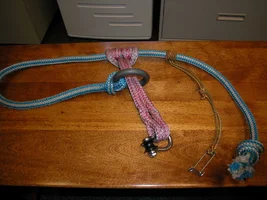
adjustable friction saver

That is the right configuration. I trust that you're not going to use those biners for the final copy. Did you find the pic of the one that John Sirbasku made? John told me that it took him some time to get all of the parts to be compatible.

I know very well the joy of making custom tools. The balance I look at is how much of my billable time I take to save a buck. In the end, it might be cheaper to buy the RG. Having all of the parts working in unison has some value.

Tom
 
thanks, yeah I'm not too sure what biners i'm going to use. definitely the locking perfect oval, maybe a new but identical D-ring like in the pic, but Im worried about two things: 1) cross loading against the branch(that's why I did'nt use the petzl HMS). 2) that ring is pretty big and seems to beg getting hung up in a tight crotch. I dunno I'll certainly put some more time into it before i hang my life on it.
 
Re: adj. Fric. svr. rings

Some time ago I bought alum. forged rings to use making false crotches.
the ones I bought, after some searching believe me, were fine except that they are plain alum, not anodized. The plain ones will let the rope dig a groove into them over time.
The rope guide, the Buckinham false crotch, and I think the New Tribe false crotch, all use forged alum rings that are anodized. This coating makes the rings more impervious to wear.
That "D" ring you have lookes real heavy to me. Also looks like it might get stuck alot.
Today I got my Rope Guide stuck 2 times! !*#?!
Sorry dont know where to buy them. I heard Buckingham's supplier will only deal with high volume orders.
frans
 
Tom, that's a nice supply site, makes me wish we had
something like that here in Sweden.
I have been thinking of making a rip-off of Sirbasku's
rip-off of the RopeGuide. But as Tom said, just looking
for the right components probably have cost me more in lost
work time than the RopeGuide cost. Still it's too much fun
making your own customized tools :) I am thinking of ways
to incorporate a "screamer" (shock absorber) and maybe
a swivel in my own ropeguide. With a swivel I can't think
of a way to setup the retrieval catch though.
For those of you that use the real RopeGuide, do you have
to replace the clutch plates every 100 hours or so like
on the Lock Jack ?
 
Re: adjustable false crotch

If you want to see a picture of my AFC setup. It is featured in the TreeWorker promotion on page 64 of the January edition of Tree Care Industry magazine (Volume XIV, Number 1 - January 2003.) I am having technical difficulties posting it here.
 
The clutch in the RG should last a long time. Since the rope doesn't move, there is very little wear.

Putting a Screamer in place of the runner on the RG would make sense. Since there is an unknown amount of dynamic movement witha sliding friction hitch, you'd have aknown load limiter in the system.

Fabricating is Fun!

Tom
 
Tom said "The clutch in the RG should last a long time. Since the rope doesn't move, there is very little wear."

So if the RG doesn't move, why do you need it? Why not just tape a hundred dollar bill to a prussik loop and have the same thing? For the life of me I cannot see any need for that expensive of a tool in such an unneccessary place.
 
Brian, I believe the LockJack part of the RG will move,
slide, and act as a shock absorber if there are
forces > 6kN.
This works until it runs out of rope in the RG, no more
than 2,5m or so if you're tied in to a real small limb.
Would be interesting to know how much of the forces above
6kN it would reduce if it had the full 2,5m to run ?
I got this info off a german retailers site:
http://www.freeworker.de/store/pd912473946.htm?categoryId=6

I believe a prussik would also move, slide, and act as
a shock absorber only the activation force, the absorbation
capacity and the heat generation will be more unpredictable.

And of course, with all respect for the people inventing
this ingenious Lock Jack, they want to find more applications
for it and the invention to pay off.
 
Frans,
Your reply does nothing to explain why you need an expensive mechanical device to adjust the length of your false crotch. And as for shock absorbing qualities, we are not tied into steel girders. Our tie-ins move with the wind and when loads are placed on them.
How does the RG with a very expensive LockJack incorporated work any better than the same setup using a prussik or other hitch or knot? Other than being able to claim you have an expensive friction saver?
 
Brian, Brian, Brian,

That old tautline hitch climber mentality is creeping back out of the depths of your psyche :) Keep him in control.

Thinking of the practicality of the RG, you're right, its an expensive, over $150, replacement for a free branch union in the same way that a ratcheting lowering device is an expensive replacement for free tree wraps. This is another example of the arc in the curve of arbo technology.

This is the way that I explain the natural crotch to RG spread.

Consider a natural crotch as a zero. This takes everything into consideration and is the low end of a baseline. Cheap, always available, lots of friction, hard on rope, hard on tree sometimes, tree wrapping rope leads to more friction, etc Now, as we go along, you know all of the pluses and minuses of the itterations.

60%-ring on ring/flat webbing
70%-ring or biner and pulley on flat webbing
90%-ring or biner and pulley on rope or what we call an AFC:adjustable false crotch
95%-homemade RG
100%-manufactured RG

Those percentages could be moved around a few points either way, no problem. The thing to consider is that the advantages of climbing on a single pulley and having [theoretically] zero friction in the climbing system is the epitome, at least this week :)

Value, like art, is in the eye of the beholder.

What I meant by the clutch not moving is that it is slid and placed when there is no load on the rope. Also. the rope in the RG should stay cleaner than climbing rope. The dirt in the rope acts as an abrasive. At the end of climbing one tree, think of how many feet of rope move through a friction hitch. How much wear is from loaded movement and how much from unloaded?

The shock absorbing capabilites of any of the units from the AFC up in my list could be a big benefit if a climber took a high fall factor drop. Most times arbos don't expose themselves to high fall factors because we keep our ropes snug.

Tom

 
You post an excellent argument for using a RG type friction saver. But you still haven't answered why you need a very expensive chunk of magnesium as part of that RG instead of a simple prussik. That IS a LockJack that adjusts the length of the RS, isn't it? The LJ sells for over $200, rather pricey when you aren't even using it and it never moves! Why have a $200 chunk of metal instead of a prussik to adjust the length of your RS?
The lifeline will still be riding on a pulley with zero friction and you wouldn't have to worry about busting that $200 LJ when removing the RG from the tree.
 
Brian,
I was also skeptical about the RG in the beginning and said a few things in this forum which I now regret...
The RG works with a complex idea and although you can re-invent it in a cheaper way, it will be hard to duplicate the compatibility of the various elements. I'm also selling an AFC but with a pulley-ring configuration. The difference between the LJ part and a friction hitch is simply that the first is more compact and "neat".
Everyone is free to choose tools according to his own budget but you can't complain to Mercedes Benz saying that you've seen much cheaper cars that takes you from one place to another just like theirs...

Sergio
 
Brian,
Besides the shock absorbing capabilties, from what I can visualize the sliding puck(LJ) is also a great advantage for retrieval. After the rope been pulled thru the pulley and catches on the shackle, the direction of pull on the shackle rotates the LJ slightly and it can slide or slither down to the stopper knot at the end of the RG. Now the whole RG is looser around the choked limb making it easier to pull the RG around and off.
Using a hitch yes does work, Ive been doing it for over 6 months, however there are very little subtle differnces and this is one I think. Using my setup, the retrieval link is at the end of the FC, when pull is exerted on the retrieval link, this does not loosen up the hitch, you are merely pulling on the end of it, which usually does the trick however if you had really snugged it tight around the limb it could become jammed because of this.(and ive come close)
One could make adjustments for this like putting a tender pulley above the hitch with the retrieval link attached to that, but no the set up is becoming to complex.

I understand your thinking using a hitch vs LJ and i too wondered the same thing. like everything else it all trial and error. like i said my system works, but to alot of us climbers (striving for the perfect system) subtle little annoyances can make all the difference in the world.
My plan is this, i will buy a RG, then I will compare it in field use to mine to see which i prefer.

how much does one cost anyway? My LJ sport cost 200. and i hardly ever use it
 
Re: adjustable false crotch

Tim, I would love to read that article.
Unfortunately I don't subscribe to TCI, I am
however looking in to the added costs of having it shipped
to Sweden. From what I've heard here and on another forum
it is very nice paper.
 

New threads New posts

Back
Top Bottom