
Navigation
Install the app
How to install the app on iOS
Follow along with the video below to see how to install our site as a web app on your home screen.
Note: This feature may not be available in some browsers.
More options
You are using an out of date browser. It may not display this or other websites correctly.
You should upgrade or use an alternative browser.
You should upgrade or use an alternative browser.
Accident Prevention
- Thread starter mrtree
- Start date

Fireman are an interesting group. Every fire and every rescue is different, as different as every tree removal and likely with more hazards and higher risks yet fireman work with a very strict set of guidelines, standards and education/training requirements.
If fire fighting can be governed by NFPA why do people think that tree work is so difficult to apply occupational health and safety standards to?
If fire fighting can be governed by NFPA why do people think that tree work is so difficult to apply occupational health and safety standards to?

monkeylove
Been here much more than a while
- Location
- Roslyn, Pa.
Fireman are an interesting group. Every fire and every rescue is different, as different as every tree removal and likely with more hazards and higher risks yet fireman work with a very strict set of guidelines, standards and education/training requirements.
If fire fighting can be governed by NFPA why do people think that tree work is so difficult to apply occupational health and safety standards to?
Easy answer is that fireman doubt bid on jobs or rescues ( they don't have competition). Maybe a couple companies per township maybe. Probably a dozen tree companies in that same township all looking to cut costs and make more profit.
Don't get me wrong I think all industries need to take a continual look at their safety, the problem I see with Tree Companies is that they are "new" to governing standards as compared to many of the other industries out there that have had them in place for decades. A lot of them were driven by much, much larger corporations that realized that a great safety program and record could be used as leverage for a deduction in insurance related costs. I would expect that the Asplundhs & Bartletts of the world push and check conformity on a daily bases. The littler guys out there only reap one benefit from being safe. Take that within scope and not literally as we all know the biggest benefit is that you come home alive by being safe. With all that being said my #1 goal at the end of the day is for myself and crew to go home at the end of the day, the job being finished and for a profit are a far away 2nd and 3rd.

flyingsquirrel25
Carpal tunnel level member
- Location
- South East, PA
Fireman are an interesting group. Every fire and every rescue is different, as different as every tree removal and likely with more hazards and higher risks yet fireman work with a very strict set of guidelines, standards and education/training requirements.
If fire fighting can be governed by NFPA why do people think that tree work is so difficult to apply occupational health and safety standards to?
You must not be a fireman, associate with any closely or they don't talk to you honestly. NFPA to firefighters is like ANSI to the tree industry. Not For Practical Application gives recommendations for standards like minimum staffing, minimum equipment, minimum apparatus on an alarm and minimum requirements for our gear. There are still companies that let their members inside an IDLH with out all their gear. Don't think for one second that there aren't the "landscaper" type companies that don't care to care, or know to care. That's why firefighters are dying at an alarming rate from cancer.
flyingsquirrel25
Carpal tunnel level member
- Location
- South East, PA
We will have to make sure you get some of that a$$ back on Monday. I got some built in wiggle room incase we need it Mert.
Thanks Frank, but that's part of being in business. I accepted that when I handed in my resignation letter. The idea is not to get so worked up over today that you loose sight of the goal. Missing the bid one day out of three or five is minor in the grand scheme of things. And doesn't mean I need to rush, hurry, change my plan or die trying. Just take the pill, learn and move on. Tomorrow is another day... As long as I'm still here!!!
flyingsquirrel25
Carpal tunnel level member
- Location
- South East, PA
So flyingsquirrel your answer to everything is I don't know and nobody else does so lets be damned.
OK... That's from left field. But ok. My answer doesn't matter, I'm one individual in an industry of many. I can't even convince you of my opinions of where our problems are. How do you expect me to change, 10, 20, 30 or 100 in our industry.
I am practicing my answers everyday in the way I bid my work, do my work, treat the guys that work with me and with the equipment I buy and maintain. I am working within my circle of influence (like I mentioned before) branching out when I can and do not compromise my standards, because in all actuality that's all I can do with my current resources.
So if my practices are considered my answers, then yes let's be damned and maybe we will get somewhere!
Last edited:
flyingsquirrel25
Carpal tunnel level member
- Location
- South East, PA
Another thread ruined
Im sorry I ruined your thread. I will shut my trap now. Please carry on with your conversation! Thanks for listening.
flyingsquirrel25
Carpal tunnel level member
- Location
- South East, PA


treehumper
Carpal tunnel level member
- Location
- Ridgefield, NJ
To put it simply, there are no real consequences for not complying. It's all well and good to have regulations and to espouse a "safety culture" but if when there is a failure to comply and nothing happens then it all falls apart. Someone said it a few years back. When a shortcut works it becomes SOP. That goes with safety protocols. Everyday, everyone needs to call out lapses or stop work when they see something isn't being done. It can't just be the boss or the supervisor, especially if they are not on the job.
I see it all the time, the crew leader is focused on getting the job done, someone doesn't put on their helmet or some other element of PPE and nothing is said, then it becomes the norm. The helmet comes off when there's nothing going on above and then it's only put on and at that poorly when they feel they have to. One of the reasons we stopped using chaps for the grounds people was they wouldn't always put them on and the crew leader wouldn't demand it.
Only when it is embraced at all levels and at all times such that anyone can stop processes in order to correct a safety lapse.
Paul O'Neill not only made it a priority at ALCOA, but proved that it will go right to the value of the company. Watch him talk about it
I see it all the time, the crew leader is focused on getting the job done, someone doesn't put on their helmet or some other element of PPE and nothing is said, then it becomes the norm. The helmet comes off when there's nothing going on above and then it's only put on and at that poorly when they feel they have to. One of the reasons we stopped using chaps for the grounds people was they wouldn't always put them on and the crew leader wouldn't demand it.
Only when it is embraced at all levels and at all times such that anyone can stop processes in order to correct a safety lapse.
Paul O'Neill not only made it a priority at ALCOA, but proved that it will go right to the value of the company. Watch him talk about it

FreeFallin
Branched out member
- Location
- Wisconsin
I don't work in the industry, I just have a lot of opinions on societal change.
Can't find the quote, but someone said - "the status quo only changes, when the status quo becomes more painful than the change."
If you want to standardize something like safety, that until now has been dependant on the willingness of a person or company to assume risk in a given situation. Then you would have to increase the risk or pain of consequence.
Right now, the strongest force I see in this situation is liability insurance companies that can say, you were not following safety guidelines so you will have to pay this yourself. They hold some power to inflict consequence so better safety becomes a less painful option.
To truly transform an industry and convince people to take on less risk, you would have to establish a body with the power to inflict consequences. For most other industries this usually takes the form of either government oversight (think banking), or unions (think textiles) to bring in either of those forces the industry would have to create enough public outcry because climbers are getting sucked into chippers everyday, or children are being forced to be groundies for $2 a day, I don't see any cause for the general public to get behind the cause so we have to ask, where would the pressure come from, to make this change less painful than the status quo?
Can't find the quote, but someone said - "the status quo only changes, when the status quo becomes more painful than the change."
If you want to standardize something like safety, that until now has been dependant on the willingness of a person or company to assume risk in a given situation. Then you would have to increase the risk or pain of consequence.
Right now, the strongest force I see in this situation is liability insurance companies that can say, you were not following safety guidelines so you will have to pay this yourself. They hold some power to inflict consequence so better safety becomes a less painful option.
To truly transform an industry and convince people to take on less risk, you would have to establish a body with the power to inflict consequences. For most other industries this usually takes the form of either government oversight (think banking), or unions (think textiles) to bring in either of those forces the industry would have to create enough public outcry because climbers are getting sucked into chippers everyday, or children are being forced to be groundies for $2 a day, I don't see any cause for the general public to get behind the cause so we have to ask, where would the pressure come from, to make this change less painful than the status quo?
Last edited:
FreeFallin
Branched out member
- Location
- Wisconsin
And just so you don't think I'm trying to dampen the idea, my question is sincere - where will the pressure come from?
A tree will always fall exactly the way the forces at play tell it to, always. An experienced feller can look at a tree and see many of those forces, then choose to add, remove, and manipulate those forces by cutting some places, not cutting others, introducing a wedge, or a rigging line, etc to create an environment of forces that will drop the tree in the desired spot.
Societal change is really no different, forces are at play, how can the work environment be manipulated to create the desired set of forces that will produce better adherence to safety standards?
A tree will always fall exactly the way the forces at play tell it to, always. An experienced feller can look at a tree and see many of those forces, then choose to add, remove, and manipulate those forces by cutting some places, not cutting others, introducing a wedge, or a rigging line, etc to create an environment of forces that will drop the tree in the desired spot.
Societal change is really no different, forces are at play, how can the work environment be manipulated to create the desired set of forces that will produce better adherence to safety standards?
treehumper
Carpal tunnel level member
- Location
- Ridgefield, NJ
It's not liability insurance so much as it would be WC. They have the bigger stake in the safety side of the business. There are plenty of agencies, government and NGOs that can add pressure. OSHA is the big player. The issue is enforcement and lack of funding for such. The other element is understanding the bottom-line benefit of safety instead of seeing it as an expense.
flyingsquirrel25
Carpal tunnel level member
- Location
- South East, PA
http://dripline.net/n-j-man-killed-wood-chipper-accident/
Another unfortunate loss. RIP.
Another unfortunate loss. RIP.

Mangoes
Participating member
- Location
- Greater Toronto Area
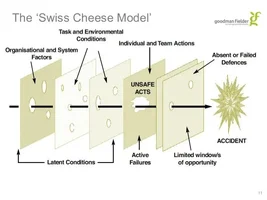
James Reason's Swiss Cheese Model is an interesting reflection excercise.
My concern is the final barrier to an accident; The decision making skill or behavior of the worker. This is the barrier which is harder for those responsible for worker safety to control.
I think it is more common for leaders to put effort in the other barrier's (née slices of Swiss cheese) in order to protect their interests. Such as policies, training, procedures, regulation, paper trail etc. Which IS a noble and fair effort on their part. Yet managing that final behavior/decision making barrier to an accident by the worker is left less controlled by many companies, even those l with very refined OHS programs.
The preceding respondents all have valid points to ponder. Unfortunately they are misunderstanding each other and therefore "written off" the others perspective.
But I think they all are pointing out, that a good OHS program is required and noble, but somehow managing the individual tree worker's decision making skill set and professional behavior is what would best propel our industry into a new paradigm of reduced injury and fatality rates.
My concern is the final barrier to an accident; The decision making skill or behavior of the worker. This is the barrier which is harder for those responsible for worker safety to control.
I think it is more common for leaders to put effort in the other barrier's (née slices of Swiss cheese) in order to protect their interests. Such as policies, training, procedures, regulation, paper trail etc. Which IS a noble and fair effort on their part. Yet managing that final behavior/decision making barrier to an accident by the worker is left less controlled by many companies, even those l with very refined OHS programs.
The preceding respondents all have valid points to ponder. Unfortunately they are misunderstanding each other and therefore "written off" the others perspective.
But I think they all are pointing out, that a good OHS program is required and noble, but somehow managing the individual tree worker's decision making skill set and professional behavior is what would best propel our industry into a new paradigm of reduced injury and fatality rates.
James Reason's Swiss Cheese Model is an interesting reflection excercise.
My concern is the final barrier to an accident; The decision making skill or behavior of the worker. This is the barrier which is harder for those responsible for worker safety to control.
Yes you are correct that it is harder to control but by no means impossible. Some employees simply need firing while others need training, education, guidance, modelling, auditing, pep-talks, coaching etc. to get to a point where the holes in the wall are minimized and as a owner/supervisor you can say that despite everything the worker made a bad decision.
One way of getting employees to think and reduce the holes in their slice of the work day is to do effective hazard and risk assessment of the job, combined with empowerment to control the hazards on site and eventually change company policy/SOP to reduce risk such that residual risk is at an acceptable level.
The preceding respondents all have valid points to ponder. Unfortunately they are misunderstanding each other and therefore "written off" the others perspective.
I do not think there is a misunderstanding when every suggestion made, including looking at other industries and fire-fighting is met with derision. I do know that when workers and employers spit out that that it impossible, it will not work, you don't understand, you have never done this job, our job is different and special or any of a plethora of other deflections and excuses, they are not ready to start thinking with a new mindset that places safety of the workers, and as a reward the financial and metal well-being of the owner on a better footing.
View attachment 42625
flyingsquirrel25
Carpal tunnel level member
- Location
- South East, PA
Don't forget firemen Mert.
Old oak brought up the firemen
Fireman are an interesting group. Every fire and every rescue is different, as different as every tree removal and likely with more hazards and higher risks yet fireman work with a very strict set of guidelines, standards and education/training requirements.
If fire fighting can be governed by NFPA why do people think that tree work is so difficult to apply occupational health and safety standards to?
You provided what the firefighting world wants it's customers (residents) to know and trust.
You must not be a fireman, associate with any closely or they don't talk to you honestly. NFPA to firefighters is like ANSI to the tree industry. Not For Practical Application gives recommendations for standards like minimum staffing, minimum equipment, minimum apparatus on an alarm and minimum requirements for our gear. There are still companies that let their members inside an IDLH with out all their gear. Don't think for one second that there aren't the "landscaper" type companies that don't care to care, or know to care. That's why firefighters are dying at an alarming rate from cancer.
For which I added my experiences as to actual real world occurrence, and what really goes on in our world (firefighters)
I do not think there is a misunderstanding when every suggestion made, including looking at other industries and fire-fighting is met with derision. I do know that when workers and employers spit out that that it impossible, it will not work, you don't understand, you have never done this job, our job is different and special or any of a plethora of other deflections and excuses,
And then accuse all those that may not see your exact views as "they are not ready to start thinking with a new mindset that places safety of the workers, and as a reward the financial and metal well-being of the owner on a better footing."
We both want the same thing, accident prevention. We both are looking at the same statistics, incidents, atrocities, and industry. We speculate differently the causes of these incidents because neither of us have complete information (and because we weren't there will probably never have it). There is very little chance that two people will ever come to the exact same solution to a problem this complex. And that's OK. One of the best parts of the buzz is the multitude of opinions, techniques and different view from such a wide array of people. You want change, I want change, we both agree something needs to be done. I think start small within our company's area of influence. You think regulations (what I interpret from your posts)... Will both work, yes. With they both take time, yes. If we start from both side of our problem, may we get to the middle faster, maybe.
The important part is we put our differences aside or we, as an industry, will be in a paralytic state of nothingness, where change can't happen!
Like my fire chief always says "you don't have to like me, I'm just asking you to work with me".
treehumper
Carpal tunnel level member
- Location
- Ridgefield, NJ
Leaders put their efforts in these areas as a means to delegate through the organization the responsibility in an effort to create buy in and a flow of information back up through the organization. How will that reach and effect the behavior/decision making by the worker? Through the coaching and mentoring of each supervisor at each level. Have every meeting start with safety. Discuss the issues and challenges, mentor toward changing behavior without the threat of termination for non-compliance. This will establish its priority in the pecking order it's raised. No rushing through it to get to "more important matters". It is the most important one bar none. Every supervisor must take that stand.I think it is more common for leaders to put effort in the other barrier's (née slices of Swiss cheese) in order to protect their interests. Such as policies, training, procedures, regulation, paper trail etc. Which IS a noble and fair effort on their part. Yet managing that final behavior/decision making barrier to an accident by the worker is left less controlled by many companies, even those l with very refined OHS programs.
Too often a crew leader won't bring up safety issues for fear that it will lead to the loss of income for the employee and thus their ability to support their family or themselves. They'll let it slide because nothing bad happens. Instead of finding a way to coach they'll keep letting it go only chastising for the worse near misses. The one's that can't be hidden. The next level manager needs to be more astute in their appraisal of such incidents. They are not one offs but usually systemic.
Companies do need to have a zero fatality/incident goal but it's the implementation of that and the persistent management that will eventually bring it to the frontline.
New threads New posts
-
test
-

-
 Throwline training and climbing 9/28/26
- Started by ClimbingTN
- Replies: 10
-

-

-

-

