A lower-able DdRT TIP

samsquatch

Participating member
Location
SE MN
Has anyone considered a lower-able pulley TIP for a DdRT system?

One option would look like an SRT system with an upside down F8 on basal anchor, Ring-Ring friction saver crotch to run single line thru, with a pinto on that end that becomes the TIP for the doubled rope - that would be the @oldfart o-ring style with Uni, for me.
advantage: remote set & retrievable.
advantage: groundie lower climber in time of emergency
advantage: also simpler to move the TIP in the canopy, you don't need to unclip the DdRT rig, just the pinto from the SRT line.
advantage: remote set-able high efficiency DdRT pinto - rather than the pinto + big ring as in the U-Saver I'm using.

disadvantage: requires separate climbing line (or a very long DdRT tail) and a pulley block up top if you're not already using one.

Just thinking out loud, it would be nice for a novice such as a wife or a neighbor to be able to lower one on the F8 if something ever happened while farting around in a tree.

Besides the extra gear, is there any other disadvantages to this?

Cheers!
SAM
 
Before I started climbing srt I would hoist up a pulley on a base anchor in certain trees, like white pines. Helpful when you can't or don't want to isolate a limb.
The biggest disadvantage in my opinion is having the base anchor in harm's way. I would switch to a regular friction saver once you reach your TIP.
I am one of those who doesn't really see much merit in the lowerable base anchor setup, but that's another argument.
 
Before I started climbing srt I would hoist up a pulley on a base anchor in certain trees, like white pines. Helpful when you can't or don't want to isolate a limb.
The biggest disadvantage in my opinion is having the base anchor in harm's way. I would switch to a regular friction saver once you reach your TIP.
I am one of those who doesn't really see much merit in the lowerable base anchor setup, but that's another argument.
Don’t wanna derail but I agree. Im trying to think of a scenario where you could lower a climber from the ground without another climber in the air. The idea of a base tie with a pulley is solid though. I’ve done it before when I was making stuff up as a young buck especially for white pine. Isolating with two throw balls is just so easy once you’ve practiced enough. But if your a solely double climber who has an extremely high tie in point that your gonna work off for the majority of your climb then yea it’s definitely benefitial
 
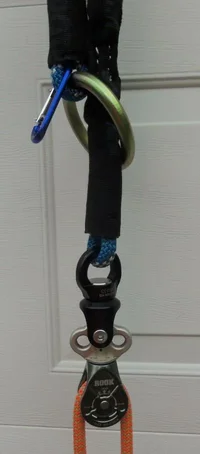
I use pulley canopy anchors for DdRT... I've made about four different ones. The one pictured below did have a different pulley in it... the swivel on the ROOK pulley makes the swivel shackle redundant, but I like the pulley better than the fixed pulley I had in it initially. A retrieval line gets hooked onto the blue mini-'biner, and I usually put a throwline through the pulley and pull the climb line through the pulley after the anchor is installed. It installs a lot like a ring-and-ring friction saver. When I'm done climbing, I pull the climb line through the pulley and at that point you can put a throwline on the end of the climbline and pull that back through the pulley, and use it to help bring the pulley anchor down slowly. Most of the time, I just pull the climb line out and then pull on the retrieval line and let the anchor fall down, if there's no concrete or anything for it to hit. You have to watch your head... the anchor is quite heavy and could crack your skull if it landed on your head.

As a choked canopy anchor, the load on the TIP is nowhere near what a basal anchor would be.

canopy-anchor-ddrt-3.webp
 
Yup all the time in the big conifers before switching to SRT. It's very useful, but pointless with SRT. Its called a false crotch system, and has been done for many YEARS! However the base tie rescue thing is a bit over rated in my opinion.
In fact it would be interesting to see a first hand account of a true ground based rescue. I look at it this way, if the climber is doing things right they are tied in twice. The two most likely ways to get hurt in a tree is a chainsaw cut, or struck-by. Both cases the climber SHOULD and SHALL be tied in twice, negating the possibly of lowering the climber from the ground.
Getting attacked by bees, KO from a hanger, heart attack, fainting, or some other event is the only time I could see some merit.
 
If one we to cut oneself, first thing would be to apply pressure, check climbing system is intact, testing ideally, then unclip lanyard. Go back to applying pressure while being lowered.
 
I agree that the scenario where the ground crew, quickly rescues the injured climber by lowering them to the ground is farfetched. Southsound brought up one possible situation. I am sure we could dream up more, but the statistics do not bear it out. A climber aided, ground crew assisted lower is a valid technique and one well worth practicing during your aerial rescue drills.

I think the reason many dismiss the adjustable base anchor stems from limited view. Even if a rescue system is rare and highly unlikely, the idea of adjustable base anchors is still valid for many reasons. It is my view that all, but the most basic climbs incorporating basal anchors, MRS or SRS, should employ some form of adjustability at the anchor point . By adjustability I mean the ability to add or subtract rope from the system. Get away from labeling them "lowaaerble" or "rescue" anchors, that is but one, admittedly rare, use. Adjustable anchors can be simple and effective, providing options in many scenarios from the rare rescue to the common redirect.

Tony
 
I think the idea of being able to lower a climber to the ground from the ground has its merits.
It is not something that we currently do however are looking to put it into place shortly as part of our safety control measures.
The majority of our work is clearing around powerlines, we are expected to be able to perform a rescue in 4 minutes, almost impossible in a work scenario.
While it may be rare that you could lower a climber to the ground without them getting hung, on the odd occasion that it was possible it would save precious minutes in getting first aid to the injured person. It also eliminates the risk and possibility of injury to another climber.
 
If one we to cut oneself, first thing would be to apply pressure, check climbing system is intact, testing ideally, then unclip lanyard. Go back to applying pressure while being lowered.
That's the magical (and most likely) scenario that makes it worthwhile. All these people complaining about hazards of a basal leg need to
1:get better ground hands if they think they'd ever possibly be dumb enough to cut it
2:get better at cutting and rigging if they're concerned about the risk of cut pieces catching it
3:watch the Shultz effect if they actually think that their weight is doubled at the primary TIP and practice working with friction and setting predirects.
It is not always the best way to climb a tree, but it is often the easiest, most efficient way to work a tree. I started using SRT as a canopy anchor only climber. I really believe that a properly basal anchored setup is both a more advanced technique and more versatile than most simple canopy anchors. It also really excels when you incorporate DSRT systems.
 
I'll add a nuance that I've never heard anyone bring up related to basal anchor rescue

If a rescue climber does have to go to the victim someone on the ground can attend to lowering while the rescuer attends to patient care and not having to split their time and skills with the lower

The pervading meme about rescue is based on the ITCC AR where the rescuer acts alone. That is only one scenario. In most crew situations there are more people who can be involved

When a broader view of lowering is taken there are more options

When I've talked about lowering in a DdRT situation I always suggest that a person belay the tails of either victim or rescuer. With only one rescue climber they can usually use three or more extra hands just for the lower. Adding in needed hands for victim care takes away attention to the lower
 
  • Like
Reactions: evo
Good discussion points, thanks everyone.
While the discussion has quickly averted to the advantages of a basal anchor in SRT terms, let's remember that without a setup like this there is NO way of lowering someone to the ground that's using a DdRT system.
So while your partner's femoral artery is gushing and you (the groundie) don't have your harness on the job, now you're waiting 4, 6, 20 minutes for the FD to show up with their big ass ladder rig, and now they can't reach the tree because it's in a suburban backyard.

In the spirit of the "What ifs" I think a lower-able anchor should be mandatory in professional climbing, no matter the rescue skill level of another climber, nevermind the scenario when one doesn't have their climbing gear because they were "just a groundie today".

Cheers!
 
Good discussion points, thanks everyone.
While the discussion has quickly averted to the advantages of a basal anchor in SRT terms, let's remember that without a setup like this there is NO way of lowering someone to the ground that's using a DdRT system.
So while your partner's femoral artery is gushing and you (the groundie) don't have your harness on the job, now you're waiting 4, 6, 20 minutes for the FD to show up with their big ass ladder rig, and now they can't reach the tree because it's in a suburban backyard.

In the spirit of the "What ifs" I think a lower-able anchor should be mandatory in professional climbing, no matter the rescue skill level of another climber, nevermind the scenario when one doesn't have their climbing gear because they were "just a groundie today".

Cheers!
I like all of that except for one word. "Mandatory" There are just too many variables to throw that in there. Furthermore, not everyone can keep up with the extra considerations associated with your life having such a long target associated with it. Rarely are the resets involved in a basal efficient on large removals. You have to account for all of the exceptions.
 
I use a lower-able DdRT system for ascent. After I get to the TIP, I switch over to a friction saver if the first TIP is not ideal. I use an omni block 1.5 on kernmaster for a lower-able TIP. I use a petzl IDs on the basal anchor. I know it is overkill, but I picked it up for $50, new, on ebay and it works perfectly for a lowering device. I also like the anti panic function for the overly ambitious groundie. It is a lot of gear, but it works so well.
 

New threads New posts

Back
Top Bottom