The difference between logging and Suburban Tree Work

I can't tell you how infuriating it is that they won't let me take the test for my contractors license because I don't have the hours under another contractor. It's obviously a good ol' boys club. I could even get insurance without that license, and in many states, you don't need a contractors license. What is the justification for not letting people take a test and demonstrate proficiency and understanding? Why should it matter that I wasn't employed full time? I have spent years learning this stuff and practice a lot at home, but those hpurs don't count; why?
Say wha? That sounds more like an apprenticeship thing. Is this a requirement for all contractors in Cali?
 
Say wha? That sounds more like an apprenticeship thing. Is this a requirement for all contractors in Cali?
Yes, but the requirement for the tree service contractors is the highest number of hours of any kind. I have been an "apprentice" for a long time, but the first licensed contractor I ever worked for says he learns from me now, at least more than he teaches me.
 
Daniel . Ok I'll bite.
Wtf are you using the center plunge in an urban setting? The center plunge removes holding power of the hinge. As a professional logger I would never use that technique in the urban setting for fear of losing control of the stem. I've had so many trees "pop" those corner posts and go 90 degrees to my desired lay. A bit of decay, included bark, seams, twisted grain can fail so easily its scary.
In the woods that cut is used to prevent fiber pull, splitting and barber chairing also its major use is to weaken the hinge so that if the tree contacts other trees on the way down it can roll off the stump. By leaving 2 small "posts" on either edge of the face it still provides just enough directional control to keep the tree on its desired path, but not enough to prevent it rolling when needed. Veneer cutters have used it for decades, also use it when your bar isn't big enough to reach your center wood if big stem.
I'm not on the ground to see you do what yer doin but it seems like you are rolling the dice with that technique. And claiming like u invented it. Wait til you have a post pop on you and you will poop yer pants.
I appreciate all your vids etc but this center plunge has no space around targets. My 2 cents.
 

Attachments

  • 20210906_102028.jpg
    20210906_102028.jpg
    722.5 KB · Views: 19
Daniel . Ok I'll bite.
Wtf are you using the center plunge in an urban setting? The center plunge removes holding power of the hinge. As a professional logger I would never use that technique in the urban setting for fear of losing control of the stem. I've had so many trees "pop" those corner posts and go 90 degrees to my desired lay. A bit of decay, included bark, seams, twisted grain can fail so easily its scary.
In the woods that cut is used to prevent fiber pull, splitting and barber chairing also its major use is to weaken the hinge so that if the tree contacts other trees on the way down it can roll off the stump. By leaving 2 small "posts" on either edge of the face it still provides just enough directional control to keep the tree on its desired path, but not enough to prevent it rolling when needed. Veneer cutters have used it for decades, also use it when your bar isn't big enough to reach your center wood if big stem.
I'm not on the ground to see you do what yer doin but it seems like you are rolling the dice with that technique. And claiming like u invented it. Wait til you have a post pop on you and you will poop yer pants.
I appreciate all your vids etc but this center plunge has no space around targets. My 2 cents.

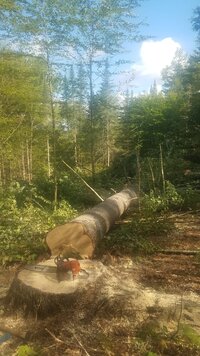
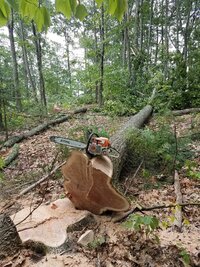
20220823_151858.jpg
 
Daniel . Ok I'll bite.
Wtf are you using the center plunge in an urban setting? The center plunge removes holding power of the hinge. As a professional logger I would never use that technique in the urban setting for fear of losing control of the stem. I've had so many trees "pop" those corner posts and go 90 degrees to my desired lay. A bit of decay, included bark, seams, twisted grain can fail so easily its scary.
In the woods that cut is used to prevent fiber pull, splitting and barber chairing also its major use is to weaken the hinge so that if the tree contacts other trees on the way down it can roll off the stump. By leaving 2 small "posts" on either edge of the face it still provides just enough directional control to keep the tree on its desired path, but not enough to prevent it rolling when needed. Veneer cutters have used it for decades, also use it when your bar isn't big enough to reach your center wood if big stem.
I'm not on the ground to see you do what yer doin but it seems like you are rolling the dice with that technique. And claiming like u invented it. Wait til you have a post pop on you and you will poop yer pants.
I appreciate all your vids etc but this center plunge has no space around targets. My 2 cents.
Good to hear from you... It's been a long time... Hope you've been well..

The center plunge is my preferred cut to use on anything big. Even when obstacles are of great value. In other words I trust the hinges that result from center plunging more than a full hinge. The one difference between my scenarios and yours (you don't trust the center plunge) is that I AM pulling with heavy equipment and a high pull line. I would bet the times you have lost your trees to side weight, you were using wedges, not ropes.

I would never attempt to fall a tree around valuable obstacles without a high pull line. I see these YT video of guys banging wedges with no pull line on trees that have been topped. That's crazy IMO. You were there to make the cut.. Why not put a line or two in there while you're at it???

For clarity, I disagree with your second sentence as follows:
The center plunge removes holding power of the hinge.
When used properly, the center plunge adds strength to the hinge. I have never lost a tree with a center plunge hinge. You might have to cut your hinges down to 2-3" thickness before you can get the tree moving with wedges. My hinge posts are 6, or 8, or 10" thick, when needed. I AM usually pulling with a 10,000 lb loader that has 4x4 and wide tires. They aren't going to pop...

The biggest bar I have been running in the last few years is a 28. Right now I think all the saws are 24s. So I'll use it often just to make short bar falling cuts easier.

And what makes you say I "
claiming like u invented it.

????

I made no such claim... EVER... What you might be hearing in my tone is just excitement. I love the cut and as said above, now use it all the time... I particularly like to use it on backleaners and with the tapered hinge on side leaners.

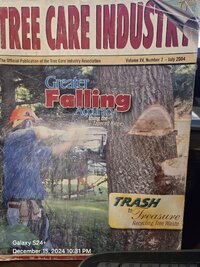
I know I have been using it since 2004 because the first time I ever used the cut just so happened to make the cover of the July 04 issue of TCIA magazine. That may actually be the first time the technique was published. But I didn't know what I was doing with it back then. I only used it because my mentor, who took the picture, told me to use it on that back leaner. It's only been the last 5 years or so that I have become much more experienced with its use. I AM a huge fan of the technique. The fact that your post, critical of the technique, got so many likes shows that, once again, I attract controversy.

SO before anyone else gets started: I don't care who you are or what kind of credentials you have. There's nothing you could say or do that's going to change my mind. I trust the cut because I have used it extensively and know what it can do. There are of course some contingencies, but that's for another comment.

 

Attachments

  • TCIA magazine cover 2004.jpg
    TCIA magazine cover 2004.jpg
    703.8 KB · Views: 10
Last edited:
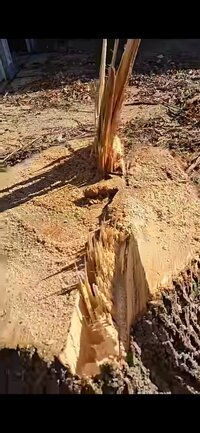
Here's a good example.. this tree was right next to a garage and well within striking distance of the house, but it was straight and when using a high pull line and the loader, there was zero chance of failure. The hinge is only as fat as was needed. If there was any appreciable side weight, I would have left a fatter hinge in the tension side of the tree.

I used the center plunge here for convenience, not control.
 

Attachments

  • Screenshot_20241215_230631_YouTube.jpg
    Screenshot_20241215_230631_YouTube.jpg
    318.4 KB · Views: 9
Last edited:
Here's the stick of another one. Fairly straight oak... not much chance of failure. Fairly big center plunge leaving 2 small posts. Cut the first up real small leaving only an inch or two of thickness.

Then bring the saw around the other side until (with the given pretension) the back cut starts to open just a hair. That way i know she's cut up and cue the pull.
 

Attachments

  • Screenshot_20241215_231754_YouTube.jpg
    Screenshot_20241215_231754_YouTube.jpg
    369.4 KB · Views: 10
The center plunge removes holding power of the hinge. As a professional logger I would never use that technique in the urban setting for fear of losing control of the stem.
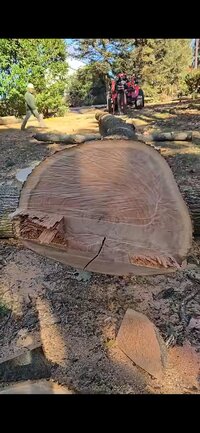
This stump is 5 feet across the long way. Those fat posts are 6 inches plus wide. Pulling with 2 ropes on the loader. I took a running start at it with the loader. By the time the hinge posts let go, the momentum was 100 percent taking this tree to the lay. You don't get momentum from banging wedges.

Another significant advantage to the pull line and loader is that you don't have to stay at the stump during the fall. That's another clear difference between GTW and logging.
 

Attachments

  • Screenshot_20241217_063941_YouTube.jpg
    Screenshot_20241217_063941_YouTube.jpg
    420.6 KB · Views: 8
Last edited:
A full length hinge undoubtedly provides more control to a stem. I still can't quite understand why you choose 2 thick posts instead of 1 long (tapered if need be) hinge. I understand the outside 2 corners are really all that is needed for directional control, but why take the risk of removing the center, especially on urban trees where defects are plenty. It seems like a bit of chainsaw showmanship and wasted moves in that setting. In the woods where every inch of that veneer log counts and to get it on the ground without tearing, splitting etc the extra work pays. In someone's yard you are adding an additional what if. And I don't like it. You do you man, but I hope people aren't paying to much attention to your vids cos this is one that takes some serious technical knowledge. I think someone/something could get messed up.


I learned how to gut a hinge in 2013. So I've only been using it for 11 years on the regular. I have never used it in an urban setting. I still do tree work to stay current and sharp, but it's not my every day.
Be safe. This video was taken yesterday while cutting on a logging job.

P.s
Why you would take a running start on a pull tree with a front end loader sounds insane. Especially with the tree cut up amd standing on posts. I guess I'm playing a diff game then you Daniel.
Be safe
 

New threads New posts

Kask Stihl NORTHEASTERN Arborists Wesspur TreeStuff.com Teufelberger Westminster X-Rigging Teufelberger
Back
Top Bottom