Critique my "treehabilitation"

First a bit of backstory...(skip to pics if you'd rather)
Last year, the city snow plow crews went around and cut branches back from the road they found problematic while plowing. Certainly necessary work. They topped a lot of branches. I ended up talking with the street department supervisor, the guy who is in the street department to whom all tree questions are directed, and a tree commission member (and friend) to discuss how that could be done better. I offered to take a few hours and do a pruning training. Basically, was going to talk about how to make property cuts at branch collars. The branches they topped could have been removed and everything would have been better off (as you all already know...). They said sounds great. Never called back to schedule.

Last week leaving church after Christmas eve service, I see a young tree in front of our building has been topped. I called street department and said "I see the tree in front of our building along Main Street was mutilated...what's done is done, I just want to make sure nobody touches the trees on the other road (corner lot), we'll take care of those." Lady answering phone blamed it on electric company. I said "no...there aren't overhead lines and the same thing happened to all the trees on main." She said they don't prune trees, but will pass it along. A bit later supervisor calls me back and says they didn't do it...he thinks the owner of the apartments across the street did (they topped their own tree in the summer, now it is all the trees along Main, so I know it wasn't them).

My tree commissioner friend isn't one to give up easily. He went to several downtown businesses. They all said they saw city trucks doing it. He has another conversation with supervisor. "Well, our guy did a tree by such-and-such restaurant". I looked at that tree...yeah, whoever did that did them all. Commissioner talks to supervisor again...he admits they did them all.

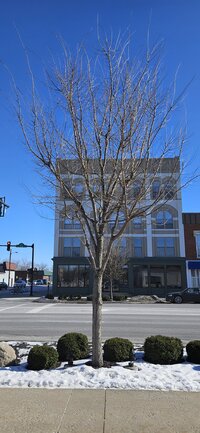
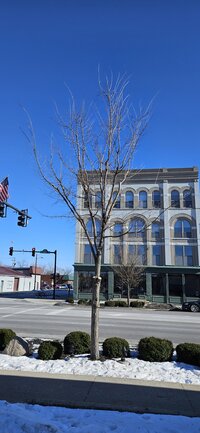
I don't have a pic before anything was done. Before pic is what it looked like when I showed up. After is what it looks like after we pruned it. I know it is not a model of young tree pruning...that was ruined before I got to it. I'm just curious to hear your thoughts.

Before:
View attachment 85643

and After
View attachment 85642


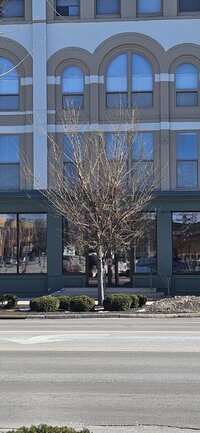
Also took couple pics up into the canopy. It needed pruned years ago...
(we've only been in the building for a year, so I'm only taking a small part of the blame for that - its been on the to do list!)
View attachment 85645


Here is what i did up there (the branch on the left is not taller than the "leader"....just a bad angle.
View attachment 85644


Fire away!
Thanks.
I’d say you likely did the tree a good service for the long run. Your work will prevent larger wounding in the future. We manage a few Elm cultivars in my area. There are some I met when they were very young and another I met in middle age.

With the young ones, structure is the main focus initially. I have thinned the stem count down by choosing the best attachments. Some of those cuts were choosing to retain 2 of 3 highly included leads at maybe 3” or 4” diameter. Those cuts seal quickly and actually form a wider union between the remaining leads. As the structure is formed, I still have to go in almost annually and remove the worst of the co-dominant stems in the periphery.

With the older one, it’s a never ending battle of chasing co-doms, but at a much lower frequency.

I think you got yours young enough to help steer them best in the long run, for good structure and aesthetics.
 
Last edited:
You have done wonders for that tree within two pruning cycles.
The only ‘criticism’ or ‘critique’ would be along the lines of selecting the lowest permanent branch. You know the tree and site, but I would imagine that the lower 1/2 to 2/3’s of the canopy will be removed. However that’s just my guess and the tree looks great. I’d probably go lighter, ‘more heading cuts to mark future removal cuts’ when training the response growth.
But I don’t work on many elms. One every few years is all.
 
You have done wonders for that tree within two pruning cycles.
The only ‘criticism’ or ‘critique’ would be along the lines of selecting the lowest permanent branch. You know the tree and site, but I would imagine that the lower 1/2 to 2/3’s of the canopy will be removed.....
I went back and forth on those lowest 2 branches - decided to leave for now.
 
Looks good! Many times I tend to stagger my removal ‘lowest perm branch’ cuts. The ones for the future get ‘marked’ with a heavy reduction for future removal. Granted this doesn’t look so great in the short term.
I made more whole second order branch removals where those main branches forked. I feel like I'm about cutting all I can as I try keep the thing from falling apart by trying to reduce co-dominate leaders. As you can see, we've taken the lowest branches the last 2 pruning cycles. Still not at the lowest permanent branch yet...and I don't think it's the next row up either - they don't have great attachment angles.
 
You have done wonders for that tree within two pruning cycles.
The only ‘criticism’ or ‘critique’ would be along the lines of selecting the lowest permanent branch. You know the tree and site, but I would imagine that the lower 1/2 to 2/3’s of the canopy will be removed. However that’s just my guess and the tree looks great. I’d probably go lighter, ‘more heading cuts to mark future removal cuts’ when training the response growth.
But I don’t work on many elms. One every few years is all.
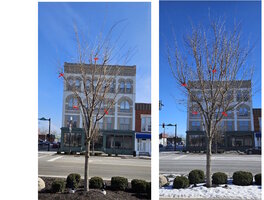
circling back around to this from last year regarding going lighter. In most cases, I might agree (though I'm getting more and more aggressive with young trees...they can take it and if its not done now, it may never happen), but I'm learning if you don't go after elm hard, you'll lose it. Just for kicks, here is side by side with where we left it last year (left) and where we found it today. I underlined a few notable branches to make it easy to compare what grew.

elm 2024 and 2025.jpg
 
circling back around to this from last year regarding going lighter. In most cases, I might agree (though I'm getting more and more aggressive with young trees...they can take it and if its not done now, it may never happen), but I'm learning if you don't go after elm hard, you'll lose it. Just for kicks, here is side by side with where we left it last year (left) and where we found it today. I underlined a few notable branches to make it easy to compare what grew.

View attachment 97238
All good points! And great photos. In time these will be very valuable
 
Can’t even tell they were butchered in the past! Looks good! Those hybrid elms can take routine aggressive pruning. Hard to get central leaders on them though just because of their natural growth habits.

If the branch unions are strong, I’ve learned to accept codominants and if a branch union has some inclusion but can’t be totally removed, a hard reduction works for the time being.
 
Can’t even tell they were butchered in the past! Looks good! Those hybrid elms can take routine aggressive pruning. Hard to get central leaders on them though just because of their natural growth habits.

If the branch unions are strong, I’ve learned to accept codominants and if a branch union has some inclusion but can’t be totally removed, a hard reduction works for the time being.
I agree mostly about the inclusion reduction thing…altering the aspect ratio of the two is a good plan and the one with more photosynthetic potential can slowly swallow the lesser.

Tough thing is most Elm hybrids I’ve come across seem to form new co-doms at every dang terminal. Hard to manage without a frequent “define the lead” type of visit, in an effort to define lower structural form.
 
Tough thing is most Elm hybrids I’ve come across seem to form new co-doms at every dang terminal. Hard to manage without a frequent “define the lead” type of visit, in an effort to define lower structural form.
Do these codoms actually tend to break apart?
Am I getting the sense we aren’t crazy about planting these due to the management required?
 
Do these codoms actually tend to break apart?
Am I getting the sense we aren’t crazy about planting these due to the management required?
I'd say they break less frequently than Pear or maple, but an inclusion is always a weak point.

I certainly highlight that they need a little more maintenance than others...but if you want a tree that doesn't need maintenance, what are you left with?
 
I'd say they break less frequently than Pear or maple, but an inclusion is always a weak point.

I certainly highlight that they need a little more maintenance than others...but if you want a tree that doesn't need maintenance, what are you left with?
Blue oak
 
Any ideas for compacted alkaline clay soils of the Midwest LOL.

Swamp white oak is pretty versatile and grows really well/good form. But unfortunately too many people think oaks are "too messy " so their use in the tree lawn tends to be limited.
I don't know of any trees that aren't "messy". That expression instantly makes me feel all prickly, and I gotta I bite my tongue. This kind of regionally specific info is something I only know for my area. I am following this closely to learn more about y'alls different envuronments.
 
Any ideas for compacted alkaline clay soils of the Midwest LOL.

Swamp white oak is pretty versatile and grows really well/good form. But unfortunately too many people think oaks are "too messy " so their use in the tree lawn tends to be limited.
I wonder how much soil prep can help. People often want to amend and decompact the planting hole (which can create some problems like compaction at the edge of holes from shovels with the handle pointed away from the trunk, pressing/ levering against the outside of the hole (the fulcrum point), as with augers, and a soil interface issue). What about a 10-20' radius from the hole?
 
  • Like
Reactions: ATH

I wonder how much soil prep can help. People often want to amend and decompact the planting hole (which can create some problems like compaction at the edge of holes from shovels with the handle pointed away from the trunk, pressing/ levering against the outside of the hole (the fulcrum point), as with augers, and a soil interface issue). What about a 10-20' radius from the hole?
I'm sure there is more information out there, but a couple of good sources about just that:
Soil profile rebuilding from Virginia Tech:
And what the Ohio Urban Foresters call their soil recipe (see the third and fourth links down):
(That link is working now... Periodically state redoes all of the department's websites in all the links are lost for some reason so if somebody is looking for this in the future, just search "Ohio division of forestry Urban forestry soil recipe" ... And hopefully it's still there unlike a couple years ago when they redid the site and it took over a year to get the toolbox back up)
 

New threads New posts

Kask Stihl NORTHEASTERN Arborists Wesspur TreeStuff.com Teufelberger Westminster X-Rigging Teufelberger
Back
Top Bottom