Pull Rope Height - what is optimal?

The higher and more horizontal the rope = the most effective.
It’s all trade offs from there. High enough it’s not tied in the bendy tips, but high enough to overcome the lean/mass with the amount of pulling force applied.

Also worker safety plays a role, 45 is 1:1 from where the rope is tied. So if a straight hand pull is the worker pulling the line at risk of being in the drop zone?
 
You realize higher and more horizontal are traded off one for the other? in the OP configuration. Alone each is true. The tradeoff was the gist of the original question.

45 degree 1:1 tie height to swat zone, but the top reaches further but#2 ground pullers can walk with the rope for a manual pull, outward from the swat zone.
 
I love the technique of hanging a log on the pull line. I never thought of doing that, but I really see the advantage. With a winch/maasdam, once the tree starts to fall, it's hard to keep tension on the pull line. You can't crank fast enough. Sometimes you really want to keep that tension going for a while (e.g. back leaner).

For my pull line, I usually try to use a redirect so I'm pulling from close to where I'm cutting. Off to the side and behind the tree. It keeps me out of the swat zone, with no "quick walk" required.
 
You realize higher and more horizontal are traded off one for the other? in the OP configuration. Alone each is true. The tradeoff was the gist of the original question.

45 degree 1:1 tie height to swat zone, but the top reaches further but#2 ground pullers can walk with the rope for a manual pull, outward from the swat zone.
Of course I do. There are many variables such as tree height and back lean.
A fair standing tree where one wants a little extra control with a tag can have a functional tag line 1/4 up the tree.
Heavy back leaners one wants a tag as high as functionally possible and the pulling point to be far.
Leverage is also a huge factor as well as desired speed of pull.
Heavy back leaners are best pulled with speed after they are cut up, this speed is often gained by lower points and more horizontal pulls. This of course is at the sacrifice of leverage multiplier, so requires a stronger pulling force.
Experience to read the sweet spot..
 
Sean works solo a lot, so cannot be behind the tree and on the machine.
Here's some solo pulling. Basal tied pull rope, redirected through a block on another tree down low, back to a masdam on the stump of the tree I'm cutting. Notch above the orange line so I can crank the masdam. The long throat on the orange sling is to avoid the butt of the tree smashing the masdam when it falls. In a similar vein to the question posed in this thread, the direction of pull does not need to pull 100% in the direction of fall. As long as there is a "forward" component to the pull, you should get forward movement. In the pic, the tree will fall 30 degrees to the right of the line the masdam sling is pointing.
 

Attachments

  • IMG_1430.JPG
    IMG_1430.JPG
    932.3 KB · Views: 47
Last edited:
Here's some solo pulling. Basal a tied pull rope, redirected through a block on another tree down low, back to a masdam on the stump of the tree I'm cutting. Notch above the orange line so I can crank the masdam. The long throat on the orange sling is to avoid the butt of the tree smashing the masdam when it falls. In a similar vein to the question posed in this thread, the direction of pull does not need to pull 100% in the direction of fall. As long as there is a "forward" component to the pull, you should get forward movement. In the pic, the tree will fall 30 degrees to the right of the line the masdam sling is pointing.
That's a great solo setup
 
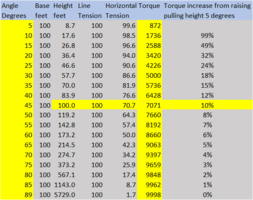
updated my posted solution to OP question with numbers felling torque vs rope angle. didn't find a "max" but instead diminishing returns per setup effort expended - shown in trunk height attachment, I'm sure if you change/inrease the distance to the tree a similar diminishing result will also occur.
 
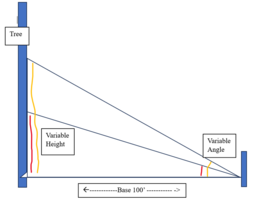
One case:
-fixed distance between winch and base of the trunk of the tree (base)
-variable/choose height up the stem (L) you attach the rope to form rope angle above horizontal (theta)

calculate:
L/base = tan(theta) so L = base x tan(theta)
component of rope tension that makes torque is tension x cos(theta)
torque is tension component x lever arm = tension x cos(theta) x L = tension x cos(theta) x base x tan(theta)

tension is a constant, base is a constant, only theta changes (which directly makes L)
so when the quantity cos(theta) x tan(theta) is the most/biggest you get the most pull over torque

Who wants to make a spreadsheet and run the angles? feeling lazy

do cos(theta) x tan(theta) = and put angle values in for theta


did - hand calculatored, 35 deg .57 and it kept on improving up to 80 deg .96!!! seems the gain on L outdoes the loss on cos(theta) bad pull angle. Now at 80 deg L is 5.67 x base that's one hell of a tall tree. Surprising result - go as high as possible. With practical constraints of course.


Teacher, can you check my homework for mistakes?

edit - values by hand

theta cos(theta) tan(theta) cosxtan = relative amount of torque from fixed base and fixed tension
15 .97 .27 .26
25 .91 .47 .42
35 .82 .70 .57
45 .71 1.0 .71
55 .57 1.43 .82
65 .42 2.14 .90
75 .26 3.73 .97
80 .17 5.67 .96

table spacing nuked when posted! doh!

cos theta is being close or not to a perpendicular pull
tan theta is L up the trunk (as a # x base), the lever length
cos x tan is the torque generation factor as a function of fixed base and varied theta.

Most guys probably work in the sub 45 range unless there's plenty of room.
note 45 to 55 - 43% higher up stem but only 11/71=15% more torque. bit of a losing proposition per setup effort
I like Excel, so here are the figures in a spreadsheet.
The torque keeps increasing the higher the pull tie-in-point, though the amount of benefit diminishes.
 

Attachments

  • Torque varies diagram.png
    Torque varies diagram.png
    10.5 KB · Views: 31
  • Torque varies by angle of height.png
    Torque varies by angle of height.png
    12.6 KB · Views: 27
Last edited:
Is 45 degrees rope angle the break even point, beyond which we have diminishing returns?
Yes. It also puts one in the swat zone.
Or is the math more complicated than that?
The math is just algebra and trig. It says to go as far away as you can and high as is safe to get the most torque out of your pull.

Most people can’t pull more than 150 pounds, so I’m assuming your scenario involves two people pulling?

Adding the third dimension on the ground opens many more scenarios. For example, anchoring the pull line and pulling down/sideways on it (by hand or with another line) increases the angle, but gives a force multiplier that’s impressive. Same principles, but gives you more options to stay in the safe zone(s).
 
Yes. It also puts one in the swat zone.

Yes for sure, immediately obvious after I asked the question :). Maybe a better scenario for the original question would be: what if my only anchor point for pulling is dangerously close to the swat zone, so I plan on redirecting the line so I can pull from somewhere safe. In that case, is there a height for the rope that is too high/counterproductive?

Anyway, thank you to everyone who contributed. Set your rope as high as possible, up to an angle of 45 degrees.
 
The lower the rope the longer the rope pulls through the fall.
that's irrelevant.. by the time the tree gets moving it's going to quickly outpace any pull line no matter how high or low. Sean' video is a good example of that... That log hot the ground early in the fall... a that point the pull line had zero effect. I only learned this from watching my own videos. The pull line goes slack early in the fall.... EVERY TIME...

Speed is rarely needed when falling anyhow, unless you're throwing tops..

For precision falling you need POWER.. FORCE....

the kind of force you get from a nice high pull line. Once you get the tree moving the hinge should be able to hold it to the lay in all but a few rare cases of extreme side lean. When that is the case, it's rare that speed is overcome side lean.

I like the spring loading effect of a high pull line. You can store energy in the flexing wood. When in dout the easist thing to do is just add another line... If you have a high pull line that you think may break out a top, or not have enough pull, then add a lower line and second anchor point and vehicke to do the pulling as needed
 
Last edited:
Of course I do. There are many variables such as tree height and back lean.
A fair standing tree where one wants a little extra control with a tag can have a functional tag line 1/4 up the tree.
Heavy back leaners one wants a tag as high as functionally possible and the pulling point to be far.
Leverage is also a huge factor as well as desired speed of pull.
Heavy back leaners are best pulled with speed after they are cut up, this speed is often gained by lower points and more horizontal pulls. This of course is at the sacrifice of leverage multiplier, so requires a stronger pulling force.
Experience to read the sweet spot..
no... backleaners need high pull lines... best to pull with vehicles if you need speed... good drivers needed.. though likely just a differenc based on te difference inthe trees we work on
 
Last edited:
no... backleaners need high pull lines... best to pull with vehicles if you need speed... good drivers needed..
Please re read what I said and if I wasn’t clear ask a question.

Back leaners need speed, they also need leverage. There is a sweet spot, if you have power you can go lower for more speed.
Back when I was pulling on a two person crew as a employee
IMG_5548.jpeg
 
Last edited:
Back leaners need speed, they also need leverage. There is a sweet spot, if you have power you can go lower for more speed.
It's likely that our different perspectives have to do with the differences in the trees we work on.

these two videos are qued up to the drops


The only one I really needed speed for was one of these two. The other one we pulled it only far enough to clear the other trees, adn then stopped and let it fail to the side weight right in the lawn.

 
Last edited:
Yes, the log hit early in the fall.

The log pulled longer that the pull rope alone. That was the point.


So long as the hinge holds, and the tree is far enough over-center to be able to bend the hinge, all is well.

When the tree has sapwood rot in a root-disease pocket (gets the heartwood) and leans 120⁰ to the lay, along the property line, I thought the simple measure to get a little longer rope force on the tree was worthwhile, along with an extra 20 seconds for a Sizwheel (pulled a 2' strip of fiber) It took an extra 2 minutes to set.

The tree hit the lay. A couple 1/2" limb tips were cut off a madrona while bucking. Had I not hit the lay, I'd have had smashed a bunch of expendable trees, adding to the clean-up.

May or may not been important. Lighthouses sometimes help, sometimes don't.

A good place to experiment with a technique in a non- critical situation for times where I won't have a competent pulling person available or lack of traction.


Without a load cell, idk how much force is added. The log added to the spring-force of the bent bole.
I hoped the fir wouldn't have caught up in the maple in a problematic way, throwing it off course.

Would have been more ideal had the log landed a bit later.

Landed it dead-on the lay. Might have been fine without a floating log and sizwheel.

Stacked the deck for comfort.
 
I try to avoid:

1.) Putting the rope below the center of gravity, to avoid yanking the bottom out if the hinge has to be thin or otherwise weak.

2.) Putting the rope so high that the top breaks.

3.) Putting the rope so high that I loose a bit of directional control that I get from the longer sustained pull associated with putting the rope lower when the hinge is less likely to independently control the directional path of the fall.

4.) Putting the rope too low and thus missing out on the tipping force from having it higher.

Each tree has a sweet spot for the goals you want to prioritize.

I have placed two lines in one or two trees to get the best of both worlds - a high one and a above-gravity-center one.

One was a big dead oak of uncertain seasoning and a hollow stump with slight back lean towards a house. I had wedges and a jack on that as well. Imagine if I had jacked the tree off the hinge and had only a single rope placed below the center of gravity to maximize control of the direction... I ended up using a bit of each of my four force appliers to delicately get the tree vertical, then had the ropes pulled hard, simultaneously, while chasing them with the wedges and jack in case the ropes were not enough or the top shattered, leading to some form of sitback. The drop went very well and I felt overly cautious in retrospect. The top rope was 9/16ths on a grcs. The lower rope was 3/4" redirected to a 4wd forward hook, pulling in reverse.
 
For those using a redirect to solve the swat zone of the top, e.g. a pulley anchored to a tree trunk in the direction of fall, wouldn't the top hit the trunk? Unless it was already far enough away that a redirect wasn't so needed?

Tree's gotta fit between self and pull point always, no?

Dan, you got the same numbers as me (same formula, well of course!) minus rounding error. Wanna try fixed L (attachment height in tree) and vary the base (distance from tree to winch) which causes theta (rope angle from horizontal) to also vary?

edit - is it as simple as L constant, find theta atan(L/base), then cos(theta) does all the torque reduction
 
Last edited:

New threads New posts

Kask Stihl NORTHEASTERN Arborists Wesspur TreeStuff.com Teufelberger Westminster X-Rigging Teufelberger
Back
Top Bottom