Pull Rope Height - what is optimal?

Muggs

Been here much more than a while
Location
Canuckistan
Continuing from another thread about the difference between basal vs. canopy anchored pull lines for dropping trees, here's another question:

If I have a tree being felled and I want to pull it over using a rope tied directly to the trunk up top, assuming that I'm pulling on level ground, from a fixed distance, with a fixed input (ie winching) force, what does the math say about what height I should tie the rope? Assuming that the rope is acting only in the x axis (lateral direction) and y axis (vertical direction), with no sideways deflection (z axis), there must be a point of height where the pull begins to act more to pull the tree down into the ground, and less to pull it sideways. That is to say, there must be a point where the x-axis vector of the pull line gets overtaken by the y-axis vector. So let's say that I've determined that I can anchor the rope at any height, from 0 to 20m (65 ft) up without worrying about breaking the tree with my pull, where is the optimal height to anchor the rope? Or am I just overthinking it entirely and the answer is just "as high as possible"? I assume the mathematical way to answer this is some combination of trig and calculus, neither of which I have engaged in since high school. Hoping someone much smarter than myself can help with the math on this.
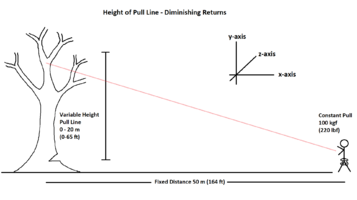
Pulling Height - Diminishing Returns.png
 
Last edited:
As high as possible.

Rope needs to be as flat as possible. That is the real thing. More in-line with the x-axis aka a flatter line angle is most advantageous
The higher the rope goes, the less pull you have in the desired direction ie the X-axis. The higher you go, the more you are pulling it down, rather than sideways.

Maybe it's totally negligible on an example of this size. Maybe the tree would have to be much taller for this analysis to matter at all. I'm not sure.
 
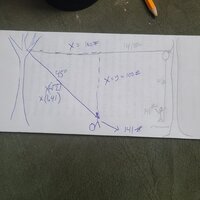
For easy calculating, let's ignore pulley friction and take the puller's weight to be 141pounds.

The square root of 2 = 1.41.

Suppose the puller pushes against something and can impart a force at 45⁰ that equals their weight.

The horizontal component of 141# at 45⁰ = 100#.

If the rope is at 0⁰, and a person hangs 141#, the horizontal component is 141#.17031787513267674145288949662841.jpg
 
First of all, you would prefer a rope angle less than 45° to get more of the force in the horizontal direction. The flatter the rope angle, more of the pulling force will be along the x-axis.

But there's a new problem: where will the tree pivot? At the hinge. Seems obvious that connecting the rope a meter above the hinge will not have the same effect as placing it 20m up the stem, even with the same horizontal pulling force. Why? Since the trunk is resisting movement (until the hinge breaks), it appears that the amount of torque applied is the key. A 100 kgf applied 1m above the hinge will produce a torque of 100 kg-m. Applied 20m up, it produces a bending moment of 2000 kg-m. So to appreciate what Sean says, higher produces the greater bending moment for a given horizontal force.

Now, how to combine higher rope placement with a flatter rope angle without getting ridiculous by moving too far enough from the tree and ending up with too much rope weight and stretch?
 
From the original question, assume that you are limited by the jobsite to how far back you can pull from. In the city we are quite often limited like this. So assume that we cannot stand further back than 50 m to pull.

Is 45 degrees rope angle the break even point, beyond which we have diminishing returns? Or is the math more complicated than that?
 
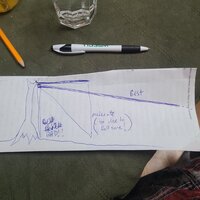
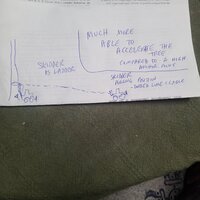
I hang a log sometimes to help accelerate the tree with a high pull.

I've never seen that log hanging technique before. Interesting. Wouldn't you be better off just tying lower on the tree and pulling straight off the machine, skipping the log altogether? Or does the log make it keep pulling even after the top of the tree has moved ahead, instead of the rope tension just dropping straight to zero?
 
One case:
-fixed distance between winch and base of the trunk of the tree (base)
-variable/choose height up the stem (L) you attach the rope to form rope angle above horizontal (theta)

calculate:
L/base = tan(theta) so L = base x tan(theta)
component of rope tension that makes torque is tension x cos(theta)
torque is tension component x lever arm = tension x cos(theta) x L = tension x cos(theta) x base x tan(theta)

tension is a constant, base is a constant, only theta changes (which directly makes L)
so when the quantity cos(theta) x tan(theta) is the most/biggest you get the most pull over torque

Who wants to make a spreadsheet and run the angles? feeling lazy

do cos(theta) x tan(theta) = and put angle values in for theta


did - hand calculatored, 35 deg .57 and it kept on improving up to 80 deg .96!!! seems the gain on L outdoes the loss on cos(theta) bad pull angle. Now at 80 deg L is 5.67 x base that's one hell of a tall tree. Surprising result - go as high as possible. With practical constraints of course.


Teacher, can you check my homework for mistakes?

edit - values by hand

theta cos(theta) tan(theta) cosxtan = relative amount of torque from fixed base and fixed tension
15 .97 .27 .26
25 .91 .47 .42
35 .82 .70 .57
45 .71 1.0 .71
55 .57 1.43 .82
65 .42 2.14 .90
75 .26 3.73 .97
80 .17 5.67 .96

table spacing nuked when posted! doh!

cos theta is being close or not to a perpendicular pull
tan theta is L up the trunk (as a # x base), the lever length
cos x tan is the torque generation factor as a function of fixed base and varied theta.

Most guys probably work in the sub 45 range unless there's plenty of room.
note 45 to 55 - 43% higher up stem but only 11/71=15% more torque. bit of a losing proposition per setup effort
 
Last edited:
I've never seen that log hanging technique before. Interesting. Wouldn't you be better off just tying lower on the tree and pulling straight off the machine, skipping the log altogether? Or does the log make it keep pulling even after the top of the tree has moved ahead, instead of the rope tension just dropping straight to zero?
Sean works solo a lot, so cannot be behind the tree and on the machine.
 
I've never seen that log hanging technique before. Interesting. Wouldn't you be better off just tying lower on the tree and pulling straight off the machine, skipping the log altogether? Or does the log make it keep pulling even after the top of the tree has moved ahead, instead of the rope tension just dropping straight to zero?
I was running the machine just out of reach before hitting an uphill section.

Bending more of the trunk adds spring force that releases as the tree tips. That was around 75' tall. I moved the top of the tree around 10 feet horizontally while pretensioning.


You can see floating a log in the Fundamentals of General Treework, I believe. Thanks, Jerry B!
 
This thread reminded me of some of Terry Hale's old videos on pulling trees down, hinges and bending moments and the like - an engineer by training, he has lots of equations to your heart's content. His climbing stuff maybe not so much (sorry), but for the physics and vectors/ statics/ mechanics of yankin' he is top notch (pardon the pun). This all makes me want to take the tractor and go at some stumps Tom Hoffman style . . . . yeee hawww . . . . :-)
 
Unless the angle between the ground (let’s stick to flat - level site conditions for the moment) and an imaginary line reaching from the topmost twig of the tree to be felled and the anchor point is 45° or less, that anchor point, be it truck or tree, will likely get swatted by the falling tree. Since one must anchor to the tree at a point well below the topmost twig, generally the pull angle will be “flat” enough to apply the vast preponderance of the pulling force horizontally.

I do this often, in fact I was doing it today and do highly recommend installing a pulley at the anchor point and bringing your pulling device (Maasdam) back to a spot with a good view of what’s happening to the tree you’re felling, and safely out of harms way.

How high on the tree depends on many factors, but the heavier the anticipated pull the higher, the better. Don’t overlook tricky variables like the wind. I typically use a Maasdam with 100’ of rope on it in combination with 100’ of double braid bull rope and anchor about 100‘ from the tree I’m felling. Tomorrow I’ll be using a 5:1 block setup in combination with the Maasdam as I’ll be pulling a small but tall one that’s uprooting itself and headed for a primary power line. The plan is to pull hard opposite the lean until it is once more upright pivoting on the roots, stop, ease the pull, notch and back cut modestly then finish the job pivoting on the hinge. It won’t be the first time I’ve used this approach.
 

New threads New posts

Kask Stihl NORTHEASTERN Arborists Wesspur TreeStuff.com Teufelberger Westminster X-Rigging Teufelberger
Back
Top Bottom