
Reduction Pruning on Large Trees

climbingmonkey24

Carpal tunnel level member
Location
United States
Looked at this maple recently and the client wants it “taken in” all the way around at least 3 ft. I’ve done reductions on smaller trees, but never one of this size (with the exception of specific areas of a tree like branches near a house, etc).

I’m curious on your thoughts about the potential benefits / downsides to doing a reduction on such a large tree. One thing that comes to mind is couldn’t it actually encourage growth and then the customer finds themselves in a situation where they’re having to keep reducing it more frequently just to keep it to size versus just letting the tree grow naturally at its own pace?

The primary concern in this particular situation is the tree getting too big for the space it occupies.
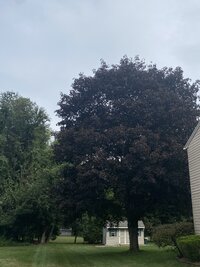

4FAAEBE4-7493-4775-9D97-EABAD7FEA7F0.jpeg
 
Yes, this seems like a kind of human problem here- the ‘taking in’ or ‘shaping’ is not a very good pruning objective- if I hear that I try to ask what exactly they are looking for as a result. More light? Clearance from house? Worried about it getting too big? Often times they get more specific and you have a whole new objective and a much easier job to do.

If that doesn’t change the outcome.. the reality is this is what looks like a crimson red Norway maple and it’s at about max height- not a precious tree, taking about 3’ in all around and cutting back to lateral branches will not kill the tree or injure it excessively- it would be a good job for a bucket truck but a waste of time in a harness. If you do cut back to proper laterals in theory that would encourage more lower and interior growth. An annoying job done for not much of a good reason, but it’s just a Norway maple.. it will be fine.. if you do it right in 3 years it will be undetectable. Do your best impression of a cicada.

We have done this style of pruning on large declining trees, ‘retrenchment pruning’- trying to help the tree get to its next phase of life, shorter and stouter, maybe live to be a veteran tree if all things go well. its not a silver bullet but a good tool in the tool chest. Some good info out of UK on those kinds of projects. Those are trees that are already 150 years old or so.

Good luck!
 
100% Stumpsprout. I wrote the below post before reading yours, so you beat me to it. I'm uploading some video to youtube now to show exactly what you are talking about.

I do it all the time and with great success. 3' isn't going to hurt that tree as far as the amount of leaves lost. All the cuts will be small and far away from the trunk. You'll e cutting back to laterals that can easily take the terminal role and should look good from day 1. A younger vigorous healthy maple with such dense foliage is going to tolerate that pruning well.

I like to leave the top alone and just bring in the sides, which is easily done from the bucket. On mature hardwoods (which this one isn't really that old) it's the long over-reaching lower laterals that run into problems with storm damage and summer limb drop. On younger trees like this Crimson maple, there isn't much chance of storm damage now, but you will be setting the laterals up to develop a very strong taper, making them practically storm proof later. And more importantly in this scenario you can make the tree "fit the space" by tucking in the sides without needing to touch the top as the tree will never run out of headroom.

Without a bucket truck, you're going to be doing a whole lot of limb walking. I could prune that entire tree in 15 minutes in the bucket with setup and tear down.
I've got lots of examples on video. We just pruned this Norway maple a couple days ago... I've ben reducing this tree every 5 or so years for probably 20 years
here's the before:

here's the after:
 
When I was asked to do jobs like this that were based on routine pruning for years to come and wondered:

What happens if I do the first dose of pruning but never get called again?

The job, in order to meet the objective of reduction, usually means at least one, maybe more, followups. Might you be starting a project you can't/won't finish?

but...first question...why do a reduction? Reduction pruning is valid in certain applications. Reducing over-reaching lower laterals is one thing that can make sense. Reducing load on bad structure too.

Try to make any cuts less than 3" in diameter to reduce decay issues. That's going to be hard to do I think
 
In Europe it wouldn’t be an issue.
Reduce it, go back and redo it when needed.
exactly.. no big deal.. do it all the time and the results are excellent
When I was asked to do jobs like this that were based on routine pruning for years to come and wondered:

What happens if I do the first dose of pruning but never get called again?

The job, in order to meet the objective of reduction, usually means at least one, maybe more, followups. Might you be starting a project you can't/won't finish?

but...first question...why do a reduction? Reduction pruning is valid in certain applications. Reducing over-reaching lower laterals is one thing that can make sense. Reducing load on bad structure too.

Try to make any cuts less than 3" in diameter to reduce decay issues. That's going to be hard to do I think
Whether or not he or anyone follows up, the reduction pruning isn't going to be a problem.

obviously the reason to reduce here is because the tree is taking up all the room in a fairly small yard

a 3" cut on this maple is going to be 8-10' long.. he only needs to go back 3', so that's going to be more like handsaw cuts of 1-2". And there is no way that decay on the branch tips are going to be a problem... dah
 
...not a precious tree, taking about 3’ in all around and cutting back to lateral branches will not kill the tree or injure it excessively- ...

Again personally, I have very little patience for this type of justification. The tree as it is now fits the space, has good balance and apparent structure and will not appreciably change if left alone for years to come. These 'non precious trees' are among the few large shade trees that will actually grow in our area.

Pruning potential for over mature trees during their senescence, is not going to be the same as a middle aged tree in good physical condition.
 
Again personally, I have very little patience for this type of justification. The tree as it is now fits the space, has good balance and apparent structure and will not appreciably change if left alone for years to come. These 'non precious trees' are among the few large shade trees that will actually grow in our area.

Pruning potential for over mature trees during their senescence, is not going to be the same as a middle aged tree in good physical condition.
I appreciate the sentiment, that is trees are living beings that should be respected. But as arborists we regularly make choices between what's good for the tree and what's good for the people. In this case, the tree's long term survival and beauty can actually be helped by both reduction and structural pruning. It's fairly obvious that taking off problematic limbs that are 1-2" in diameter is going to be a lot easier on the tree than waiting for the tree to become over-mature.

I like the way you approach tree work and agree with most of the points you make, but will have to respectfully disagree 100% with you in this one. Take a look at the pruning videos I listed above.
 
I am of course commenting on the original posters situation, not all the other possibilities in others.

Growing a sun-loving grass under any of the Norway maple cultivars is a fools mission and deserves some discussion with the client. Even if you get more dappled light under the tree it will be the wrong color spectrum. Trees and grass are like oil and water, not great partners.
 
I appreciate the sentiment, that is trees are living beings that should be respected. But as arborists we regularly make choices between what's good for the tree and what's good for the people. In this case, the tree's long term survival and beauty can actually be helped by both reduction and structural pruning. It's fairly obvious that taking off problematic limbs that are 1-2" in diameter is going to be a lot easier on the tree than waiting for the tree to become over-mature.

I like the way you approach tree work and agree with most of the points you make, but will have to respectfully disagree 100% with you in this one.
Agreed.
 
These 'non precious trees' are among the few large shade trees that will actually grow in our area.
Damn. That sucks. We have a few dozen better options with similar size. The cultivar isn’t invasive here but Norway maples sure are. Plus they are all dying from verticillium wilt this year.

obviously the reason to reduce here is because the tree is taking up all the room in a fairly small yard
I think that’s a subjective response to the situation. I definitely don’t agree that it’s taking up too much space in the yard.
 
  • Like
Reactions: ATH
They only germinate within their immediate location. You never see any in the natural forested areas.
I haven’t noticed the crimson king variety anywhere except for purposeful plantings.

The traditional variety seems to spread quite easily around here, except, like you said, not in our forests.
 
Crimson king is seedless.

Norway maple certainly can be a forest invader...ive seen it a handful of times...not like honeysuckle or privet, ailanthus, pear, buckthorn, etc.... but it is a woodland invader.

Yes... verticillium is a real problem too. They aren't one of my top choices, but I don't hate them. We've planted some Crimson sunset, but I don't think we've ever planted an A. platanoides.
 
To the question in the OP:

I would try hard to talk the client out of it. Almost every client I work with would be much happier with that tree if it were raised a few feet and back from the house if needed (see all the above descriptions about doing that in a way that has minimal impact on tree health).

My reason for not wanting to prune it all the way around:
It won't really accomplish anything in the long term. If that is the plan, it will be a high maintenance tree for many years. Why fight against nature. There is plenty of room for that tree (based on one pic...). Why create a need to be back at it every couple of years? Lift and pulling it back from the house will cost less and requires less frequent returns.

This tree, should be in a prime spot where it is giving a ton of benefits without much cost. Why turn it into a high cost item? Invest maintenance early on with structural pruning/young tree training and on very mature trees that need more help to stay healthy and/or safe.
 

New threads New posts

Back
Top Bottom