












Navigation
Install the app
How to install the app on iOS
Follow along with the video below to see how to install our site as a web app on your home screen.
Note: This feature may not be available in some browsers.
More options
You are using an out of date browser. It may not display this or other websites correctly.
You should upgrade or use an alternative browser.
You should upgrade or use an alternative browser.
Hitch hiker/2/x thread
- Thread starter RBJtree
- Start date



Tom Lynch
New member
- Location
- Brockville
It shouldn't bind, some more time will tell. There is no way for it to rotate and lockout the engagement of the lower dog (carabiner). A fair question for sure.
I really prefer having a pinto to assist with tending, makes ponytail redirects a pain. Having to manage a swivel, rope, pulley and a carabiner aloft is annoying. I'm reworking the design, including all of these features in the spine with quicky style (HHx) with swivel. Hoping to machine a prototype by this winter.
I really prefer having a pinto to assist with tending, makes ponytail redirects a pain. Having to manage a swivel, rope, pulley and a carabiner aloft is annoying. I'm reworking the design, including all of these features in the spine with quicky style (HHx) with swivel. Hoping to machine a prototype by this winter.

Not disputing that your method works as smooth as butter, just that allowing it to rotate causing the dogbone to not touch the rope, makes it work like melted butter. I believe Rico discovered this by having the cord crossing in the back. Since this is rope walking, and not a sit stand system, the small amount of sit back is a non issue with me.Interesting, I found just the opposite. If the rope is stiff from your body weight and you are advancing with a knee and foot ascender, the HH advances like a dream, and stays oriented for instant engagement.
Same with a haul-back setup. Having the pulley underneath and on the carabiner, keeps the HH straight on the rope with super smooth engagement and release with less set-back than if the HH body were to rotate.
Replacing the carabiner with something that makes less contact turns it into melted butter forming rivulets that run down your arm and cascade off your elbow smooth.
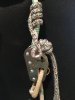
Note: the stopper knot is only a single overhand, use what feels safe.
Last edited:
If you look at Brocky's pickti
Honestly, have you climbed on that, more than once?
Not disputing that your method works as smooth as butter, just that allowing it to rotate causing the dogbone to not touch the rope, makes it work like melted butter. I believe Rico discovered this by having the cord crossing in the back. Since this is rope walking, and not a sit stand system, the small amount of sit back is a non issue with me.
Replacing the carabiner with something that makes less contact turns it into melted butter forming rivulets that run down your arm and cascade off your elbow smooth.
View attachment 68323
Note: the stopper knot is only a single overhand, use what feels safe.
Honestly, have you climbed on that, more than once?
Brocky, you are an acknowledged forum rope and hitch wizard, but this is wrong on so many levels.
But first let me address your comments on rotation benefits.
"Not a sit stand so sit back is not an issue" If all you were doing was that one ascent than that would be true, but how you tend your HH will carry through into work positioning, and in that, sit back does matter, a lot. The shortest distance is a straight line and keeping the HH straight gives the least amount of sit back, no matter what phase you are in.
"allowing it to rotate causing the dogbone to not touch the rope" How so? If the HH rotates it must bend around the dogbone and lower, in your setup, roller. When running straight up the rope, no one surface is under any pressure at all, so if you have tied your hitch right, there is just that small amount of drag coming from the collapsed hitch, nothing more.
Now your setup. Starting on top, the way you have tied onto the dogbone has caused the holding edges to be almost in line with the slot, they should be perpendicular. If you rotate the HH they could get even closer. If you work with the dogbones long sides inline with the slot they have a very good chance of catching an edge and jamming.
Your soft shackle in the bottom slot would, I am sure, give Paul a heart attack. The force form even a small fall is tremendous in that area. Even the heavy steel carabiners and shackles show wear marks. It is of no consequence that you, hopefully, used cut proof cordage, when pressure is applied against it, it will give. This will not only alter the applied and potential friction, it also could deform enough to possibly cause complete failure. As I see it, the whole thing is a terrible idea.
But first let me address your comments on rotation benefits.
"Not a sit stand so sit back is not an issue" If all you were doing was that one ascent than that would be true, but how you tend your HH will carry through into work positioning, and in that, sit back does matter, a lot. The shortest distance is a straight line and keeping the HH straight gives the least amount of sit back, no matter what phase you are in.
"allowing it to rotate causing the dogbone to not touch the rope" How so? If the HH rotates it must bend around the dogbone and lower, in your setup, roller. When running straight up the rope, no one surface is under any pressure at all, so if you have tied your hitch right, there is just that small amount of drag coming from the collapsed hitch, nothing more.
Now your setup. Starting on top, the way you have tied onto the dogbone has caused the holding edges to be almost in line with the slot, they should be perpendicular. If you rotate the HH they could get even closer. If you work with the dogbones long sides inline with the slot they have a very good chance of catching an edge and jamming.
Your soft shackle in the bottom slot would, I am sure, give Paul a heart attack. The force form even a small fall is tremendous in that area. Even the heavy steel carabiners and shackles show wear marks. It is of no consequence that you, hopefully, used cut proof cordage, when pressure is applied against it, it will give. This will not only alter the applied and potential friction, it also could deform enough to possibly cause complete failure. As I see it, the whole thing is a terrible idea.
Last edited:
Dave, thanks for your observations, you bring up some valid points.
If the neck tender is removed once in the tree, and you know there is some sit back, hand tend it that much farther than when it becomes taut.
Rotation: the HH hitch, or 180 degree French Valdotain, when tied has to be very tight for it to grab reliably, this pulls the dogbone up tight to the rope. If the body doesn’t rotate it pushes up the hitch, and keeps the dogbone touching the rope producing drag. A rotating body makes the dogbone go to the far end of the slot.
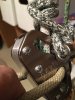
The dogbone can’t rotate far enough for it to become parallel with the slot, the hitch’s crossover in front and the stopper in back trap the rope in its position, when the device is loaded. It’s possible for the dogbone to become wedged if slack, but that can happen with the original configuration. With the hitch being a continuous coil it would self adjust and still grab if the db were to somehow jam, just a part of the ability to descend would be affected.
The bushing does have a 1/2” flat surface, which might bend before the shackle broke, or not. Using something softer like copper tubing would be better to get the bending. It would seem a lot of the load would be taken up by the cord, rope, and dogbone before the lower connector was engaged. To eliminate the sharp bend from the flat surface, a small rigging ring can be used. It appears, needs further use, to act like a sheave, which the bushing didn’t, and is even smoother.
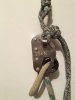
If the neck tender is removed once in the tree, and you know there is some sit back, hand tend it that much farther than when it becomes taut.
Rotation: the HH hitch, or 180 degree French Valdotain, when tied has to be very tight for it to grab reliably, this pulls the dogbone up tight to the rope. If the body doesn’t rotate it pushes up the hitch, and keeps the dogbone touching the rope producing drag. A rotating body makes the dogbone go to the far end of the slot.
The dogbone can’t rotate far enough for it to become parallel with the slot, the hitch’s crossover in front and the stopper in back trap the rope in its position, when the device is loaded. It’s possible for the dogbone to become wedged if slack, but that can happen with the original configuration. With the hitch being a continuous coil it would self adjust and still grab if the db were to somehow jam, just a part of the ability to descend would be affected.
The bushing does have a 1/2” flat surface, which might bend before the shackle broke, or not. Using something softer like copper tubing would be better to get the bending. It would seem a lot of the load would be taken up by the cord, rope, and dogbone before the lower connector was engaged. To eliminate the sharp bend from the flat surface, a small rigging ring can be used. It appears, needs further use, to act like a sheave, which the bushing didn’t, and is even smoother.
Last edited:
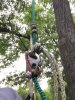
Take a second look at this overused picture. Notice the length of the hitch legs and the distance that the hitch is sitting above the HH. Combined it is more than enough to set the dogbone in the bottom of its slot. Totally clear even with that fat vortex.
I stand by my statement that if the hitch is tied and dressed properly, there is no noticeable drag, and there is almost zero chance of catching an edge of the dogbone.
I can't comprehend your desire to use a soft shackle in the bottom slot. You are definitely losing a primary component of the design. As the shackle gives under pressure, it is dumping energy that would have gone into pressure against the spine that helps equalize top and bottom points on the spine.
Pauls first prototypes were mandrel formed from a very hard steel. Even so the edges still burred and rolled from the substantial pressure in that area. He eventually found some super strong steel that worked. My point being the HH is capable of high degrees of force in that area. Proceed with caution.
I stand by my statement that if the hitch is tied and dressed properly, there is no noticeable drag, and there is almost zero chance of catching an edge of the dogbone.
I can't comprehend your desire to use a soft shackle in the bottom slot. You are definitely losing a primary component of the design. As the shackle gives under pressure, it is dumping energy that would have gone into pressure against the spine that helps equalize top and bottom points on the spine.
Pauls first prototypes were mandrel formed from a very hard steel. Even so the edges still burred and rolled from the substantial pressure in that area. He eventually found some super strong steel that worked. My point being the HH is capable of high degrees of force in that area. Proceed with caution.
Attachments
I have to agree with Dave here...When my 3 wrap HH hitch is really dialed in, and I am running it stock (biner straight too ring on bridge) it offers almost zero drag on ascent. Kinda reminds of the Runner in that respect...Fucker just falls up the rope....I stand by my statement that if the hitch is tied and dressed properly, there is no noticeable drag, and there is almost zero chance of catching an edge of the dogbone.
I did take a look, and enlarged that section and taking a straight edge, matched up the two sections of the back of the rope. The dogbone had to be touching the rope comparing it to the cord going through the eye.
Yes, it performs amazingly as originally intended. It‘s functioning can be improved is my point. Although just catching the corners of the eyes isn’t ideal, it is enough to keep the dogbone out of the slot. The hitch keeps it from being able to be parallel with the slot and trying to rotate it either way, even slack. The position it is in in the second picture of post 317 is where it is locked and doesn’t move no matter what, because of no slack in that section.
If by the shackle giving you mean stretch, no matter what material, it will only stretch as far as the amount of load applied, it won’t continually stretch without increasing the load. Even cord on rope, without hardware would share an equal amount of load as a carabiner, when hanging on it. A flat top carabiner would probably work also but the bolt heads against the carabiner spine would stop rotation, the soft shackle easily slips over them.
I’m not understanding why the materials would change the forces being applied. If you are saying the edges will cut the shackle, with both the bushing and the better rigging ring, it makes very little contact, more rubbing than going over an edge. I’m thinking the damage in that area that you describe is due more to two solid objects interacting and banging against each other, can’t happen here.
It only takes a piece of hitch cord along with using the carabiner to try out the top part.
Yes, it performs amazingly as originally intended. It‘s functioning can be improved is my point. Although just catching the corners of the eyes isn’t ideal, it is enough to keep the dogbone out of the slot. The hitch keeps it from being able to be parallel with the slot and trying to rotate it either way, even slack. The position it is in in the second picture of post 317 is where it is locked and doesn’t move no matter what, because of no slack in that section.
If by the shackle giving you mean stretch, no matter what material, it will only stretch as far as the amount of load applied, it won’t continually stretch without increasing the load. Even cord on rope, without hardware would share an equal amount of load as a carabiner, when hanging on it. A flat top carabiner would probably work also but the bolt heads against the carabiner spine would stop rotation, the soft shackle easily slips over them.
I’m not understanding why the materials would change the forces being applied. If you are saying the edges will cut the shackle, with both the bushing and the better rigging ring, it makes very little contact, more rubbing than going over an edge. I’m thinking the damage in that area that you describe is due more to two solid objects interacting and banging against each other, can’t happen here.
It only takes a piece of hitch cord along with using the carabiner to try out the top part.
"I’m not understanding why the materials would change the forces being applied."
It is because the angles, which by the way took a lot of experimentation in less than single degree increments to get just right, create a wedging force against the rope.
Think of it as in pounding over a tree with wedges, as it is mechanically the same. Hard and smooth surfaces are needed for efficient energy transfer. If one of the components is soft and squishy it doesn't work, just as when the wood is too rotten and just compresses or if you were foolish enough to try pounding in a soft rope in place of the hard wedge.
It is because the angles, which by the way took a lot of experimentation in less than single degree increments to get just right, create a wedging force against the rope.
Think of it as in pounding over a tree with wedges, as it is mechanically the same. Hard and smooth surfaces are needed for efficient energy transfer. If one of the components is soft and squishy it doesn't work, just as when the wood is too rotten and just compresses or if you were foolish enough to try pounding in a soft rope in place of the hard wedge.
Last edited:
The only thing the soft shackle, which stretches very little, is bearing against was the bushing, and now the rigging ring that acts like a pulley, both solids, that in turn bears on the rope, which likewise bears against the spline of the HH. The careful designing might have been required for the solid carabiner, but the shackle also travels down the slot and still creates friction.
Sorry, I for some reason am not making myself clear. Your bushing is inside the HH body and not being controlled by the slots. The only thing riding against the slots is the soft shackle. It will not, it can not transfer the energy to the bushing as well as a hard object.
I also experimented with bushings and needle bearings in the lower slot. My conclusions were that the improvements were insignificant and hard to justify the additional part.
I also experimented with bushings and needle bearings in the lower slot. My conclusions were that the improvements were insignificant and hard to justify the additional part.
The rigging ring performs so much better than the bushing that its use has been dropped. The shackle is guiding the ring down the slots, pushing it against the rope. The angle insures that any load pushes the carabiner or ring push down more with increased load. The carabiner or shackle do come into contact with the top of the slot at the bottom portion of the slot, but the load is being directed in the opposite direction against the rope and HH.




















