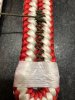
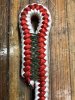
Documenting my hand-sewn eye process

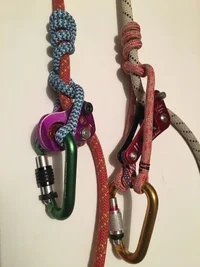
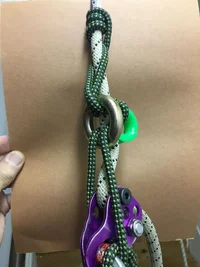
Saw this exact machine splice on my camp harness bridge and thought hey, why not prussik cord? Haven't given it a whirl yet... the srt esq picture I was trying to fit a cmi pulley with an offset pulley (poor man's wrench) in trying to make a cordage based hitch hiker..

more of a thought study than something I plan on putting into regular use (love my zigzag too much for hitch cord anymore) but perhaps the great creative minds on the buzz can come up with something more. If it works definitely something to get commercially done... I spent almost 3 hours doing the stitching, and for a disposable prussik cord, that's a bit much


Obviously ignore the non life support biners and the garbage pulley, it's what I had on hand
Interesting concept with the hitch cord. Your modded pulley isn’t a HH but a RW being used in the Australian mode/ configuration. Michoacán works nice, as the legs don’t touch the rope, and lets it rotate fully.
DA2C4FCF-7302-49A1-8BBB-BE91C083E156.webp
 
Interesting concept with the hitch cord. Your modded pulley isn’t a HH but a RW being used in the Australian mode/ configuration. Michoacán works nice, as the legs don’t touch the rope, and lets it rotate fully.
View attachment 64882

Haha, awesome. I was fiddling with something similar in reaction to the Stitch Hitch thread. Question is, with the wrench below the hitch is it taking 50% of the load off the hitch as desired for SRS functionality? Or does as I suspect the hitch grab most of the load before the wrench can make any difference?
-AJ
 
Interesting concept with the hitch cord. Your modded pulley isn’t a HH but a RW being used in the Australian mode/ configuration. Michoacán works nice, as the legs don’t touch the rope, and lets it rotate fully.
View attachment 64882
This is why I come to the buzz, everything I think of that might be new, someone already had played with it and has excellent insights
 
The load goes through the wrench first so that it is always loaded, unlike the conventional configuration. They give a nice, easy descent, and double as tending devices.
 
The load goes through the wrench first so that it is always loaded, unlike the conventional configuration. They give a nice, easy descent, and double as tending devices.

That confuses me, in the regular wrench configuration the wrench is inline between the upper rope anchor and the hitch, the wrench below the hitch there is only the tension of rope weight below the wrench and some amount of tension between the lower wrench because of the deflection it creates just below the hitch. What am I missing? I can't see how the wrench is taking 50% of the load when it's below the hitch.

Have you climbed on it in a tree as opposed to indoor testing? Not doubting you just not understanding it.
-AJ
 
I haven’t tried it on a job, but definitely creates friction by the ninety degree turn of the rope, to take some of the load off of the hitch. I’m guessing it doesn’t matter if the friction is above or below. The Mich hitch worked slightly better when using the brake hand to make friction also.

I didn’t notice any difference when I used the Sticht above the HH, but since you mentioned it, I tried the pulley wrench under it and noticed an improvement in descending and tending.
I’m outside here on a, I’m guessing, 8 1/2” diameter tree.
0FEBAB99-EF1E-4BF0-9912-751C5116C825.webp
 
It is very dependent on the weight below the wrench in my limited experience.
I was keeping one of those pulley wrenches on my lower D.
I had issues with my hitch binding and behaving poorly... unless I pinched the fall between my feet. Then it works beautifully.
 
I haven’t tried it on a job, but definitely creates friction by the ninety degree turn of the rope, to take some of the load off of the hitch. I’m guessing it doesn’t matter if the friction is above or below. The Mich hitch worked slightly better when using the brake hand to make friction also.

I didn’t notice any difference when I used the Sticht above the HH, but since you mentioned it, I tried the pulley wrench under it and noticed an improvement in descending and tending.
I’m outside here on a, I’m guessing, 8 1/2” diameter tree.
View attachment 64886
That is a very cool setup.
 
The wrench works on tension through the bent portion of the rope which creates the normal force on the bollards. The hitch makes this tension. Rope internal bending friction also contributes. Hence the distinction about extra tail weight affecting its operation vs HH.
 
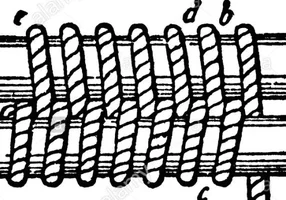
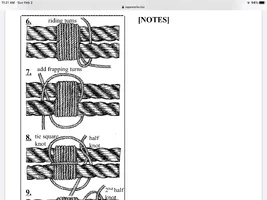
I wonder how racking seizing would work for making eyes.

2020-02-01_racking_seizing.webp
It's usually done tightly, then covered with a second pass that doesn't go between the ropes.

I've seen pictures of where it was used on the rigging of old sailing vessels, so it must be pretty strong. And it could be done by hand little or no tooling.
 
Synthetic rope diameter contracts when loaded making the seizing ineffective no matter how tightly done, from what I’ve read.
 
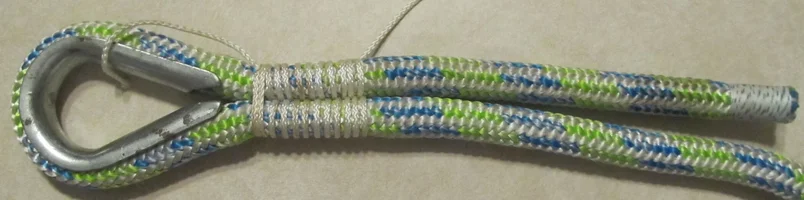
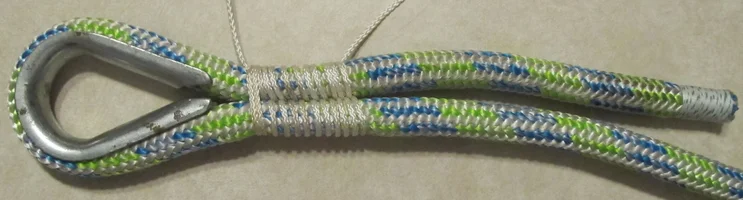
That's true, but wrapping tightly compresses the rope before it is loaded. You can see the effect in the first picture taken right after wrapping.
IMG_3369 (2).webp
After loading it to 170 pounds five times, there's some shifting. A second pass that fits down between the first would probably reduce that a bit.
IMG_3370 (2).webp
That's my first try using Voyager rope and #21 braided nylon twine (200 lb). If I was serious about using it for life support, I'd use at least three sections that size with second passes...and do a LOT more testing.
 
"Brocky: Interesting concept with the hitch cord. Your modded pulley isn’t a HH but a RW being used in the Australian mode/ configuration. Michoacán works nice, as the legs don’t touch the rope, and lets it rotate fully."
Question I have about the reversed RW setup shown on the right - when tending then, could the rope have a tendency to rotate the slick pin in the RW a lot and could the bird then possibly cause excessive wear on the RW, where it wouldn't normally? Slick idea though. Is this setup just because they're in the southern hemisphere?
 
The Slick Pin and shoulder bolt on the pulley don’t seem to rotate when loaded while descending, only when tending the hitch upward.

Correct, possibly reinforced by recently hearing the Men At Work song, the name is due to the devices being down under, your Reversed RW sounds better!
 
The Slick Pin and shoulder bolt on the pulley don’t seem to rotate when loaded while descending, only when tending the hitch upward.
That's kinda what I meant - the use of the slick pin for tending means it's now acting "like a pulley", whereas in the normal intended design use as Kevin foresaw it, the RW was in the upper position above the prussik and hence didn't really rotate the pin. Using equipment differently than the original design intent can sometimes have unforeseen consequences. This rotation could potentially cause wear from the rotation of the pin's spring lock (sorry I don't know the name of this thing) against the body of the RW? Which maybe also gives me pause about a question someone asked a few years ago now about their gear experiencing corrosion - they worked near a salt water environment. Once the annodized coating is worn away, the metal might be more susceptible to this also (but I'm fussin here now).
 
Break Testing the Hand-Sewn Eyes (long post warning):

Back story: I bought a big box of mostly arborist rope from Atwood Rope Co (which I was very pleased with, BTW; their static 11mm climbing line is absolutely perfect for SRS) as I wanted some shorts for projects. Some of the rope I got was non-spliceable 12 strand with a parallel core and some was kernmantle static. I didn't really want to learn to sew eyes so I tried to find a local shop to stitch them for me. I tried marinas, canvas repair shops, shoe repair guys, etc. No one had a machine with enough lift to sew the rope and I understand the big tree supply outfits don't do it anymore. So, I found this thread (pun) and ordered a speedy stitcher.

Luckily, in the box from Atwood was a bunch of their micro and nano cord which is great thread and is already the right material, i.e. it matches the material the rope is made of. A quick call to a beekeeper netted me some beeswax and I was off. I met @moss on a rec climb and came away thinking that he is total guru in this sport of ours so I wanted to follow his directions exactly.

I really love climbing trees but it's not my profession. I'm a mechanical engineer by education so I couldn't help but make a science project out of this. I also wanted to help the readers of this thread to know the limits of what we are doing and try to increase the information available to us going forward. I don't think fear is nearly as good of a decision metric as data is. With that said, please let this post inform you but continue to make your own life-safety decisions.

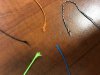
First I broke the thread I was using so I'd have accurate numbers for the calculations:
IMG-7369x.jpg

I got numbers for each type of thread. The thin nano cord (1/32" / .75mm) broke between 22 and 38 lbs depending on color. The bigger micro cord (3/64" / 1.18mm) was in the 70-78 lb range, again depending on color (more likely the tightness of the braid). Then I stitched up a prototype of what I'll make as a lanyard adjuster in the future:
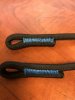
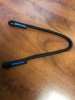
IMG-7370.jpg

IMG-7369.jpg

No pre-compression on this one. This had a theoretical stitch strength of 3212/14kN lbs per eye (although the thread isn't actually in line with the load there is a component of friction too. This cordage happens to have a very slippery cover so I expect it to break below the aggregate strength. We can discuss this in another post. Others have found break strengths in the neighborhood of aggregate thread strength) Note: This wasn't designed as a life-support component, just a test prototype. I believe it was mentioned in another post that the standard is 3360lb/15kN per eye minimum on hitch cord when both eyes are used (can anyone confirm this?) and we all know the Z133 standard says 5400lbs/24kN for all components in the climbing system. Time to test. First, a basket pull as it would be used:
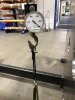
IMG-7372.jpg

I have access to overhead cranes and forklifts at work but our hanging scale only goes to 2000lbs. The hoist I was using is a 4000 lb unit. The basket pull to that weight showed no deformation in the stitching. Ok, time to double the stress:
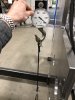
IMG-7377.jpg

No problem going to 2000lbs in a straight pull. You can see the thread which started perpendicular to the cordage is starting to look diagonal. This seems to be a good indicator of heavy loading, in my testing, and I'll use it during gear inspection going forward.

I took the scale off so as not to damage it and continued pulling. The piece I was lifting was a little over 5000 lbs of steel and I picked up the half I was connected to before the end (and the pin in the shackle) broke. That made quite a racket and brought some employees out to see even though it was break time. Oops. So, since I wasn't picking it up from the outside edge a (very) conservative estimate of the break strength would be 2500lbs or 78% of theoretical. See my note at the end of the last post about better instrumentation. Here's the carnage:
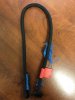
IMG-7378.jpg

So, for my actual life-support version of this I'll use a stitch count that equals at least 130% of the desired strength because of the slippery cover. Likely more because I don't have the exact number it broke at. It was very encouraging, though, to see the fruit of my labor holding that much weight off the ground.

Now time for some bigger rope. This is nice, supple 12-strand from Atwood which holds a lovely knot but isn't spliceable (but I bet stronger) because of the parallel core. This is their 1/2" product but measures closer to 5/8". It's listed at 6000 break strength but their other products I've broken have broken above rated strength.

This time I used much thicker thread (3/64" / 1.18mm) as I wanted to test fewer, stronger strands. It was a challenge with a 190R-25 size needle but I got it done, this time with a little pre-compression:
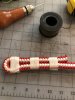
IMG-7386.jpg
Starting second pass:
IMG-7387.jpg
Third pass complete:
IMG-7390.jpg

I had a thought when this was done: Why are we stitching eyes? To create an eye in the rope. What are our other options to create an eye? Splicing and knots. If you can't splice the rope you're left with a knot. So, on non-spliceable rope my hypothesis is that our stitched eyes don't necessarily need to exceed the break strength of the rope but should exceed the break strength of a knot (typically 75% of the rope). This could make it a better option than a knot, as long as the stitching stays protected. With that in mind I tested my next sample to see if I could exceed the strength of a knot. I tied a bowline with a Yosemite finish in the other end of this test sample:
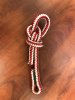
IMG-7399.jpg

I'm at my picture limit so the next post will feature the test data. Stay tuned.

 

New threads New posts

Kask Stihl NORTHEASTERN Arborists Wesspur TreeStuff.com Teufelberger Westminster X-Rigging Teufelberger
Back
Top Bottom