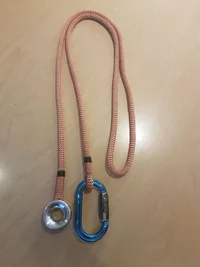
Show off them splices

Quick question.. is there a reason i don't typically see Trex used as hip prusiks, endless loops, e2e's? It's always Tenex tec, Tenex, or Yalex..

Is it too slippery with that wax coating or something like that?

Sent from my Pixel 2 XL using Tapatalk
 
Ahhhhh! I gotchya.. think i paid 30-40 cents for this 3/8ths..

Which leads me to another question..

Wtf is going on with my endless loop splice.. am i supposed to be doing a long taper on the x-over? A short taper you just cut off at an angle? Or am i going about it all wrong & need to follow Samson's end to end 12 strand directions where one side of the loop will end up way bigger than the other?

I been going at it with the 12 strand e2e instructions in mind, except I'm not removing 6 stands on each side after the brummel because there isn't one in this case.

I swear I've completed this type of x-over sucsessfully on a ton of other splices, i don't know why this one is blowing out. Maybe this is an additional reason as to why we never see T-rex used on e2e's & loops? I have noticed it frays out way worse than Tenex tec, Yale Optimus, Ice Tail, etc.. & maybe that wax us allowing it to pop out when manipulated over an extreme angle (the carabiner i worked the splice over to try and smooth).. IDK.. just a theory.

In the picture it looks like i had the lengths wrong, they were correct at first, i just saw what was happening & pulled them out... but wtf.. this thing went crazy.
28b2454681ccc5320cc6b78ebb066ce8.jpg


Edit Again - Ok so i just deleted the first & second edit.. I've finally figured out what was going on with this scenario & I'm going to explain for anyone else as this was very very frustrating...

The problem i was having with this was that I had not tapered enough. If you look at most directions for end to end splices you are not getting the full picture to complete an entire loop, at least not in a way that I'm used to seeing them. In other words, unless you are content without having the tails overlap each other.. Also, the suggested length in these End to End directions always seem like they will most likely make for a very long endless loop iirc.

Now, if you want the tails to overlap each other because you are going shorter than whatever the End to End instructions calls for, you probably going to want to use the 12strand Eye to Eye instructions, just minus the eyes..

Now when i said i had not tapered enough, i don't mean i didn't do enough at the tail ends. What i mean is that i never removed the 6 strands that start a little past the brummels in the Eye to Eye instructions that make the overlapping tails alot more compact & able to fit within the 8in x-over. At the time i was unsure whether it was OK to do this in the loop configuration as the End to End instructions want 5 fids worth of tail without any mention of removal other than the very end. Which says to me you need allot for it to be secure. So ignoring those lengths while removal as well didn't seem right to me for the size i was trying to complete.

How was it popping out- It was popping out / herniating because of the fact the X-over was so full of Cordage & the fact that the T-Rex frays very easy & is really slick when new. The x-over was still bulging even after doing heavy tapering for the last 8inches that make up the X-over (4in earlier than eye to eye xover instructions). Because it was bulging, the strands were seperating enough that any of the dual carrier stands underneath inside the bury were easily able to pop out.. & when there's so many strands cut inside there (that's 2 per strand), it's not hard to end up with something that looks like the picture above.

This may or may not be the case with any other 12 strand dual carrier Cordage, but i think it was exaggerated by the fact that the T-rex is so slick & easy to fray.

I was able to undo the one in the picture & resplice it without losing length, i actually gained a few inches because your gaining cover length back by removing the strands as if it were a Eye to Eye process instead of End to End where no removal happens.

 
Last edited:
Has anyone seen this type hollow eye splice? When i bought my Zig Zag, i bought it accepting the common belief that it would not pass any sort of spliced or sewn termination.. I took that fact to the bank & never thought otherwise.. However, recently I've been poking around European & UK Arb shops & to my suprise I've come across not only one but two different rope manufacturers selling spliced eyes that will pass through hardware like the ZigZag, the Spyderjack, ART Positioner, Closed off Rope Grabs, the Hydra pulley or any other device were always unsuccessfully trying to pass terminations through..

Is this some new type of splicing technique? Some newer type of rope construction that allows it happen? Or both?

Not only is this hollow splice being used in ropes, but it's being utilized in E2E prusiks as well..

Of course, my next question is, what's the procedure/instruction for it? Of course 16 strand comes to mind, which i believe the blue rope picture is, but that E2E looks like it's much more than that.

See pictures below.
ca3c0b17027acc977df031b2227cb3f2.jpg


8a15cf16928b2596d1cd84b6b56fd079.jpg


Sent from my Pixel 2 XL using Tapatalk
 
My first double braid splice. 10 mm Ocean Polyester. Friction saver/Super Smooth/choked anchor. Struggled with the bury at first. Searched the buzz and the core reduction really helped with the final bury. Thanks again tree buzzers :-)
View attachment 54816
You got a link for that method? There's also a different way some ppl taper the cover on this cordage as well, keeps the cover from fraying out as bad. I do get nervous though, reducing the cores on these things...IIRC, i believe the core removal is just to make the initial core tail bury easier & not as much so for the final. (For example, i went overboard with the core removal on Tachyon once & went to far back with it & then on the final bury i could just pull the eye out with very little resistance). I think on my one & only ocean splice i stuck with the traditional core amount but used the different cover technique.

I've found that a wire or soft fid (used together) & taking the time to fully understanding exactly what's going on, on the inside, is the easiest way for me to bury things, as well as end up with a safe product...

Sent from my Pixel 2 XL using Tapatalk
 
You got a link for that method? There's also a different way some ppl taper the cover on this cordage as well, keeps the cover from fraying out as bad. I do get nervous though, reducing the cores on these things...IIRC, i believe the core removal is just to make the initial core tail bury easier & not as much so for the final. (For example, i went overboard with the core removal on Tachyon once & went to far back with it & then on the final bury i could just pull the eye out with very little resistance). I think on my one & only ocean splice i stuck with the traditional core amount but used the different cover technique.

I've found that a wire or soft fid (used together) & taking the time to fully understanding exactly what's going on, on the inside, is the easiest way for me to bury things, as well as end up with a safe product...

Sent from my Pixel 2 XL using Tapatalk

Core reduction is done only on the last 5 or 6 inches of the core which is removed after completing the crossover bury and exiting the cover back toward the standing part. After I pulled the core from the cover I lightly taped the end so it didnt fray. Because the core is a triple carrier, I simply began to remove single strands to preserve the braid but reduce the total volume by approx. half. (Thanks for the tip Nick.)...I believe Arlo had a thread discussing the core reduction. There are also threads discussing tapering, however I used Samsons 5,5,5,5...method. kept tape on and braid held. I will try Nicks method the next time I do OP and compare.

Thanks again for all involved in the wealth of knowledge
 
Has anyone seen this type hollow eye splice? When i bought my Zig Zag, i bought it accepting the common belief that it would not pass any sort of spliced or sewn termination.. I took that fact to the bank & never thought otherwise.. However, recently I've been poking around European & UK Arb shops & to my suprise I've come across not only one but two different rope manufacturers selling spliced eyes that will pass through hardware like the ZigZag, the Spyderjack, ART Positioner, Closed off Rope Grabs, the Hydra pulley or any other device were always unsuccessfully trying to pass terminations through..

Is this some new type of splicing technique? Some newer type of rope construction that allows it happen? Or both?

Not only is this hollow splice being used in ropes, but it's being utilized in E2E prusiks as well..

Of course, my next question is, what's the procedure/instruction for it? Of course 16 strand comes to mind, which i believe the blue rope picture is, but that E2E looks like it's much more than that.

See pictures below.
ca3c0b17027acc977df031b2227cb3f2.jpg


8a15cf16928b2596d1cd84b6b56fd079.jpg


Sent from my Pixel 2 XL using Tapatalk
scroll down to slaice- https://www.teufelberger.com/en/pro...and-rescue-ropes/technology/terminations.html
 
Levi.. yes I've seen those Slaice's all over the place but i was under the impression that they do not fit through the Zig-Zag etc.. It's also seems as though they are not very strong compared to the beaking strengths I'm looking at with the Agriope terminations... I haven't looked into the slaice strength recently so i may be misunderstood on those numbers. As far as fitting through, I've never heard that they can. If I'm wrong, then I'm glad as it's just one more option that will.. you know what i mean?
 
Yeah. There's talk about that slice somewhere in this thread way back. I think maybe @oceans had some good info on it.
I looked into it a bit more by searching a few threads around here & i keep hearing the Slaice will not pass a zig zag. Yes, Oceans is a pretty knowledgeable guy.

Still curious about the Agriope Splicing technique though... As well as those hollow Gleistien E2E's, they really just look like Ocean Poly but hollow.

Sent from my Pixel 2 XL using Tapatalk
 
Perhaps the Gleistiens cover is strong enough to be buried inside itself. Some marine lines are designed this way. The core is polypropylene, and eliminated when spliced. It's done this way to make a continuous loop with no diameter change.
 
Core reduction is done only on the last 5 or 6 inches of the core which is removed after completing the crossover bury and exiting the cover back toward the standing part. After I pulled the core from the cover I lightly taped the end so it didnt fray. Because the core is a triple carrier, I simply began to remove single strands to preserve the braid but reduce the total volume by approx. half. (Thanks for the tip Nick.)...I believe Arlo had a thread discussing the core reduction. There are also threads discussing tapering, however I used Samsons 5,5,5,5...method. kept tape on and braid held. I will try Nicks method the next time I do OP and compare.

Thanks again for all involved in the wealth of knowledge

Where core reduction is really critical is on ropes like Tachyon, Tendril and Scion which have really tight cover strands. If you don't reduce the core on those ropes it is just about impossible to get the core through the cover, especially if you are splicing used rope. But I reduce the core on all types of double-braids just because it makes it so much easier.
 
Perhaps the Gleistiens cover is strong enough to be buried inside itself. Some marine lines are designed this way. The core is polypropylene, and eliminated when spliced. It's done this way to make a continuous loop with no diameter change.
Interesting..
Not that i would Just assume this, but when talking about those Gleistien prusiks, if it was the same cover construction material & looked like the same weave as Ocean Poly & had very similar MBS, would it be safe to assume one could do the same with the OP?
Where core reduction is really critical is on ropes like Tachyon, Tendril and Scion which have really tight cover strands. If you don't reduce the core on those ropes it is just about impossible to get the core through the cover, especially if you are splicing used rope. But I reduce the core on all types of double-braids just because it makes it so much easier.
I do the same on just about every Splice i can't freely pass a fid through.. i don't get particular about what or how to pull the core strands.. I just tape the end & place another peice of tape a few inches down from there, split the core through middle & cut right next to second peice of tape. Then i Snake my soft fid through & boom done.. Since I've been using a soft fid i have yet to have the troubles i used to have passing cores through tight covers..

Now final buries i can't say the same..lol. Some are just freaking tight, especially so if playing it safe conservative on core & cover taper. Ive been noticing that manipulating these two tapers bears a bigger difference on burying difficulty than actual length of bury.

Speaking of buries & tapers.. & this isn't a question directed at you Arlo, but more so anyone..
With the goal of trying to maintain a "flexible splice" where is that happy medium? I've noticed that I've created some splices where I can push down on throat & slowly work the bury back out... However, if this is whiplocked right there at the throat is it dangerous? I ask in comparison to ones that become rock hard & there is no way your pushing down on that throat to work anything back out.

Sent from my Pixel 2 XL using Tapatalk
 
In the interest of safety I just follow the manufacturer's recommendations for tapers. If it is so loose you can easily back out the bury I would be a bit nervous about that.
 
In the interest of safety I just follow the manufacturer's recommendations for tapers. If it is so loose you can easily back out the bury I would be a bit nervous about that.
Ok.. so it would make you nervous.. Me too..

However.. while trying to think this through, doesn't it want to bury itself even further when loaded? Instead of going the other way? Then of course it's whiplocked.. so is our nervousness/concern warranted?

I've never actually bought anything with a "professional splice" already done, so it's hard to feel/see other examples... right? You know what i mean? For example, sometimes depending on cordage they come out rock freaking hard like these 8mm Epicord splices I did this week.. Their hard so i trust it, i say to myself there's no way that's coming out.. however part of me says there's no way this would be acceptable coming from a place like Treestuff or Sherrill as they just aren't flexible & would have to be way longer than usual to be useful... But on the other hand, maybe their 8mm Epi's are just like mine.

Edit- I just remembered the Reep on my hook was spliced by Honey Bros.. I just took a look at the it & it has the same flexability I'm talking about above. I'm pretty sure if it was not Lockstitched I'd be able to pull the final bury out of there.. Just incase I wasn't clear in my previous, the type of flexibility I'm talking about is NOT just being able to pull the bury out with one pull & barley any resistance. I'm talking about having to manipulate, pull down on the throat & then being able to move the bury out Little by Little until it finally slides out.

Regardless.. this Reep Splice on my hook is just like this, should i be nervous/concerned with it? I kno.. I kno.. this stuff is hard to dechiper on via i-net.. I'm just trying to find that happy medium & I know following manufacturer instruction to the "T", always ends up being a rock hard splice..

Sent from my Pixel 2 XL using Tapatalk
 
Last edited:
If you are interested in doing eye splices in Marlow Vega, I just stumbled across this video on youtube. He makes it look easy, which is bullshit, but it can be done.

 
That gives a general idea of how it's done. They cut out the hard part of burying the core, and only showed it as it exited. He does make a comment about needing a strong pin, possibly indicating a struggle to do the bury. The Vega bury lengths are longer than the ones in the video, which I'm guessing is 10mm rope. The subtitle for step 13, burying the cover for 100mm conflicts, with verbal instructions of doing it for half of the core bury, which would be 150mm.
 
That gives a general idea of how it's done. They cut out the hard part of burying the core, and only showed it as it exited. He does make a comment about needing a strong pin, possibly indicating a struggle to do the bury. The Vega bury lengths are longer than the ones in the video, which I'm guessing is 10mm rope. The subtitle for step 13, burying the cover for 100mm conflicts, with verbal instructions of doing it for half of the core bury, which would be 150mm.
Yeah, I really struggled with this one when I first tried it. I think it will get better with practice, but I have only done two so far. I can understand why Wesspur does not want to be bothered!
 
Hey... Has anyone ever noticed this literature within the "used class 1 double braid" instructions?

""""If a hollow spot appears at the throat this means that the core tail was cut off too short.
Do not worry as this does not affect the splice performance nor its strength. Reason:
the total load of an eye splice is split between its own two legs. Therefore, each side
of the splice only has to support 50% of the total load. The braided cover alone can
handle this load factor."""""

So.. what this suggests to me is... When persuing a nice flexible splice, that it's ok to give the core tail a really heavy taper, even to the point it gets sucked up into the eye (which has always concerned me in the past). In the end, emphasis should be placed on not going too crazy with the cover taper while trying to achieve a flexible splice.. (think hitch cord & rope tools).. I've always tried to match the core tail & cover tail respectively.. not identical, but not too much off one or the other.

What i don't understand is if your using a full fid core tail bury (like most direction suggests), how would it even get sucked that far up there. When using a full fid bury instruction, I usually have a hard time pulling the tail out that far just for the taper, so there's no way i could cut it that short. Maybe if it was a really large eye there would be enough cover slack in eye to pull the core tail out that far & cut it far enough back that this would happen.. HOWEVER, when your doing a 1/3 bury like alot of members suggest for E2E's, it's very easy to have it suck back up that far as you don't have to pull that much tail out.. in an 8mm cord that's only like 2.5in or so.. somewhere around there..

Anyhow.. I'm going on & on here.. Im just wondering if anyone has noticed this literature as I've always thought this was a "scrap it & start over" scenario & it also sounds like a way to achieve flexibility in a splice by going heavy on the core tail & moderate on the cover tail.

Am i misunderstanding?

Edit- (just realized this) Even more so confusing compared to traditional instruction, is that in these specific directions, your not even creating a bury past your original core extraction point... Which just sounds very odd.. In other words your just tucking the buried cover tail away, whipping & calling it a day. & It says it still rates at 90%..

Sent from my Pixel 2 XL using Tapatalk
 
Last edited:

New threads New posts

Kask Stihl NORTHEASTERN Arborists Wesspur TreeStuff.com Teufelberger Westminster X-Rigging Teufelberger
Back
Top Bottom