X-rigging rings

.... when you are done with your rigging and you want the block back.

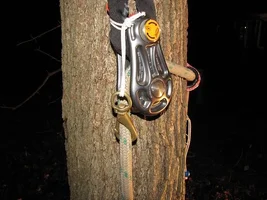
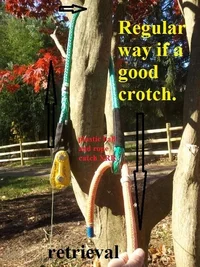
Just add a plastic ball to the end of the riggng line. the rigging line and ball go through the ring. then go through the block and the ball catches in the brass snap. Have a throw line attached to the rigging rope of course. The ball catches in the snap and pulls the block out. The ring is the only thing that goes over the crotch. (by the way, the ring is VERY round and goes through most crotches). This is a great way to remove a block without having the block to go up over a crotch.
 

Attachments

  • 342610-retrievenoblockovercrotch2.webp
    342610-retrievenoblockovercrotch2.webp
    78.9 KB · Views: 256
From the photos above I think that X is using a method that I have used to lower my FS out of trees in the past. When I don't want to crash it down. I will girth the retrieval ball to the spliced eye on my climbing line with a throw line also tied to the eye. As the large ring on the friction saver is pulled over the crotch a bight of throw line is pulled over as well. You can then lower the friction saver with the throw line bight. Things can get tangled and it can be a pain, but it will work. I wouldn't want to bomb out a block and have it hit a rock or anything but the softest pile of leaves.
 
[ QUOTE ]
Ok, thanks. What are the rings rated for alone? Are they marked with this rating?

[/ QUOTE ]

Thanks for asking, as others probably have the same question.

You can't think of them as you would any solid ring.

The sling and ring must be used together at all times, you can't have a loose ring, like you do with those that you put on a harness bridge.

The combined sling and ring, is going to have a breaking strength of what ever the sling material is.

We have never been able to break a ring. Only distort them some, this happens around 18,000 to 19,000 lbs. At 30,000 Lbs the ring was visibly distorted, but nothing extreme.

We never tried to pull apart a ring by itself, because there is no reason to ever use it in that way. It is NOT designed to be used that way.

Now, distortion can happen slightly sooner if the sling diameter is small and does not fill the groove up. Also, the smaller diameter rigging rope you run through the ring, the sooner you could get some distortion. But, these would still be near 18,000 Lbs and we are talking distortion that you have to use Vernier Calipers on to be sure. (To get a very small diameter rigging line and get it up to those numbers, it would have to be dyneema and no one in their right mind uses dyneema as their rope rigging line.) So, I probably didn't have to go into explaining all that about distortion. We are using tenex tec for several reasons, we can use big diameters to fill the groove up and still not be real costly, like dyneema would. Plus 3/4" tenex tec is around 22,000Lb breaking strength which is plenty. Tenex tec doesn't pick and catch everything like loose dyneema does. Plus, a lot of people on forums keep repeating that tenex is low melting point, but do they really know temperature it degrades at? 350 degrees F (melting point is 480-500 F). Nylon degradation is 325F, Polypropylene is 250F. Dyneema degradation starts at only 150 degrees F! Dyneema melts at 300 F. So, I think it's not fair to be calling tenex a low melting point fiber.

So, since the rings do not truely fail before any sling would fail and since distortion varies with what sling diameter is used and also with what size rigging line is used, a SWL can not and should not be put on the ring itself. If rings are ever sold loose, we have no idea what size sling and what size rigging ropes a user might use them for. I ring itself can't have a SWL value, unless it is a ring and sling combo together.

Which is what we sell. The slings have labels under clear shrink wrap, that shows the SWL.

 
[ QUOTE ]
From the photos above I think that X is using a method that I have used to lower my FS out of trees in the past. When I don't want to crash it down. I will girth the retrieval ball to the spliced eye on my climbing line with a throw line also tied to the eye. As the large ring on the friction saver is pulled over the crotch a bight of throw line is pulled over as well. You can then lower the friction saver with the throw line bight. Things can get tangled and it can be a pain, but it will work. I wouldn't want to bomb out a block and have it hit a rock or anything but the softest pile of leaves.

[/ QUOTE ]

The method X has been using with a block and a ring on the same sling is similar to a big ring, small ring, friction saver.

His normal method is to act like the block is the LARGE ring and the X-Rigging Ring as if it is the small ring.

342679-2012-11-1411.28.18.jpg


see video he just put up today, shows his method:
http://www.youtube.com/watch?v=ofGCgVc4M7k

Doing it this way, when setting from the ground; the ring will travel up over the crotch. Then on retrieval, the ball and rigging rope catch the XRR and the block flips up over the crotch. Of course, yes, you use a throw line just as you would when being good to your FS.

Now, some people worried that it is hard to get the block to flip up over a crotch. Which, surprisingly is not as hard as you would think. You are pulling down on bull rope, which is very nice.

So, since some worried about that, X looked for a retrieval method that made the block side, the "small" ring side. So that the block would not need to be pulled up over the limb or crotch.
 

Attachments

  • 342679-2012-11-1411.28.18.webp
    342679-2012-11-1411.28.18.webp
    98.5 KB · Views: 65
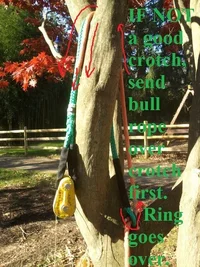
if you tried the retrieval that original way and the block was getting stuck, or you thought it might get stuck, you could send the rigging line over the crotch with a throw line. It still lowers safely to the ground. X should be putting out some videos.
342684-2012-11-1411.28.48.jpg
 

Attachments

  • 342684-2012-11-1411.28.48.webp
    342684-2012-11-1411.28.48.webp
    93.7 KB · Views: 53
With my Ropeguide I tie a 3/8" rope the length of atleast the fall to the rig and wrap once or twice to the stem above the device to create what is in essence a porti to slow the descent of the rig. No crash, nice smooth controlled descent.
So you can just retrieve with out fear.

Same idea as in my avatar, the 2ndary control line to slow the piece from swinging hard into the rig point.
 
[ QUOTE ]

The sling and ring must be used together at all times, you can't have a loose ring, like you do with those that you put on a harness bridge.

The combined sling and ring, is going to have a breaking strength of what ever the sling material is.

We have never been able to break a ring. Only distort them some, this happens around 18,000 to 19,000 lbs. At 30,000 Lbs the ring was visibly distorted, but nothing extreme.

We never tried to pull apart a ring by itself, because there is no reason to ever use it in that way. It is NOT designed to be used that

So, since the rings do not truely fail before any sling would fail and since distortion varies with what sling diameter is used and also with what size rigging line is used, a SWL can not and should not be put on the ring itself. If rings are ever sold loose, we have no idea what size sling and what size rigging ropes a user might use them for. I ring itself can't have a SWL value, unless it is a ring and sling combo together.
.

[/ QUOTE ]


I understand that the rings should only be used in conjunction with a given sling, as a " closed " system, but at the same time a block always needs a sling, even if it can be changed out.
I dont think id buy a block that didnt have a breaking strenght on it, even if i knew it was way stronger than the sling or the rope id be using with.
Plus it wouldnt be too hard to cut the sling and change it.

I dont want to sound pessimist or anything and Im sure theyre plenty strong, but we've seen rings fail before that didnt have any info on them...
 
[ QUOTE ]
The "ring" in the first pic looks like it's teardrop shaped. Was that a prototype or something?

[/ QUOTE ]not sure of what picture, but i did notice that during resizing of some pictures and especially my large poster that I put together for the expo a few rings looked tear drop or oval because of the slight stretching i did to the photo to fill up space.

None of them shown were nothing but perfectly round. I did not have a tear drop shaped prototype.

I have the videos of the independant break testing machine work and you will get to see what a broken sling and distorted ring looks like.
 
[ QUOTE ]


I understand that the rings should only be used in conjunction with a given sling, as a " closed " system, but at the same time a block always needs a sling, even if it can be changed out.
I dont think id buy a block that didnt have a breaking strenght on it, even if i knew it was way stronger than the sling or the rope id be using with.
Plus it wouldnt be too hard to cut the sling and change it.

I dont want to sound pessimist or anything and Im sure theyre plenty strong, but we've seen rings fail before that didnt have any info on them...

[/ QUOTE ]

I will think on this some more, but I don't see how we can put a rating on the ring itself.

You said, "a block always needs a sling, even if it can be changed out. I don't think I'd buy a block that didn't have a breaking strength on it"

Yeah, but the blocks sling does not wrap around the block and give the block strength. The block is going to have the same breaking strength pretty much no matter what sling you attach to it.

If you want to know what your X-Rigging Ring and sling breaking strength is, it IS what ever the values are of the cordage you are using. Plain and simple.

If you cut a ring off of one of our factory slings, what ever the new fiber you add to the ring is, that will be your new breaking strength.

The X-Rigging Rings are pretty much a thimble. A super strong, light, low friction thimble.

I will think on it some more and thank you for the thoughts.
 
A block has a rating on it because it can be used with many different attatchment points. the shiv or bushing or pin in the blocks do not have independant markings because they are part of the whole system. If you were to take it apart and use a piece in something else there would be no rating on it. This is what he is selling ... a system.
 
[ QUOTE ]
A block has a rating on it because it can be used with many different attatchment points. the shiv or bushing or pin in the blocks do not have independant markings because they are part of the whole system. If you were to take it apart and use a piece in something else there would be no rating on it. This is what he is selling ... a system.

[/ QUOTE ]

Exactly Mark, and from what I can see it is a hell of a good system.

I could have really used those rings on a nasty tree last month where we used the fishing pole technique during the rigging.

Awesome work David!
 
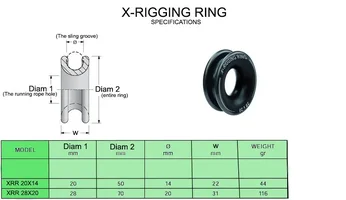
Heres a question, what is the width of the rings themselves, the 20 and 28mm? What kind of bend ratio would be created with a single ring on 1/2" line with the "small" ring? 2:1, 2.5:1, 3:1? In that pic earlier in the thread its obviously about the size of the bushing on the mongo big ISC spring block, but was that the large or small ring, and what are the dimensions exactly? Would love to swap a bunch of these in for light rigging duties, obviously the WLL exceeds smaller blocks and pulleys, curious about the friction efficiency vs even a small pulley. Do they run well enough to pull up smaller stuff by hand, or does a pulley/block have a huge advantage here?
 
[ QUOTE ]
A block has a rating on it because it can be used with many different attatchment points. the shiv or bushing or pin in the blocks do not have independant markings because they are part of the whole system. If you were to take it apart and use a piece in something else there would be no rating on it. This is what he is selling ... a system.

[/ QUOTE ]

Thank you Mark, a great way to explain it. I couldnt' have done better myself.

I am currious what the ring by itself tensile is now though, even though it will never be used in that form.

It's kinda like asking, what's the tensile strength of the paint on a tank? Why? What does it matter?, the armor plating of the tank is the important part.
 
[ QUOTE ]
Heres a question, what is the width of the rings themselves, the 20 and 28mm? What kind of bend ratio would be created with a single ring on 1/2" line with the "small" ring? 2:1, 2.5:1, 3:1? In that pic earlier in the thread its obviously about the size of the bushing on the mongo big ISC spring block, but was that the large or small ring, and what are the dimensions exactly? Would love to swap a bunch of these in for light rigging duties, obviously the WLL exceeds smaller blocks and pulleys, curious about the friction efficiency vs even a small pulley. Do they run well enough to pull up smaller stuff by hand, or does a pulley/block have a huge advantage here?

[/ QUOTE ]

Great question Jeff, I meant to show this and forgot.

Here are the specifications:
342899-X-RIGGINGRINGSPEC.jpg
 

Attachments

  • 342899-X-RIGGINGRINGSPEC.webp
    342899-X-RIGGINGRINGSPEC.webp
    23.6 KB · Views: 69
also, i noticed that the video still had the setting of the block with ring and retrieval in fast motion. I will show it in real time with verbal explanation.

It's a bit hard, I have to do my day job too; as it's the only thing bringing in money at this time.
 

New threads New posts

Back
Top Bottom