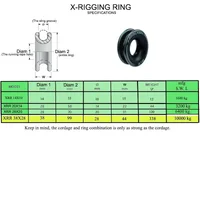
X-rigging rings

Rescueman I borderline begged David to let me go work with him to learn more about rigging with the rings appropriatly. And he shed some knowledge for me. But I see how your assuming I'm careless and sloppy. I'm sure everyone on here will cosign your statement about my rigging practices......
 
I respect those who do it well - and come home safely every evening.

I think we are all here for the same reason. Much of Arboricultural technology in particular per roping technology has stemmed from the rock climbing and rescue industry over the past several decades. The development of these X rings has certainly been a fantastic tool . Having someone across industries critique our development is also a fantastic tool in my perspective. Although The words of some critiques may seem harsh at times and hard to swallow, I feel it is valuable information and should be taken more seriously rather then attacked personally.we are not physics professors, engineers or fireman anymore than they are arborists. But we both can learn a lot from each other and that is what this site is really good for. Just a thought.
 
Because I didn't start tree-climbing until I was nearly 60
So with less than two years experience in actual arborist climbing and No actual use of the product you feel that because you are eloquent with the english language and have a extensive grasp of mathematics/physics and engineering this entails you to come lord it up over me?

HOW BOUT PLAIN SPEAK FOR THOSE WHO ARE NOT AT YOUR LEVEL or is that not a simple enough statement?
if you truly do know your stuff then demonstrate that base by being able to translate what you said on the opposite page.

"Wadda I call your experience with your X-rings? Sloppy and careless."
If you haven't been riding the wooden pony what gave you the gumption to lecture me about the subject?

Stop running around and hiding behind your own skill in verbosity and answer the bloody question put to you this is not a private conservation in case you had not noticed captain obvious.
 
From what I understand rescue man is saying that hard anodized can create a micro edge putting undue strain stress and or damaged on our ropes. It was mentioned in a rescue article that a descending eight was soft anodized as opposed to hard anodized implying there was an issue with the hard anodized finish. I would like to see more specific information about issues with this hard anodized finish if those issues do in fact exist.
 
I think we are all here for the same reason.
Appreciate your post baumeister, but he's here to show off. Stuff we can learn by a simple Google search. When it comes to gettin' up a tree, pruning, or taking it down, speedlining limbs over a house, running a chainsaw aloft, and dropping heavy loads into a block (with which his math is "oh so exquisite") his skills don't amount to shit. I guess those who can't do....teach.
 
Last edited:
Well tree logic, he admits that he doesn't do tree work professionally and has said he respects those of us who do it well and come home safe and sound. Tones of superiority can certainly appear and texts either on purpose or importantly I just appreciate his knowledge and look past the snobbish tones.
 
I've engaged in tree-climbing work as rarely as possible, but I've been felling and processing trees for 35 years.

I do have a climbing saddle, split tails, lanyards, gaffs,
I've engaged in tree-climbing work as rarely as possible, but I've been felling and processing trees for 35 years.

I do have a climbing saddle, split tails, lanyards, gaffs, tailboard block, throw ropes, Big-Shot and a bunch more arborist equipment.

tailboard block, throw ropes, Big-Shot and a bunch more arborist equipment.

So... Then... No?
 
They are nice, we bought one at work. Well actually I bought one and told them to give me money because we needed it. Use that thing a few times every month.
Monkey, thanks! and thanks to Nick for bringing it up with the link. I will buy several, what a good price. Not as large as what I was looking for in the past, but what I was looking at was $3,500. These little ones at tree stuff can record to around 4,400 lbs and should be able to handle not breaking till 6,000 lbs.
I could do some things with that for that price of $700. Great price.

I'm home now, just catching up......
 
Been waiting for the new multi xring setups. When will they be available?
They have been delayed due to attempting to get in a new cordage, but that is taking too long with lots of delays, so we are proceeding with the tested and true tenex and Samson products. When? Next month I hope.
 
As author of the 4 to 1 bend ratio thread I want to venture the following engineered guess. The strength of oceans splice is going to be equal to or greater than that of the standard splice w larger cordage available at this point. I would be willing to put up some dough for pulling tests. Also see a huge advantage of using a smaller sling diameter and getting more out of it. Large slings are not easy to work with especially when you have been in spikes in a removal all day. :):):)
Baumeister, this is very interesting. With your confidence, I'm definitely going to check it out. I was planning on break testing a bunch more stuff, likely at the end of next week, so we are having spliced up Ocean's 1/2" configuration verses the 1 inch. Both on a beast ring. I don't see how they would be near the same, because the entry of the burry has not been the location of breaking of past slings. maybe 1/2" will break there on a large beast ring, due to the abrupt change. I would expect that if you had to use half inch, a teardrop shape would be important on a ring that size.
I will gopro record all the breaking as usual. Not that I'll get around to showing it unless I have to. o_O
 
Last edited:
And I will go with devils advocate/ simpleton and get down to the nitty,

If there is a genuine reason why I could change the way I am rigging out which will result in less ride ( having the shit pummelled out of me) by transferring the energy throughout the system by spreading the loading in a different manner to the one I and many others currently are taught to and use every day then there is ears up attention from this little duck.
Then ears up little duck. Ducks can't put their ears up though.... they just have ear holes like most birds.:confused:

It is in my mind, similar to believing the earth is flat and then someone explaining that no the earth is in fact round, all the maths and technical jargon aside how bout a dumbed down discussion for the masses?
That's why I think you will get what I'm saying in my article.

Having caused through ignorance massive load failures resulting in total loss of the rigging point, snapping slings and lowering ropes, bending biners etc I have set out to do things better and if the X-rings achieve just that then they Will replace what I currently use because Any gain that increases the safety margin and/or increases production is a winner with me.

Wow, StihlMadd. I've never broken a rigging line, block, lowering device while at work. Only in testing these last few years.
I did bend 3 steel biners on a near vertical speedline before I had the rings though at work.
 
sorry was printing out forms and loading the shotgun, I have kept all examples of failed equipment and can provide photos :D
worst one was not when the failure occurred in the rigging components but when I sheared off the entire top of the tree sending the rigged piece and the top hurtling down onto the ground crew and leaving myself 60 ft up looking at a broken end with a inch or so of timber still supporting the climb line - by god only knows what chance all crew emerged from under the wreckage unscathed. :tarjetaroja:
 
I'm sure X-rings have their place, but they seem to have a number of vulnerabilities.
From the Tree Stuff website:
  • X-Rigging Rings(XRR) are for rope rigging, NOT for climbing and life support use. The XRRs are very low friction, however, hard use and abuse could result in the ring becoming heated. Choose your sling material wisely in regards to what tasks the ring will be put through. Research your sling or rope material for degradation temperatures before choosing your cordage material.
  • Do not use a single XRR as a terminal rigging point. The bend ratio with a single XRR and most rigging rope sizes does not meet best management practices in rigging. Consider triple ring use for terminal rigging. Use arborist blocks for heavy weights, long runs and when less friction is needed.
  • XRR must be secured in a very tight professional splice. Do not splice if you are not qualified, slings can be purchased already complete with XRRs.
  • Inspect your XRR and splice before every use. If the splice is loose enough for the ring to possibly come out, do not use.
  • When an XRR is pushed to extremes, they will deform; the outside groove pinches inward and the XRR will become oval. Discontinue use if the XRR is ever deformed.
  • IF the black Hard Coat Anodize is ever worn away, discontinue ring use; as the friction will increase and heat will increase.
I'm not much of a fan of hard-coat anodizing, as when it wears away it can leave a micro-edge that can cut rope fibers. Overheating may also be a problem if ropes are allowed to run too fast.
Oh my. I wrote all of those caution statements. Why? Two reasons: There are plenty of dump people out there and no matter how dump they are, I would personally feel awful and devastated if a person was killed with some product that I put out. That is the number one reason.
I don't want it for life support because what if a person used one as a friction saver ring in DRT and had the ring in a very loose eye. Then the climbing line was slacked and shaken and the ring fell out. AND they didn't notice it and repelled extremely fast; rope on rope and their friction saver rope burned through, they would fall.
These rings take heat way better than say a Stainless Steel large porta wrap. You will roll off smoke and glaze the rope on the porta wrap way before you get even a SINGLE large ring to glaze the rope. But, I don't know, some idiot might decide to lower a log 5,000 feet into the bottom of the grand canyon really fast. IF that happened, I'm sure the ring would be very hot and might melt the sling.
Personally speaking, I've used them many times as a friction saver for my climbing line. Should others do this? NO, officially.
IF I had a ring that was messed up due to muddy ropes or sandy ropes and it got a shiny aluminum patch worn past the anodizing, would I continue to use it? Yes, I would rotate the ring in the splice and keep using it. Should others do this officially ? NO
IF an XRR is deformed, then it was extreme forces, you are lucky that the sling didn't break. In almost all cases, the sling breaks first or at the same time. IF it didn't break, throw the sling away, because it was RIGHT there, right at the edge of breaking and will break soon.
The second reason to post all those overly cautious statements was to cover my butt, like all companies try to do.
Now:
I'm not much of a fan of hard-coat anodizing, as when it wears away it can leave a micro-edge that can cut rope fibers.
.
Rihiheeallly? (said in an Ace Ventura voice)
Let me explain what hard coat anodizing is in common language:
take aluminum and stick it in an acid bath and add electricity and other stuff.
the surface oxidizes, kinda like rust on iron.
The aluminum is penetrated and becomes the outer layer. It is part of the aluminum, plus it does build up some thickness on top as well
DO NOT think of it as paint, or powder coat or a coating.
You can NOT chip it off. You would have to grind it off, wear it away.
Wearing away with say muddy ropes is possible. Happened to me after using rings exclusively for three years ; then finally used them in heavy rain and muddy ropes with decent weights being lowered. Two little shiny patches on my beast rings.
Once the black hardcoat is missing, you are left with a shiny aluminum patch. You can feel a depression where the bare aluminum meets the hard coat. But believe me, it’s not like a paint chip. It’s like if you sanded down a paint chip with 3000 grit sandpaper and you think to yourself, “yeah, I think I feel an edge”.
Micro edge? I guess it could be called that. Causing a rope to fail? OH COME ON !
In a pristine testing environment with a new rope with no wear at all, then the rope pushed to breaking point in a machine with a tool that had a micro edge in the tool, then maybe. But I even doubt it then. It would rather break at the tightest bend.
From what I know, companies do aluminum tools in regular anodize because they can make pretty colors and it wears off quickly. Plus most companies can easily do this.
Things wearing out = more future sales AND pretty colors sell.
Hard coat anodize is difficult to get it right. Expensive due to this. Most businesses can’t get it right, they often make brown results and have to scrap it.
Hard coat can only come out BLACK. That is the only choice.

 
Stooping to ad hominem to avoid responding to the substance of a comment is a form of adolescent hostility.
I've engaged in tree-climbing work as rarely as possible, but I've been felling and processing trees for 35 years.

I do have a climbing saddle, split tails, lanyards, gaffs, tailboard block, throw ropes, Big-Shot and a bunch more arborist equipment.

Kind of the pot calling the kettle a hostile adolescent, no?
 
Xrings are sheave less blocks, its all about the sling strength , you can't beat xrings hardiness or strength to weight ratio ! Can't beat them ...cannot ...you fuckin cannot . Real world user right here speaking from xperience with the product . ..I'm not talking tree pieces ..they hold up to whole trees if the sling is rated the ring is nooo problem ..TRUTH!
 
Any rigging hardware also comes with a MBS and SWL, but the X-rings apparently have not been tested for load ratings.

xrr mfg SWL.webp
I don't like to show these because they are pretty much irrelevant. These rings are used in thimble form and they are machined aluminum.

You won't break them. I assume that antal wanted to stop the nagging of "number-geeks" that were asking for numbers; so they put this out.

But it makes no difference. They are used in thimble form, but extremely strong to resist deformation. Thimbles don't need stated breaking strengths; because it doesn't make sense, they are irrelevant; but many people can't get that.

They will never break like a cast tool, they are machined aluminum, but will stretch like chewing gum if enough force applied in a breaking machine..... as long as the cordage held long enough.

If you put 3/4" tenex tec around it, it might be 41,000 lbs. IF you put 1 inch steel cable around it, it might be 90,000 lbs. before the sling breaks.

It takes a LOT to deform them and you actually can't get them to break in the configuration they are made for.

So for that chart, I believe it was set as 10% deformation as the breaking point to come up with these SWL.

Again, it's not important. What is important is what I said in the caution statement; if you find a ring deformed, retire the sling because you were really close to breaking that sling.
 

New threads New posts

Back
Top Bottom