
work positioning

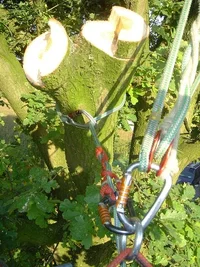
Any of you guy's using this set up for work positioning? I'm using it more then my side d-rings at the moment and love the freedom it gives you to move yourself into mulptipal positions from one anker point. Also when putting your handsaw away your lanyard is'nt in the way (i have my handsaw on my lefthand side and i'm righthanded).

Infact the only thing i can think of that is bad about this set up is you have to watch which way you install the biner of your landyard, gate facing up, when moving and you would have your gate facing down you could push/rub the gate open.

I wounder if it would have an advantage in a rescue situation?
 

Attachments

  • 32072-DSC02379.webp
    32072-DSC02379.webp
    116.1 KB · Views: 437
Pretty soon you'll find that working on SRT is better than DdRT. Once you get the friction dialed in on the hitch you can work up and down on the single rope much quicker than DdRT.

Are you familiar with the way I setup my SRT? The climbing rope goes through a TIP and then to the ground. At the ground I run it through a rack. Using a friction device at the ground would allow a rescue without having to send a climber into the tree. Of course, there are times when a rescue climber would have to go up. If so, they would have their hands free to help the victim and not have to worry about the lowering, another person on the ground would do that.
 
I use my lanyard in that manner on a regular basis, particuly if i am attaching my lanyard above my head and are putting alot of weight on it. My lanyard is 4 meters of spliced 16 strand with an ART positioner, attached to the harness with a biner. Being able to reposition the lanyard is very useful, I have used mine as a variable re-direct on a couple of occaisons.
 
Very interesting Jelte. Do you find it getting in the way when your not using it? I mean is it hanging right there between your legs when not in use, lanyard that is.
 
For over thirty years I've have referred to using a lanyard in this manner as "A safety on a tag." Safety line, laynard, work positioner, buck strap, whatever you perferr to call it. Peter Jenkins calls them, "Daisy Lines." Regardless, the technique capitalizes on the full length, or reach, of the safety. It's most useful for that. Where as doubled over you get only half the reach.

One disadvantage, though, you have to make it back to the snap, or connector to release it. Which can be a pain at times, but that is something you weigh out before setting and using it as such. Sometimes the gain for a secure work position out-weighs the pain it may take to get back and release the connector.

On another note, A few times I've seen the snap connector gate get caught in an odd bind against the stem and actually become tripped opened. Though, to no avail for me. As long as the line was taught it wasn't going to roll out. So, in that respect you do have to watch it.

As in your attached image, I prefer to have the system fixed to my saddle center ring, but not inclusively. Situations and work positions may dictate right or left D attachment, at times.

In all, this is a good technique to use for securing a work position at a farther reach than a doubled line could afford.

Jerry B
 
Kiwiman...Do you mean that is your typical lanyard setup? It's the same thing i do with my climbing line while working a spar: choke the climbing line to use as a backup to my lanyard during the cut, or ease down a few feet to cut a notch (on bigger trees), but you are using it as a primary lanyard? Is it tippy from side to side?
 
[ QUOTE ]
I use my lanyard in that manner on a regular basis, particuly if i am attaching my lanyard above my head and are putting alot of weight on it. My lanyard is 4 meters of spliced 16 strand with an ART positioner, attached to the harness with a biner. Being able to reposition the lanyard is very useful, I have used mine as a variable re-direct on a couple of occaisons.

[/ QUOTE ]

codz, nice avatar! where did you get the cool t-shirt from? /forum/images/graemlins/wink.gif
 
[ QUOTE ]
Kiwiman...Do you mean that is your typical lanyard setup? It's the same thing i do with my climbing line while working a spar: choke the climbing line to use as a backup to my lanyard during the cut, or ease down a few feet to cut a notch (on bigger trees), but you are using it as a primary lanyard? Is it tippy from side to side?

[/ QUOTE ]

I switch from side-d's to center anchor point depending on the situation. In pruning situations i find it gives you more freedom of movment...is it tippy? well yes and thats what i like about it...you can turn from side to side to get into a work postion easier....

Eric, when i'm done using it i'll switch it back to my d-ring, but sometimes i'll leave it on my center point and climb to the next position....i don't find it a problem.

jelte
 
I have had some mixed responses about the avitar, it is a photo of me making use of some eucalypt sap, bloody funny I think. The shirts are our work shirts, we pinched the logo (with permission) from the likes of Tree Climbing Europe.
Like Gerald said, using a lanyard in this manner to give double the normal length can make some really dificult to reach limbs possible.
 
I used to use this method of attaching my lanyard, being able to swith it to the sliding D for greater versatility, but I have rcently switched to not using a biner and tying my friction hitch lanyard adjustment directly to my D-ring, saves weight on my harness, but it's a trade-off I guess.
I might try it out again, with hesititation since I'm always trying to reduce the weight of my harness...
Maybe I should toughen up eh?
 
[ QUOTE ]
You could cut out the D ring and replace it with a 'biner. Choice of biner would have to be considered at great length.

[/ QUOTE ]

Now Mangoes, are you suggesting that we alter our life support gear? /forum/images/graemlins/smirk.gif
 
Just a question to those of you who tie
the friction hitch directly in to the D-ring.
Doesn't it get messy when you hang on your
wire-core lanyard for felling as well.
How do you solve this ?
 
It does get a little bulkly with the wire-core lanyard as well, but for the amount of removals compared to the pruning we do, I just deal with the extra gear.
That's a good thought about replacing the D with a biner, thanks. Have to think about that...
 
[ QUOTE ]

I might try it out again, with hesititation since I'm always trying to reduce the weight of my harness...
Maybe I should toughen up eh?

[/ QUOTE ]

Russel, Kia ora

I would trade the wire core lanyard in for a biner on a soft lanyard....

I find wire core bulky and heavy, also if you get in a sticky situation and your buddy would have to rescue you, cutting through a soft lanyard is much easier... /forum/images/graemlins/smile.gif

Using a soft lanyard keeps you sharp /forum/images/graemlins/wink.gif

Jelte
 
It is much easier to cut the webbing holding the attachment point of the lanyard than it is to cut a wire core lanyard, unless of course you are in the middle of a cabling job with cable cutters in hand.
 
[ QUOTE ]
It is much easier to cut the webbing holding the attachment point of the lanyard than it is to cut a wire core lanyard, unless of course you are in the middle of a cabling job with cable cutters in hand.

[/ QUOTE ]

That is if you use webbing or a prussik/VT.... I think a lot of people use a micro grab in combination with a biner?! then you be.....

Jelte
 

New threads New posts

Back
Top Bottom