Women Arborist Injured at New York Botanical garden?

When you climb, you are the captain of the ship.

I've had a few friends here involved in work place mayhem, and the thing I ask them (often months after the dust has settled) is why do they think it happened. Not what did their employer think; what did OSH think - but what did they think. The answers tend to be a variation of a theme; and the theme is 'I made a mistake.' Which, funnily enough - is generally what the employer thinks; and what OSH thinks.

The thing that gets me; that really really gets me, is that if an arboricultural system of work can not cope with one mistake from a well intentioned and good person who believed they were acting appropriately - then what does it say about the arboricultural system of work? Also, what does it say about how we assess our systems of work before the climber ascends?

[Rambling and disorganised thoughts follow...]

I can understand the appeal of it's my butt therefore it's my responsibility; but I'm not that comfortable with the captain of the ship analogy. Surely safety needs to be a collaboration? The more minds addressing the complexity of a climbing operation the better... right? Same with the rescue challenges that any given job could present...? The communication challenges...? The choice of primary anchor point...?

I do appreciate this discussion - and I do appreciate all the awakening threads where those actually involved speak. But I don't like how we look to identify the last mistake made; or the key mistakes made. There's a whole world of reality that places our people in the situations where they make the decisions they make. Those people are good people; those people are well intentioned; those people do want to make it home. I appreciate that finding the mistake is part of it; but it must surely only be a part of it. I want to understand the factors that created the world the climber was in when the mistake was made; because I'm not ever going to be in the exact same situation (we're Hornet free for one thing) - but our separate worlds may very well share common influences.
 
There's a spider that lives on driftwood at a beach down south somewhere that if it bites you it really hurts. There's a stinging nettle that grows way out in the wilderness and if you roll around in it you could die. I've never seen either and that's about it.
 
I can see how stinging nettles could kill you from pain alone. First prick last year. Just one prick of a needle and your really in for some nasty feeling pain. Not unlike our friend the bald faced hornet.
 
Neal, you make some great points. It's a process of peeling back the layers to get to the essence of the event. At the least being able to say, "oops my bad" is a good starting point. After that the digging to get down to the various pieces can begin. All in how the company responds to the initial admission of the mistake.
 
...The thing that gets me; that really really gets me, is that if an arboricultural system of work can not cope with one mistake from a well intentioned and good person who believed they were acting appropriately - then what does it say about the arboricultural system of work?...

Wow! What does a person's goodness have to do with this discussion? And nobody here is trying to point fingers in blame for a verdict of guilt. The awakening threads are merely podiums for people to be informed of and discuss the dangers faced in the tree industry in the hopes that the knowledge gained may someday spare someone else the same fate.

There are many other jobs besides tree work that have large and indispensable support crews such as a racing team, a surgeon, or the captain of a ship. All share knowledge and effort to accomplish a specific task. They also share a uniqueness in that the one individual in control of the knife or wheel controls the outcome of what they are trying to accomplish. Jobs like these are very unforgiving and place a lopsided burden of responsibility on one person. This is not about being right or wrong or trying to place blame, it is just how it is.
 
By good person I mean someone who is trying to do things properly - cf someone who is deliberately doing something improperly. I don't think one person controls the outcome in surgery, aboard ship et.cet; I think they are much more akin to team work. Responsibility will ultimately rest with someone, key decisions will be made by one person - but they will be fed information from their team; but that's a different issue.

All I know is that when I go back through more than a decade of Awakenings there's a certain commonality across the stories - and yet they still happen. They even still happen to regular and experienced Tree Buzzers. I'm not saying there isn't a lop sided responsibility - I'm asking if there should be...

Why does arboriculture have a lopsided burden of responsibility?
Is it appropriate that the industry has ended up this way?
Is it wise?
Is there a better way?
Can a team approach work?

We have an impending law reform down our way. It will significantly shake up health and safety. Hence I am very interested in asking such questions.
 
By good person I mean someone who is trying to do things properly

Really has nothing to do with trying to set the record straight so a more sound method can be applied in the future.

And in this particular case I am sure the person responsible would love to know what he did wrong so it doesn't happen that way again.

And I don't what your on about doing things without a leader. When the climber is in the tree I am all ears. If the climber becomes disabled I take over seeing I am the alternate climber. But what is important is that there is a plan in the first place no matter who has the say.
 
I personally learn a lot from the Awakening threads. There have been many times where I was about to do something in the tree and I remembered, "Oh yeah, someone got hurt doing something like this. Better rethink it." And it has changed the way I think in the tree. The number one thing for me is when I get that, 'Go, go, go! attitude'...I stop for a minute, visualize the result carefully, make any changes necessary, and then go, go, go.

But yes, everyone has a responsibility on the crew and everyone is accountable. The climber is the metronome though. He/she has a bird's eye view of pretty much everything going on, recognizes mistakes that can't be seen on the ground, and can hurt a lot of people if not working within the mindset of a chief. Once the climber is on the ground and everyone has a few minutes to talk, it's important to discuss things he/she saw that shouldn't be done again, and praise the things that were done beautifully. It's good for training and morale.
 
Last edited:
I too have learned a good deal from awakenings. It's is a priceless forum - and one of the few purely arboricultural safety resources. I am particularly grateful for how it has changed how I think about the impact a chipper has on a worksite - and how much a worksite changes by simply firing the thing up; and what needs to be done before they can be fired up. I have become particularly pedantic about keeping the tail of climbing lines well tendered and ordered....

I don't think I suggested that we not identify mistakes; I believe they should be the start point - not the end point. I also don't think I suggested an arboricultural worksite without a leader. If I did create that impression then I now clarify that I think it would be a bad idea to be leaderless. What I am curious about is an arboricultural worksite without such a lopsided safety responsibility - and whether a collaborative approach can work. The particular model I'm interested in is borrowed from surgery; an exercise that certainly isn't leaderless, but is certainly much more collaborative than it was - and with good results from that change of approach. I've got an arboricultural model in mind (which has some of the characteristics that TreeLogic mentioned in the post immediately above.), and I'll love to field test it in a safe to fail way; if anyone is curious or keen then please PM or e-mail me...
 
DSMC, this is not about allocating blame in the thread or the Awakenings forum. The reference here is about what happens in the workplace. Instead of an objective analysis of an incident taking place, there is a search to pin blame. Once the mistake or the mistaken is found the game ends. Problem not solved. Neal referred to a great book on this topic, Field Guide to Human Error, by Sydney Dekker. IMHO, that should be the model of our discussions on this forum to give us the best information that can be gleaned from an accident.
 
Finding where something went wrong doesn't necessarily mean placing blame. The squeaky wheel gets the grease. Gotta find where the squeak is coming from 1st.
 
Sure wish they'd take that approach with trailer wheels/hubs. Some things just need constant greasing and sometimes you don't know til they squeak. But touche, I get your point :)
 
Great thread and maybe currently in need of a recap (that can be corrected by the group consensus). But I'd first like to give kudos to R4chel's ability to give a detached overview and to her obvious grit and courage to face this head on in the interest of betterment for all.

We are up in a conifer goal of removing deadwood for aesthetics because of an upcoming benefit. Maybe a little discontent with the lack of response on some safety issues suggested by the climber combined with an obvious lack of timely safety meetings and instruction is playing in her psyche. With this in mind MAYBE a thorough pre climb inspection was overlooked or under committed to in thoroughness.

Maybe that paper mache nest SHOULD have been spotted...particularily if it was a warm day and the little bastids were active. If I see one white/bald face hornet anywhere...I am not going anywhere until I am comfortable that I will not encounter them by surprise (mostly on their part). So we make a deadwood cut either on the way up or down ( I am thinking down as not on an ascending system but who knows).

The nest is impacted and immediately a guard hornet looks for the enemy. Upon finding one soon the disturbing party is tagged, putting a pheromone on them leading to countless stings until the invader is chased away. Trouble is the invader cannot get the predetermined distance away so a relentless amount of piercing poison injections are administered until one begins to think they will NEVER relent and the result is certain death ( I have been there numerous times).

Rachel (taking liberties on guessing your name) has a decent amount of experience climbing but likely not a load of cowboy bail outs as fast to the ground as possible. Likely no gloves (burns on hands) and with this small hitch it is next to impossible to have a fast bail out without maybe feeling it has become TOO fast if you have not done it much like I see protocol in a Botanical Gardens. The hitch seizes up with overcorrection and is a tight unreleasable lock now and no hopes of pulling up to release some of the pressure and loosen it, and now the GM steps in to save the climber just like he should but makes a (it seems to me) almost lethal mistake.

I have taken a couple of bad falls and been in the midst of a bald face hornet's swarm after disturbing their nest a number of times. A taughtline or Blakes and this doesn't happen as a bailout is much more doable and next to impossible to bind the hitch. The GM with training gets her down and renders all this thread moot with a number of stings this is a very low level mishap.
 
Last edited:
I think that too often in our industry a groundman is thought of as an unskilled laborer position. Pay almost always reflects exactly that. They are often under appreciated and undertrained, but in an emergency situation, they can be the difference between life or death for us. Thinking of the climber as the "captain of the ship" can be dangerous, as it can effectively remove responsibility for safety from the others on the crew. If your crew foreman or climber is a hardass who doesn't take suggestions and criticisms well, you will be unlikely to point out a mistake you see, which could potentially be fatal. Feeling that the entire job rests solely on your back can promote that mentality.
 
Bob and I had the pleasure of meeting Rachael at the NYTCC at the Brooklyn Botanical Garden. She's very knowledgeable and technically adept. Great to have a chance to really discuss the details of the accident and get her perspective on it. Thanks for your candidness. It was also wonderful to see her mobile and recovering so well.
 
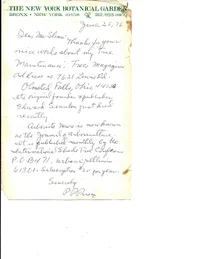
Hope she gets back up there. After my worst fall early in my career I actually got right back up there the same day but rolling around in bed that night some broken ribs punctured my lung and doc made me take some time off. Thought Rachel might enjoy seeing this artifact from the other Botanical Garden and the author of the letter is none other than PP Perone, author of "Tree Maintenance" the tree person's bible prior to any Shigo books. The year of my letter, the bicentennial, I attended Japan's loan to the US, their bonzai collection which was overwhelmingly amazing, at the Brooklyn Botanical Gardens.

Also Rachel, here is me, a few months shy of 66, doing an eab td, no clean up and no worries about a little damage in honeysuckle in the woods, the day before yesterday with my trusty ms 150. I'd prefer to do pruning which I can still get to any cut anyone else can get to but when a client needs a take down, I do a take down. Hang in there (pun intended).

ppperone.webp
 

New threads New posts

Kask Stihl NORTHEASTERN Arborists Wesspur TreeStuff.com Teufelberger Westminster X-Rigging Teufelberger
Back
Top Bottom