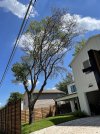
Will she make it? Red oak appears to be dying after new build

Photo appears to show leaves stuck in the fence and a hunk of the concrete that was removed.

It certainly doesn't look like the CRZ was adequately protected by that fence. Should be a minimum of 8x DBH radius in each direction. With an older mature tree like that, it would actually have to be more like 15-18x. It looks like the tree was a goner anyway you look at it, given the size of the lot. It's possible that the building could have been located more forward on the lot if the tree had been removed, which might have given you more options for space behind the home.

I'd very much like to know who erected that fence, who specified the dimensions, and whether a city building code enforcement arborist signed off on it.
 
  • Like
Reactions: ATH
Photo appears to show leaves stuck in the fence and a hunk of the concrete that was removed.

It certainly doesn't look like the CRZ was adequately protected by that fence. Should be a minimum of 8x DBH radius in each direction. With an older mature tree like that, it would actually have to be more like 15-18x. It looks like the tree was a goner anyway you look at it, given the size of the lot. It's possible that the building could have been located more forward on the lot if the tree had been removed, which might have given you more options for space behind the home.

I'd very much like to know who erected that fence, who specified the dimensions, and whether a city building code enforcement arborist signed off on it.
Yes we questioned it multiple times but we reassured they had taken all the preventative measures and done root system injections prior to drilling piers. I believe the builder put the fence up. I think we were naive with no new construction/old tree experience/knowledge. Circle of life, live and learn.

We have a smaller red oak in back that is further from house and it also isn’t going to make it.

The house could not have come any further forward on lot per city setback code, we tried. The lot is small and the tree was just as close to the original house.

We meet with builder tomorrow and we’re hoping they will cover the removal of both which will also involve sprinkler system and adding sod, changing landscape.

Hopeful they have a tree farm connection and will let us buy at their cost. Thinking two trees flanking the front lot. (Would center them with windows on left and right side of bricked portion of house. How far in from sidewalk would you recommend? Would love recommendations. My in laws suggested Bradford Pear. My husband loves red oaks. We are located in Dallas.

Really appreciate all the insight on this board. Wish we had found it prior to construction!
 
  • Like
Reactions: ATH
My in laws suggested Bradford Pear.
NO literally the worst idea. Anything but!

If you have a sense of what size tree you’re looking for that would narrow down the suggestions. Nothing wrong with a red oak, but white oak / chestnut oak / swamp white oak / burr oak are going to be a bit more resistant to stresses. Also I don’t know the specifics of Dallas but consider what will do well in your climate 50, 100 years from now, as everything is changing a bit.
 
I like Red oak. I like the idea of putting a tree in front of each of those windows. I don't like those 2 ideas together. take that current tree (in your mind) and put one in each of those spots. Is there room for that? This will really crowd anything your neighbor (or a future neighbor) has over there. They'll crowd each other too.

If you do that, I'd do something in the "medium" sized tree. Bradford pear is the right size, but WRONG tree (as 2 others above have alluded to). Just to put some specifics on that: all of the Callery pear (Bradford is a cultivar of that) have very weak wood. Most have poor structure as well (which can be managed with a lot of maintenance). Those combine for a lot of failures. I've collected a lot of "pear wall of shame" pics over the years if you want to look about 15 years into the future should you plant one of those. In addition to those features, the little pears are a mess in the winter. The flowers stink (subjective, I know...but they do). Then, to top if off, this is a very invasive species. (It will be illegal to plant Ohio as of January 2023 because of its invasiveness - I know you aren't in Ohio...but just saying that is how invasive it is.).

Or, do a full-sized tree in line with that one, but maybe halfway between the house and sidewalk? ('d stay at least 10-15' off of the sidewalk with a "full-sized" tree if you want to push it forward.)

I'll let locals make more specific recommendations. To get the best tree, match your preferences (do you want a large shade tree, flowering tree, good fall color, berries for the birds, shape/form, etc...), soils (nutrients, pH, texture and water availability - don't count on long-term irrigation - irrigation is fine to get it started, but it needs to fend for itself at some point), climate, growing space, etc...
 
First thing first. Call 811 and get all your underground utilities located. That will tell you where you can plant so that the tree won't be killed when a gas/water/sewer line has to be worked on or replaced. Consider the adult diameter at breast height, and allow for 3-4 times that amount as a radius for a circle which should not have any underground conflicts included. (Make sure that stump is THOROUGHLY REMOVED!). Once you've found the largest open space in the front yard, measure the shortest cross section and divide by 10. That should be the fully mature diameter of whatever tree you wish to plant, in order to allow it sufficient soil volume to reach its full potential. Talk with your county extension agent and visit any botanical garden/arboretum they may have so you can see what kinds of trees are best suited for your locality.

An excellent resource on site selection can be found at https://hort.ifas.ufl.edu/woody/site-analysis-web.shtml

Remember that trees are like time capsules, you want them to be there for a very long time, so you have to look ahead to consider the conditions the tree will have to deal with over the long term, and find a species best suited to those anticipated conditions. For instance, it's probably a good idea to select for drought tolerance as one factor.

PS, I asked earlier regarding city sign off on adequate preservation for that tree. If the city signed off on it, they should be able to provide you with replacement trees from their own nursery inventory or resources. Be sure to use the above reference website to search for information on how to select good nursery stock tree root and canopy structure, as well as information on best practices for tree installation (There's an ANSI Standard for that too.)
 
Last edited:
Long awaited update and hoping for more words of wisdom...

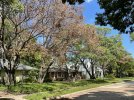
Our city, Richardson, does not have arborists involved with residential construction - so no one from the city was involved with the trees or signed off on any plans regarding the trees.

Per the contract with builder there is no warranty on trees or landscape.

We’ve had two certified arborists out to assess.

Arborist A is Dallas Tree Surgeon (not affiliated with our builder) said both our trees are goners and the back one is infested with borers. They said their demise is most likely due to construction/root system. They said the borer infestation is an after the fact infection that occurs after the red oaks start to shut down and die.

Arborist B is Advanced Tree Care (this is who our builder asked to come out and assess since they did the treatments during construction) said there’s a 40% chance they could survive with a treatment that costs $650 and they will know within 10 days of treatment if they will survive. I asked how they would make that determination and he said the leaves would change color and/or new buds would appear. I am skeptical.

To add to the confusion - our neighbor two houses down has two very dead live oaks in front (including a picture) which are also infested with borers. Arborist B is blaming those two trees for spreading borers to our trees. Arborist A only saw borers on our back tree (also including a picture of our back yard red oak).

Arbotist A gave a bid of nearly $8k to remove both trees and grind stumps. Builder says they have a more cost effective tree remover and we are awaiting their bid.

After doing some research and speaking with local arborists and tree farms, we are leaning towards Bur Oak to replace, with either one or two in front, will depend on lot assessment and cost.

My questions for you all are:

Should we get a third aborist out to assess?

Is arborist B full of it or is there actually a chance of saving these trees?

What amount should we expect to pay to remove both trees?

Any guidelines we should ensure are followed about properly grinding up stumps?

What’s your opinion on the borers? (Which came first, death from construction and then borers OR borers from neighbors trees and then death?)

Could the borers spread to our other neighbors?

TIA
 

Attachments

  • 039F6D41-0913-42D6-B4C6-10E6470FACD0.jpeg
    039F6D41-0913-42D6-B4C6-10E6470FACD0.jpeg
    1.3 MB · Views: 23
  • 7770DF5F-AA5F-4DA2-B192-66543894EDED.jpeg
    7770DF5F-AA5F-4DA2-B192-66543894EDED.jpeg
    797.4 KB · Views: 23
Last edited:
the only thing that is going to make that front tree change colors this year is paint. even if they eliminated all pests attacking the tree, it needs to put on an entirely new flush of leaves. That is very unlikely to happen this year even if the tree does live into next year. Even if they did, it wouldn't be 10 days. You are right to be skeptical.

40% sounds like a BS number. "I told you it was more likely to die than not" (but I made the number high enough to give you false hope). Also, it sounds to me like "B" didn't do their job of protecting the trees the first time around, so I certainly wouldn't hire them again.

Borers attack stressed trees. The stress came first, then the beetles moved in.

2 things can facilitate movement to the neighbor's trees:
1) If their trees are stressed..in which case secondary pests would find them even if you never had any trees on your property.
2) If there is a very high population of borers, they may overwhelm even an otherwise healthy tree...this is an abnormality.

Make sure you are following oak wilt guidelines in whatever you are doing...
 
Long awaited update and hoping for more words of wisdom...

Our city, Richardson, does not have arborists involved with residential construction - so no one from the city was involved with the trees or signed off on any plans regarding the trees.

Per the contract with builder there is no warranty on trees or landscape.

We’ve had two certified arborists out to assess.

Arborist A is Dallas Tree Surgeon (not affiliated with our builder) said both our trees are goners and the back one is infested with borers. They said their demise is most likely due to construction/root system. They said the borer infestation is an after the fact infection that occurs after the red oaks start to shut down and die.

Arborist B is Advanced Tree Care (this is who our builder asked to come out and assess since they did the treatments during construction) said there’s a 40% chance they could survive with a treatment that costs $650 and they will know within 10 days of treatment if they will survive. I asked how they would make that determination and he said the leaves would change color and/or new buds would appear. I am skeptical.

To add to the confusion - our neighbor two houses down has two very dead live oaks in front (including a picture) which are also infested with borers. Arborist B is blaming those two trees for spreading borers to our trees. Arborist A only saw borers on our back tree (also including a picture of our back yard red oak).

Arbotist A gave a bid of nearly $8k to remove both trees and grind stumps. Builder says they have a more cost effective tree remover and we are awaiting their bid.

After doing some research and speaking with local arborists and tree farms, we are leaning towards Bur Oak to replace, with either one or two in front, will depend on lot assessment and cost.

My questions for you all are:

Should we get a third aborist out to assess?

Is arborist B full of it or is there actually a chance of saving these trees?

What amount should we expect to pay to remove both trees?

Any guidelines we should ensure are followed about properly grinding up stumps?

What’s your opinion on the borers? (Which came first, death from construction and then borers OR borers from neighbors trees and then death?)

Could the borers spread to our other neighbors?

TIA
I agree with everything @ATH said. I think that arborist B is not someone you should work with. They seem to be missing the mark in a few ways ATH already laid out. The first arborist sounds like they made a pretty objective assessment of the situation.

Around $8k for the two removals would definitely be in the ballpark for any insured crew. You have a lickity brand new house and they’ll have to be very careful rigging the pieces down and not touching gutters, etc. I would imagine they’ll first look to do the job with a crane to make the removal safer and faster.

Re stump grinding protocols, call 811.

The borer infestation is much more likely to be the result of construction stresses.

You chose a bur oak! I love that idea. I think it would be an excellent tree in that landscape. Be sure to place it far away from power lines and the house to give it the space it will need 50 years down the line.
 

New threads New posts

Kask Stihl NORTHEASTERN Arborists Wesspur TreeStuff.com Teufelberger Westminster X-Rigging Teufelberger
Back
Top Bottom