similar to what i do with my capacity scale.
I look back toward the truck and view how extended the boom is and view the angle of the boom.
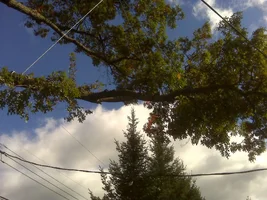
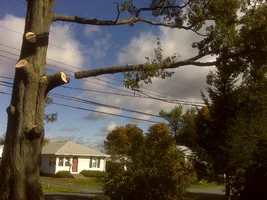
I look at the tree section and say to myself, ok, I can cut it there and that should be about 60% capacity.
I'm usually right on. Often less.
If I'm not on the scale after the cut, I'll start taking bigger peices on the next cut.
I like 60% for any pick in the air.
I'll do 80-100% for a trunk pick where the cut is next to the ground.
You are guessing weights before you make the cut, (which is what I always did with a stick crane and opporator too), I am guessing it in terms of capacity. Same thing man. I'm just the operator too.
If your stick crane can do 5000lb at a certain location, and you are shooting for a 2500lb pick, that's pretty much the same thing I'm doing. You are shooting for 50%. I'm shooting for 60%.
I dont' have to count extensions, calculate the angle of the boom or memorize the crane chart. I just have to glance at the angle and length extended and know what is right.
I have to confess, I have always been able to say I haven't taken a pick in the air that ever reached 100%. But about two weeks ago, I had a pick swing out and spike it to 100%. No harm, but I didn't like it at all. Hot day, irritating honey locust and I should have re-done the slings or put on a control line because I KNEW it was going to swing out a bit, it just did it a little more than I thought. Was interesting to see the hydraulics sag down. The AOS did it's job and there was no bouncing. The crane company said I couldn't have hurt anything doing that. I just had the crane in last week for a checkup and some minor things fixed; after this and all is good.
I look back toward the truck and view how extended the boom is and view the angle of the boom.
I look at the tree section and say to myself, ok, I can cut it there and that should be about 60% capacity.
I'm usually right on. Often less.
If I'm not on the scale after the cut, I'll start taking bigger peices on the next cut.
I like 60% for any pick in the air.
I'll do 80-100% for a trunk pick where the cut is next to the ground.
You are guessing weights before you make the cut, (which is what I always did with a stick crane and opporator too), I am guessing it in terms of capacity. Same thing man. I'm just the operator too.
If your stick crane can do 5000lb at a certain location, and you are shooting for a 2500lb pick, that's pretty much the same thing I'm doing. You are shooting for 50%. I'm shooting for 60%.
I dont' have to count extensions, calculate the angle of the boom or memorize the crane chart. I just have to glance at the angle and length extended and know what is right.
I have to confess, I have always been able to say I haven't taken a pick in the air that ever reached 100%. But about two weeks ago, I had a pick swing out and spike it to 100%. No harm, but I didn't like it at all. Hot day, irritating honey locust and I should have re-done the slings or put on a control line because I KNEW it was going to swing out a bit, it just did it a little more than I thought. Was interesting to see the hydraulics sag down. The AOS did it's job and there was no bouncing. The crane company said I couldn't have hurt anything doing that. I just had the crane in last week for a checkup and some minor things fixed; after this and all is good.