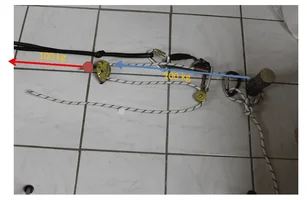
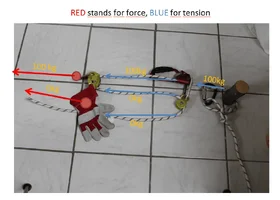
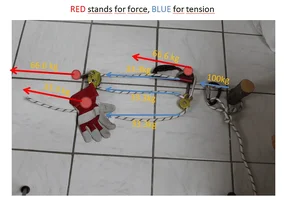
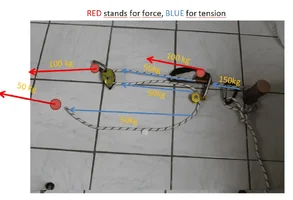
*useless info*
Participating member
- Location
- usa
That can be an expansion thang...My brain hurts.
.
We would look for no free ride ;thus a 1 to 1 trade off of distance/power.If you're talking about the amount of rope to pull to move one foot, it's a 3:1.
If you're talking about mechanical advantage, it's a 2:1. Pull 100 lbs to raise your 200 lbs body.
Every pulley position gets 2 legs of pull: dual pull on load or anchor or dividing input, but always 2.
.
A static pulley on anchor is a re-direct 1:1 just changes direction
Moving pulley as jig output on load adds extra leg of pull /power against loaded point/but slower in trade.2/1 power traded for 1/2 speed
Moving pulley on jig input as gives extra input length to pull reduces power/increases speed in trade 1/2 power traded for 2/1 speed(double distance in same amount of time)
.
Compound systems are more complicated, but just confidentally follow same rules, re-confirming them even around questionable turns, just keep the faith and carefully follow.

the 2 handing systems i try to show i look at as such a compounding. bodyweight + 2xEffort as inputs to maximize.
.
i think should stretch understanding to see compounds, then easier to see 2 handing. But then most assuredly, simpler systems will be well within mental powerband at a glance..
.
old long link: mytreelessons.com/images/Force Patterns of Pulley Systems.GIF
.
edit:
i found this moldy oldie i made to show how consistent the forces play out
>>even around counter-intuitive corners, just keep to the plan
>> with mind open
to perhaps wrap all the way around this more,from viewing this facet of the gem...
(weightless ropes and pulleys on 100# load)

ANSWER:
G)400; has 100# pulling 'ripcord' /support setting line tensions @100
>>bottom strap simply has 4x100 pulling upward (answer G)
>>top pulley and rope termination pull 200+ 100 downwards respectively
+ 100# device weight downwards
= 400# upward/400# downward on same device so no movement, all forces accounted for
Last edited: